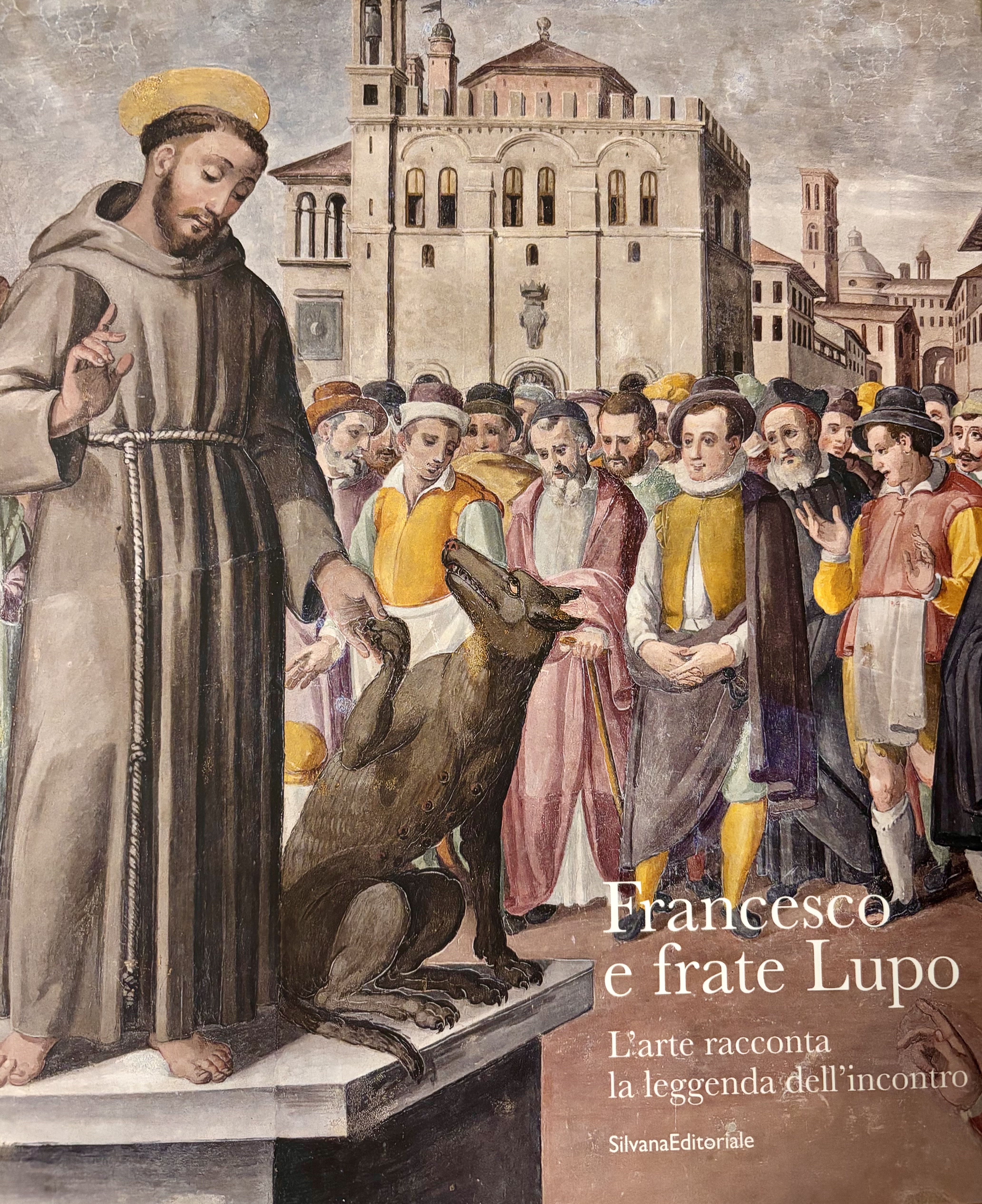
Saint Francis of Assisi and the wolf of Gubbio
Reflecting on the beloved legend of Saint Francis and the wolf of Gubbio, this piece weaves together art, history and personal pilgrimage. Drawing on a major Gubbio exhibition, it explores competing interpretations of the story while affirming its enduring call to peace, restorative justice and interspecies kinship. (15 min read)
“The Wolf of Gubbio”, one of the most popular stories from the life of St Francis of Assisi, has long been the subject of intensive scholarship and widespread artistic representation.
To honour the 800th anniversary of the death of St Francis, the city of Gubbio organised a huge arts event, across 8 sites, about this story. A substantial catalogue of 344 pages (with 9 forewords, an overview and 15 essays with footnotes and 302 images of over 250 objects) sets out the scholarly and creative underpinnings of the objects and the story.
In this piece I share what I learned in Gubbio and from translating the catalogue (which is only available in Italian). I rely heavily on the contributors to the catalogue but my key takeaways are:
- there has been and continues to be strong popular and artistic interest in the story;
- there are very many artistic representations of the story in a diversity of mediums and voices;
- there are contested views as to whether the story is true and about the wolf;
- there is a labyrinth of sources and evidence which are difficult for the ordinary reader to evaluate;
- there is consensus that the moral of the story remains relevant and useful;
- the story has been used to promote causes aligned with the charism of St Francis (for example goodness, nature and the environment and peace) and is worth promoting for that reason alone.
The catalogue puts forward a range of perspectives but does not conclude if the story is true or even how it should be interpreted. The elegance of this approach is that it leaves the viewer with a significant armoury of ideas to apply to the interpretation of the artworks.
Personally, I believe that the essence of the story is true even if the details are not. Over a decade ago I was introduced to the work of an animal communicator – a psychically gifted woman – who correctly relayed precise, specific and very unusual information from a dear friend’s dog. On the basis of that experience, I have no doubt that St Francis could communicate with creatures such as wolves. I would be chuffed if this post also stimulated conversations and research about interspecies dialogue, although it seems we have a long way to go in listening to other humans.
Francis of Assisi
Born Giovanni Bernadone in 1181 or 1182, Francis of Assisi lived a privileged life as the son of a wealthy cloth merchant. He was a popular and natural leader but also a vain and sinful young man. A series of mystical experiences led him to dramatically change his life. He tried to live and preach in accordance with the way of Jesus. Embracing poverty and love for all creatures, while remaining a staunchly obedient Catholic, he established three new religious orders. Many miracles were attributed to Francis, including the first case of the stigmata (the crucifixion wounds of Jesus). He died on 3 October 1226 and was made a saint within 2 years of his passing. Francis is the patron saint of Italy (along with St Catherine of Siena), animals, merchants and ecology.
Gubbio
Gubbio is located in the north eastern province of Perugia in the central Italian region of Umbria. It is about 10 hours walk from the Portiuncula in Assisi. It is a beautifully preserved medieval town of about 30,000 people.
Francis of Assisi fled to a friend in Gubbio after surrendering his clothing to take up a holy life. It was in Gubbio that he received his first tunic – the genesis of his encounter with “Lady Poverty”. He also visited Gubbio in later years. Gubbio has several Franciscan sites of interest to pilgrims.
The story of St Francis of Assisi and the wolf of Gubbio
The essence of the story is that the people of Gubbio were living in fear of a ferocious wolf who was killing animals and even people. Francis spoke to the wolf and criticised his wrong doing. He obtained the wolf’s agreement to not harm any person or animal in future in exchange for being fed by the people of Gubbio. The agreement was upheld, the wolf became friendly and accepted. The people of Gubbio mourned the wolf when he died two years later.
The story became well known because of “The Little Flowers of St Francis” (“Fioretti de San Francesco”) a book written in late 14th century – at least 250 years after Francis’ death – but based on an earlier Latin text (“Actus beati Francisci et sociorum eius”) which may have been written as early as 30 years after the saint’s death.
The symbology of the wolf is explained by the Umbrian Institute for Cultural Heritage:
In the symbolic universe that feeds the unconscious and the creativity of man, the wolf has a dominant position. Predator and prey, cunning and generous, a metaphor for fear and courage, it is a tempting and mystical creature that spans centuries and cultures…
A wild animal, a nocturnal predator, solitary or organized in packs governed by rigid hierarchies, the wolf has experienced mixed fortunes in the collective imagination. Its attack on flocks, and sometimes on humans, has been equated with the criminal actions of bandits, kidnappers, and murderers, transforming it into a metaphor for violence and the oppression of the weakest: an ‘enemy’ to be fought in ruthless hunts, regulated and encouraged by specific laws that, incredibly, have persisted from the late Middle Ages to the present day.
An invincible presence of the wild, the wolf is thus a liminal presence, operating beyond the ordered space protected by the city walls, but one that could also succeed in overcoming the margins, bringing with it fear and death. And it is precisely the overcoming of the margins that plays a decisive role in the encounter between the saint and the wolf: Francis and his brothers leave the city to meet him, accustomed to the wild world, to overcoming the margins, to encountering those who live hidden, those who are rejected. Francis represents the perfect antagonist who, accustomed to living and surviving ‘beyond the threshold,’ is able to ward off the wolf’s threat by drawing it closer to man, bringing it within the city walls.“
Francis, disarmed of everything except his faith, transformed ferocity into brotherhood, conflict into alliance, fear into mutual trust. That gesture of peace concerns not only an animal and a city, but becomes a symbol of a new relationship between humanity and creation, between society and nature, between human communities called to coexist, overcoming fear and division.
Taking this idea further, the Guardian of the Convent of San Francesco observes:
“It is not an easy story, but an episode full of pain and courage, a courage that is more necessary today than ever to chart paths to peace in the immense tragedies that are theaters of war. And, above all, for their future.…
Francis delves into the animal’s heart, grasping the injustice he has suffered. He does not reproach him, but understands him. And immediately thereafter, he opens the path to true, far-sighted redemption, inviting every citizen of Gubbio to offer the starving wolf a piece of bread every day. For it is hunger that generates wars. Once hunger has been conquered, the wolf changes.…
Wars today are that ferocious wolf, forced to starve by perpetuated injustice. There’s no point in taming political leaders. We need to create a culture of popular pacification that makes fraternal coexistence possible, through food, medicine, fuel, water. For everyone. This is the method that must change, also learning from the story of the Fioretti: confronting, speaking deeply, to understand that evil is always the fruit of injustice suffered. A piece of bread generously offered, opening the door of one’s home, is the only path to peace. Otherwise, all those children wounded today will be potential terrorists tomorrow.“
In a time when violence is often met with violence, even in international relations, Francis’s example points to an entirely different path, which is perhaps the only way to achieve peace: calming the violent with the power of love and dialogue.
Quoting again from the Guardian of the Convent of San Francesco:
“Art recounts the legend of the encounter, so that the message emanating from art may nourish the spirit of the visitor. The wolf, once ferocious, became lovable, “because, once fed, he was no longer hungry.” Everyone changed him. It’s restorative justice“.
Artistic representations of the encounter
There are innumerable representations of the encounter between Francis of Assisi and the wolf of Gubbio, with the earliest pictorial evidence in one of the cloisters of the Convent of San Francesco, dating to the early decades of the 15th century. Unfortunately lost, the image was reproduced in a drawing from 1653 and a copy is held in the State Archives of Rome.
One scholar notes that it is difficult to trace a path of the different and varied interpretations that the theme has received and continues to receive even in modern and contemporary culture.
This exhibition, from 27 September 2025 to 19 April 2026, was the first dedicated entirely to this theme. The exhibition traces the “figurative fortunes” of the iconography of the encounter, highlighting how, in medieval mythology, the episode of taming the wolf had a profoundly symbolic role – transforming it from a ferocious beast to a beloved brother.
The exhibition had over 250 objects from the 15th to 21st centuries, including paintings, drawings, sculptures, ceramics, illustrated books, postcards, manuscripts, documents and engravings from private collections, archives and libraries, as well as Italian and foreign museums.
I was interested to see that the wolf was portrayed as ferocious in only 4 works (7.10; 7.22; 7.41a; 9.9) and that Francis shaking the hand of the wolf was predominant.
Most of the objects were exhibited at three sites:
- The iconic Civic Museum of the Palazzo dei Consoli displayed the hanging and sculptural works and a special exhibition about the monument of St Francis and the Wolf at Vittorina by Farpi Vignoli.
- Reflecting Gubbio’s fame since the Renaissance in the production of majolica, a large exhibition of ceramics was housed in the Logge del Tiratoi (Perugia Foundation).
- The Diocesan Archives of Gubbio exhibited archival material as well as many versions of “Fioretti” (“The Little Flowers of St Francis”), including one with stunning illustrations by Maurice Denis, and graphic art, including lithographs, postcards, postmarks, devotional pictures and holy cards.
The diversity and number of works was such that it took the best part of a day to see them all and a week to study the catalogue. I have previously shared some photographs of the exhibition and commented on some of the works by Gerardo Dottori (whose Triptych of the Passing of St Francis is the thumbnail for this post).
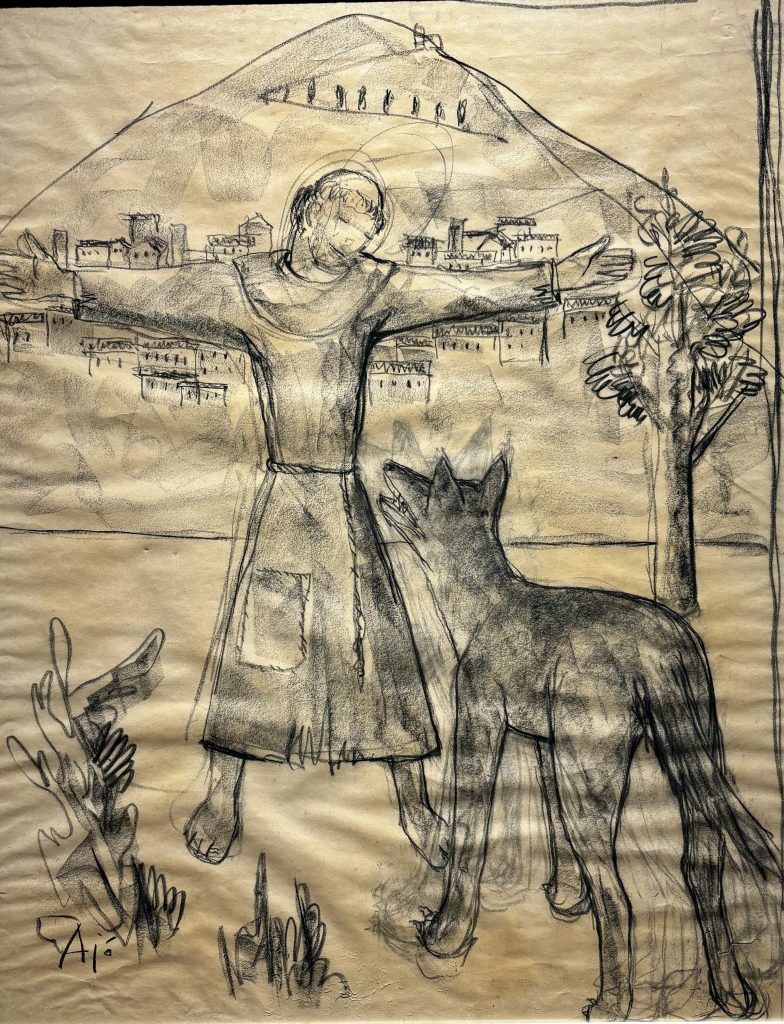
Another artist whose work really impressed me was Aldo Ajo. In the 1930s, he created several works featuring Franciscan subjects and in the 1940s developed a series of ceramics including panels depicting St Francis and the Wolf. A pencil drawing from the late 1970’s was distinguished in the exhibition. Photographs of some of the Ajo pieces are at the bottom of this post.
Arthur Boyd, one of Australia’s preeminent artists, worked for a decade on a large series of works about the life of St Francis in pastel, lithograph and tapestry, including several on the subject of St Francis and the wolf of Gubbio. Boyd’s work, which is highly expressive, uniquely represents the encounter and would have been an excellent addition to the exhibition.
The supporting scholarship
The catalogue contains essays that delve into many historical, sociological and pedagogical themes connected to the exhibition and to the city of Gubbio: from the origin of the legend in Franciscan hagiographic literature and in the Minorite preaching (Antonio Montefusco), to the crystallization of the municipal miracle in the civic identity of Gubbio (Riccardo Rao), to the role of the wolf of Gubbio in modern historiography (Alberto Luongo), in Gubbio in Franciscan sources (Marco Bartoli), to finally delve into the origins of the legend of the discovery of the tomb of the she-wolf and her bones (Fabrizio Cece), and the figure of the saint in relation to children and animals (Raniero Regni).
I cannot do these essays justice in this post but draw attention to the following three conclusions I found most interesting:
Firstly, a provocative essay by Antonio Montefusco concludes that the story of the encounter between Francis and the wolf is not ‘original’ and remains outside even unofficial memory appearing in preaching circles around 1270. He argues it is likely a reworking of the episode of the calamities that struck the castrum of Greccio transformed by preachers into an edifying tale. In the early 14th century, and perhaps not in Umbria, the story also takes shape due to its location in Gubbio. He asserts Francis probably didn’t believe in a tamed wolf.
Riccardo Rao argues that long before the legend of St Francis and the wolf of Gubbio began to circulate, there were already lives of saints that told of miraculously tamed wolves and who prevented the kidnap of children by wolves. In 11th-century Apennine Italy, there is a surprising concentration of these miracles. Nearly every saint with a significant cult in the area forced a wolf to pull a plow or carry a bundle of wood. Indeed, all these saints are characterized by having domesticated a wolf. The wolf of Gubbio is different from those tamed by the other saints: he is a criminal to be condemned. This special quality led some historians to see the wolf as the zoomorphic image of some real character, perhaps a magnate in conflict with the people of Gubbio or a brigand who sowed terror in the countryside. We will never know whether the Gubbio episode was actually preceded by a peacemaking with a nobleman who had fled the city or with a bandit. Rao concludes that the story was intentionally inserted into a text with moralistic purposes and that the issue is primarily one of an allegorical struggle against evil rather than a literal fear of the wolf—that is, that the Fioretti uses the image of the wolf as a threat to the faithful.
Finally, I take comfort in Fabrizio Cece’s conclusion that the 1941 historical and hagiographical study by Fr Ugolino Paris, OFM, published in the journal Studi Francescani, remains the authoritative text on the historical validity of the legend:
- The Wolf was a literal canine (not a human outlaw): Addressing a popular revisionist theory that the “wolf” was actually a human criminal or a madman tamed by St Francis, Paris pointed to physical evidence. He detailed the 1873 discovery of a canine skeleton enclosed in a small sarcophagus during street-paving work near San Francesco della Pace.
- The Scale of the Beast: Paris noted that the skull of the excavated skeleton was documented by the municipal veterinarian to be at least 25cm long, confirming it belonged to an unusually large and formidable predatory animal.
- The Reality of the Burials and Lore: While the original skeletal fragments were unfortunately shattered and dispersed in a local workshop over time, Paris concluded that the deeply embedded local tradition of burying the beast respectfully within the city walls reflected a genuine historical interaction between St Francis, the local community, and a real animal predator rather than a purely allegorical fable.
Would you like to visit Gubbio?
My interest in this subject comes both from researching St Francis for my book and from visiting the places where his story, spirituality and artistic legacy are still encountered today.
If you are considering a pilgrimage to Assisi, Gubbio or other Franciscan sites in Italy, I would be very happy to talk through the possibilities — including how art, history and spirituality can deepen the experience.
Namaste.

You might also like:
→ What is the most important depiction of St Francis of Assisi?
→ Who’s really in charge of the National Gallery?
© Paul McCarthy & Iluminar.au

