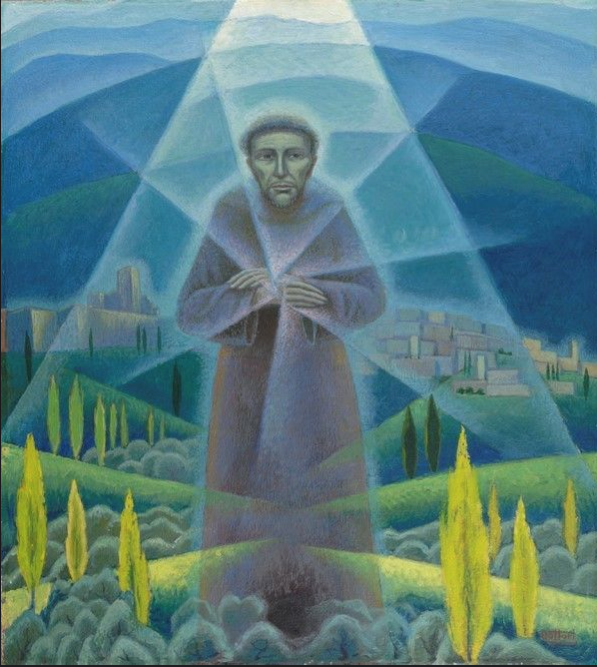
What is the most important depiction of St Francis of Assisi?
From Cimabue’s frescoes in Assisi to Arthur Boyd’s tapestries in Canberra and the wolf of Gubbio, this post explores how artists across centuries have imagined St Francis. Weaving pilgrimage experiences with exhibition reviews, it considers how faith, iconography and modern appropriation shape the saint’s enduring image. (6 min read)
This post brings together more than 60 significant artistic depictions of St Francis of Assisi. I prepared it as a starting point for anyone interested in how art, pilgrimage and Franciscan spirituality intersect.
Francis of Assisi died on 3 October 1226. To commemorate the 800th anniversary of his death, extraordinary religious and secular events are being held around the world.
I made a pilgrimage to Assisi for the exposition of the relics of St Francis and to various other sites in Italy connected to St Francis. A highlight was visiting Gubbio for the first time and experiencing a huge exhibition about artistic representations of St Francis and the wolf of Gubbio.
“Arthur Boyd – St Francis Tapestries” at the National Gallery of Australia, Canberra
Closer to home there is an internationally significant exhibition of artworks about the life of St Francis by Arthur Boyd at the National Gallery of Australia. I cannot stress enough how important Boyd’s work is in the history of artistic representations of St Francis of Assisi but I was unsettled by the secular mindset of the Gallery and its failure to acknowledge the anniversary or engage Christians in resolving some of the interpretative challenges with Boyd’s work.
I chose to respond to my experience at NGA by returning to the source material about Francis, reading more deeply about Boyd and reflecting deeply on his contribution to our understanding of Francis. I also found solace in some exhibition catalogues. It was a challenging but deeply rewarding week.
“St Francis of Assisi” at the National Gallery, London
In 2023, the National Gallery in London delivered an absolutely superb exhibition about the life and legacy of St Francis. The exhibition included art works by old masters such as Zurbaran, Sassetta, Botticelli, El Greco, Murillo, Caravaggio, Ribalta, Fra Angelico and modern masters like Arthur Boyd. The exhibition also included a relic of St Francis (his habit was loaned by the Basilica of Santa Croce, Florence) and a modern response by Alberto Burri. Contemporary works by Andrea Buttner, Richard Long and Anthony Gormley highlighted the continuing relevance of the subject.
Re-reading the catalogue for the National Gallery exhibition was very satisfying. The images, labels and essays were all superb and evidenced best practice in curation of a religious art exhibition. Most significantly, the curators demonstrated a good understanding of and respect for the charism of Francis and, as a result, the exhibition was explicitly informed by his faith.
“Francesco e frate Lupo – L’arte racconta la leggenda dell’incontro” (Francis & brother Wolf – Art tells the legend of the Encounter) at 3 sites in Gubbio, Italy
The catalogue for the first major exhibition about artistic representations of Francis and the wolf of Gubbio in 2025-26 is a comprehensive and intellectually rigorous tome. At 344 pages – with 9 forewords, a comprehensive curatorial overview, 15 scholarly essays and the images of all 302 objects in the exhibition – it demonstrates the importance of this subject and art history. Again, Francis’ faith is central to the exhibition and the related scholarship. Most interestingly, the Bishop of Gubbio, Director of the Convent of San Francesco and Director of the Library of the Sacred Convent in Assisi all provided forewords to the catalogue.
Depictions of Francis
Art historian Tom Boase tells us that images of Francis started circulating not long after his death and it has been asserted that there are more images of Francis than any other saint.
When I was researching my book on St Francis I was keen to know what he really looked like. I considered the first known portrait of Francis in the Sacro Speco Chapel of St Gregory in Subiaco but ultimately landed on the portrait by Cimabue in the lower basilica of St Francis of Assisi as my favourite and put it on the cover of my book.
It has been argued that the early images of Francis, such as those by Cimabue, influenced the development of greater naturalism in Western art. And indeed, trends in art making can be illustrated through depictions of Francis.
Inspired by the exhibitions mentioned above, I have identified more than 60 significant artists who have created important works about St Francis, including many featured in the National Gallery exhibition and 9 Australians (most notably Arthur Boyd, Clifton Pugh and Salvatore Zofrea).
The main works are portraits or depictions of St Francis receiving the stigmata or preaching to the birds. However, a third category, by artists such as Giotto, Sassetta, Gozzoli, Berlinghieri and Arthur Boyd, depicts the most important events in the life of St Francis in a cycle of scenes.
While most images of Francis were created for veneration or religious education, a broader interest in Francis has led to the appropriation of his image for various causes (most notably, peace, the environment and animal welfare) and as a device to explore unrelated themes and feelings.
Although the Cimabue fresco remains my favourite image of Francis, I chose to lead this post with the portrait of Francis by the Italian painter Gerardo Dottori (1884-1977). I am not especially fond of Dottori’s art making but I was moved by this story about him in the Gubbio exhibition catalogue:
“I would simply like to recall the profound relationship that Gerardo Dottori also had with Saint Francis and Franciscan spirituality. The Triptych of the Passing of Christ, from 1923, was donated by the artist to the convent of San Francesco del Monte in Perugia in 1971. Dottori deliberately chose to simulate the structure of a medieval triptych in this work. The presence, in the side panels, on either side of the saint’s death, of the two episodes with Francis and the Wolf and the Sermon to the Birds, confirms that it is precisely these two events that constitute the most well-known emergence of the relationship that tied the Assisi artist to the natural world and which prelude the encyclical letter of John Paul II in 1979 proclaiming Francis “patron saint of ecologists,” but also confirms Dottori’s great interest in Franciscan iconography. Dottori wrote about the Poverello in 1928, speaking of himself: “in my paintings there is something for all tastes: dawns and sunsets, winters and springs, rivers and lakes, mountains and plains; the newest goddess speed is glorified, and my great friend Saint Francis, the hymn-man who died singing”.
The supporting material includes a link to the Dottori painting mentioned in this quotation, together with many other significant depictions of St Francis.
My interest in this subject comes both from researching St Francis for my book and from visiting the places where his story, spirituality and artistic legacy are still encountered today.
If you are considering a pilgrimage to Assisi, Gubbio or other Franciscan sites in Italy, I would be very happy to talk through the possibilities — including how art, history and spirituality can deepen the experience.
Namaste.
Explore the supporting material:

You might also like:
→ Who’s really in charge of the National Gallery of Australia?
→ St Francis of Assisi and the wolf of Gubbio
© Paul McCarthy & Iluminar.au

