Who’s really in charge of the National Gallery?
While the Roman Catholic world commemorates 800 years since the passing of the most popular saint of all time—Francis of Assisi—the National Gallery of Australia hosts a significant exhibition of art about the life of St Francis without acknowledgement or awareness of the anniversary. Despite a secular curatorial mindset and the absence of engagement with the Christian community, the timing of the exhibition is remarkable and it is a rare opportunity for those interested in St Francis to reflect on his charism and efforts to be a perfect example of the teachings of Jesus. (18 min read)
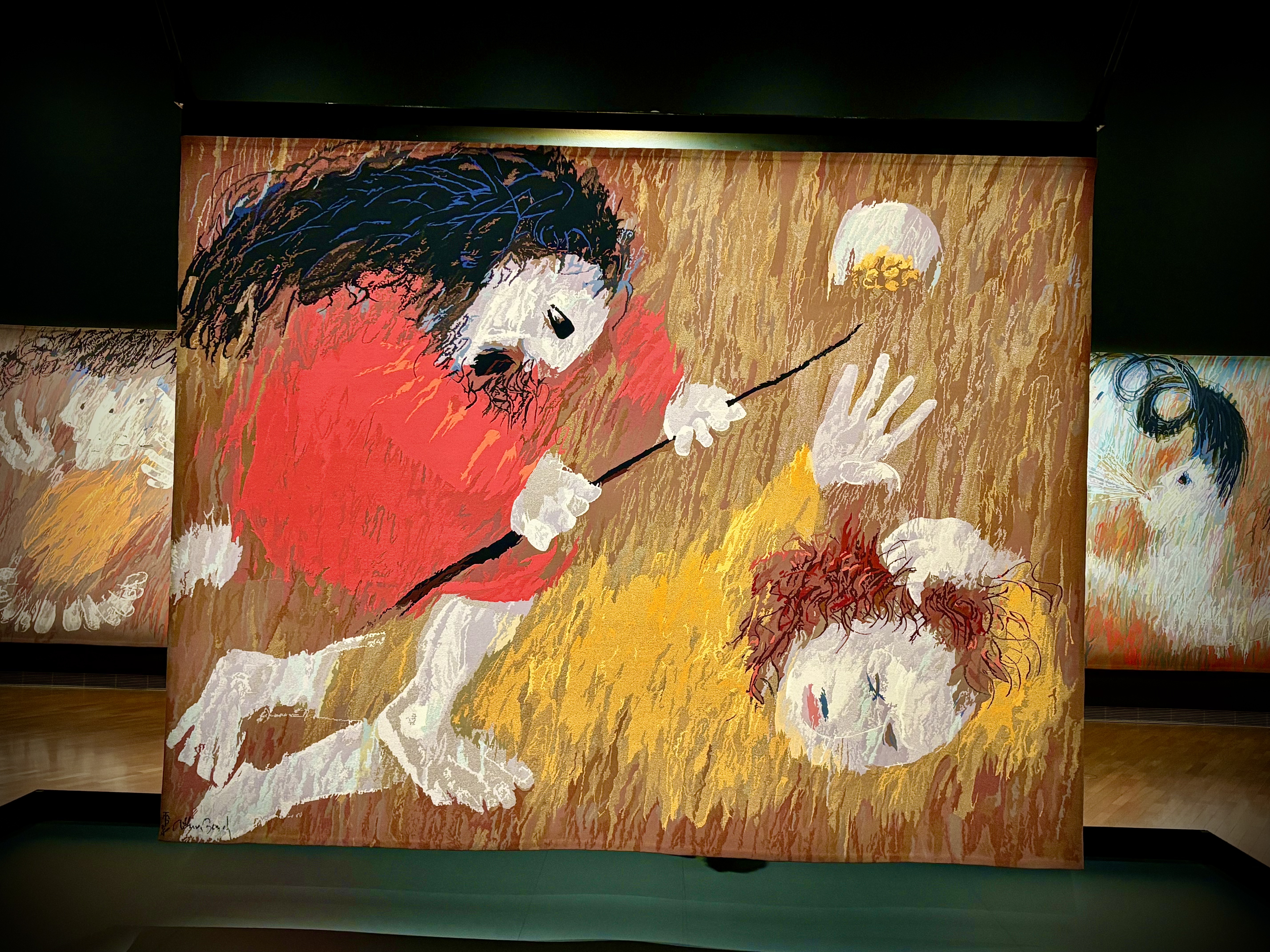
The Australian artist Arthur Boyd donated about 2500 items to the National Gallery of Australia before the building opened in 1975. Boyd also sold 20 very large tapestries to the Gallery at cost price (which was about 5% of their value). The tapestries, as well as many of the donated drawings and lithographs, have as their subject the life of St Francis of Assisi.
The Gallery’s exhibition, “Arthur Boyd: Tapestries“, is the first time the tapestries have all been shown together. Despite a longstanding ambition to display the works, it was argued there wasnt space to do so. How interesting that a relatively easy “fill-in”” during a period of major reconstruction of the building coincides with the 800th anniversary of the passing of St Francis. Surely, this is the hand of God.
The Boyd exhibition, which closes on 18 October 2026, is an unintentional but fitting local complement to the first exposition of the relics of St Francis, the first major exhibition on artistic representations of St Francis and the wolf of Gubbio and “Image of Francis – From the Middle Ages to the Twentieth Century” at the Gallery of Modern and Contemporary Art in Arezzo. Even the Art Gallery of NSW is holding a special event in the week of the Saint Francis’s anniversary called “Breath of Faith” about a sculpture of St Francis by Pedro de Mena.
St Francis of Assisi
Born Giovanni Bernadone in 1181 or 1182, Francis of Assisi lived a privileged life as the son of a wealthy cloth merchant. He was a popular and natural leader but also a vain and sinful young man. A series of mystical experiences led him to dramatically change his life. He tried to live and preach in accordance with the way of Jesus. Embracing poverty and love for all creatures, while remaining a staunchly obedient Catholic, he established three new religious orders. Many miracles were attributed to Francis, including the first case of the stigmata (the crucifixion wounds of Jesus). He died on 3 October 1226 and was made a saint within 2 years of his passing.
According to the scholar Ernest Renan, Francis “constitutes proof that Christianity, at least once, has been lived by a human being in all its radicality”.
Studying the life of Francis is very helpful for those seeking to progress spiritually. He is an extraordinary example of moral reform. He was not born a saint and his life was not perfect. But through effort and grace, action and contemplation, he transformed himself and ultimately the Christian world.
Most people have woolly ideas about Francis. He is the world’s most popular saint, commonly associated with animals, jolly friars, peace, and the environment. But not many people understand his mission to live the Gospel and follow the example of Jesus literally.
Fr James Martin SJ, the author of “My life with the Saints” and a series of videos called “Who Cares about the Saints”, speaks in a contemporary voice about St Francis and encourages us to go deeper into his charism:
“Francis’ life was one of total conversion and I think we have tamed Francis into something that is really domesticated and cute, like a little doll. But if you met the real Francis of Assisi, the guy that stripped himself naked in the public square, the guy that lived the most austere poverty, the guy that took the Gospel literally in terms of being as radical a Christian as you could be, the guy that basically transformed the medieval church, you would not see him as cute. You would see him as someone who was really untameable, someone who was wild in a sense and who had this incredible energy. Here was the guy who really sacrificed everything to serve Jesus. I think that by taming the saint we not only distance ourselves from the real story, which is unfortunate, but we separate ourselves from the reality of the Christian message which is impinging on all of us. It is a lot easier to see Francis of Assisi as a little concrete garden statue than it is to see him in all his complexity, but I think as Christians that is what we are called to do”.
Franciscan studies is now a recognised field of scholarship and there are very many books, films and artworks about Francis. The earliest sources include the writings of St Francis, biographies by Thomas of Celano and St Bonaventura, and the Legend of the Three Companions. But there are two later works read by Arthur Boyd that must be mentioned:
- “The Little Flowers of St Francis” (or “Fioretti de San Francesco”) was written in late 14th century – at least 250 years after Francis’ death – but based on an earlier Latin text called “Actus beati Francisci et sociorum eius” which may have been written as early as 30 years after the saint’s death. Boyd’s copy of this book was donated to Australia.
- “St Francis of Assisi” by art historian, museum director and academic, T S R Boase was published in 1936 but most copies were lost in a fire. Boyd read the book and made 16 lithographic illustrations for a new edition issued in 1968.
Sacred art was used in the late medieval period to convey the life story of St Francis. Many important stories from Francis’ life are captured in 13th and 14th century works in the Basilica of St Francis in Assisi (visited by Boyd in 1964) and in various narrative alterpieces, including the panels of Borgo San Sepolcro Altarpiece in the National Gallery in London painted by Sassetta (which Boyd studied in the early 1960s).
Arthur Boyd (1920-1999)
Boyd was one of Australia’s most important twentieth-century artists, but his reputation that extended well beyond Australia. Born in Murrumbeena, Victoria, into the celebrated family of artists, he was self-taught and worked primarily in Melbourne before spending extended periods in the United Kingdom from 1959, and later living between the UK and Australia.
Boyd created a unique visual language using oil and other forms of painting, drawing, watercolour, gouache, pastel, ceramics, sculpture, illustration, tapestry, and printmaking—including etching, lithography, and screenprinting.
Among his most outstanding works are the Bride series of the late 1950s, the “Life of St Francis” tapestry cycle of the 1960s, and his iconic Shoalhaven landscape paintings and a large tapestry for the Great Hall of Australia’s new Parliament House (“Untitled (Shoalhaven Landscape)”) in the 1980s. He represented Australia at the Venice Biennale in 1958 and 1988.
Boyd was quiet, humble, and compassionate—an artist whose social conscience was inseparable from his creative life. He often refused biographical or literal interpretations of his work but it obviously addresses his concerns about social divisions and injustice, especially the treatment of Aboriginal people and the Australian environment.
Boyd’s parents were Christian Scientists but he also had Catholic family members. He was not religious but clearly spiritual. His wife, Yvonne, said he was very fond of St Francis. He had a range of views on the afterlife.
Boyd’s generosity to the nation was extraordinary. In addition to making one of the greatest ever donations to the National Gallery, he and his wife gave their Bundanon property—about 1,100 hectares on the Shoalhaven River—to the Australian people in 1993, creating the foundation of a centre for artists, education and public engagement. Boyd was made a Companion of the Order of Australia (AC)—our highest civilian honour—in 1992 for eminent achievement and merit in the visual arts and for service to the development of Australian art. In 1995 he was named Australian of the Year.
Boyd died in Melbourne on 24 April 1999. The cause of death was not publicly reported. His funeral was the simplest of ceremonies and his biographer Darleen Bungey reports “Arthur Boyd was buried in the manner in which he lived: without fuss, quietly, modestly. His headstone was as small and plain as the stonemason could manage. The man’s immortality lay elsewhere; in his works, his gifts, and in the faces of those gathered around his grave”.
Boyd’s images of St Francis
Arthur Boyd’s “Life of St Francis” series was created over a decade. He produced 21 pastels, 525 lithographs (from a series of 21), 20 tapestries, 3 ink drawings, at least 1 oil painting, and many preliminary sketches on this subject between 1964 and 1974.
We know that Boyd was interested in St Francis earlier in his career, but the impetus for the series seems to have been works by Sassetta in the National Gallery, Boyd’s visit to Assisi and Gubbio and studying 2 books about Francis’ life.
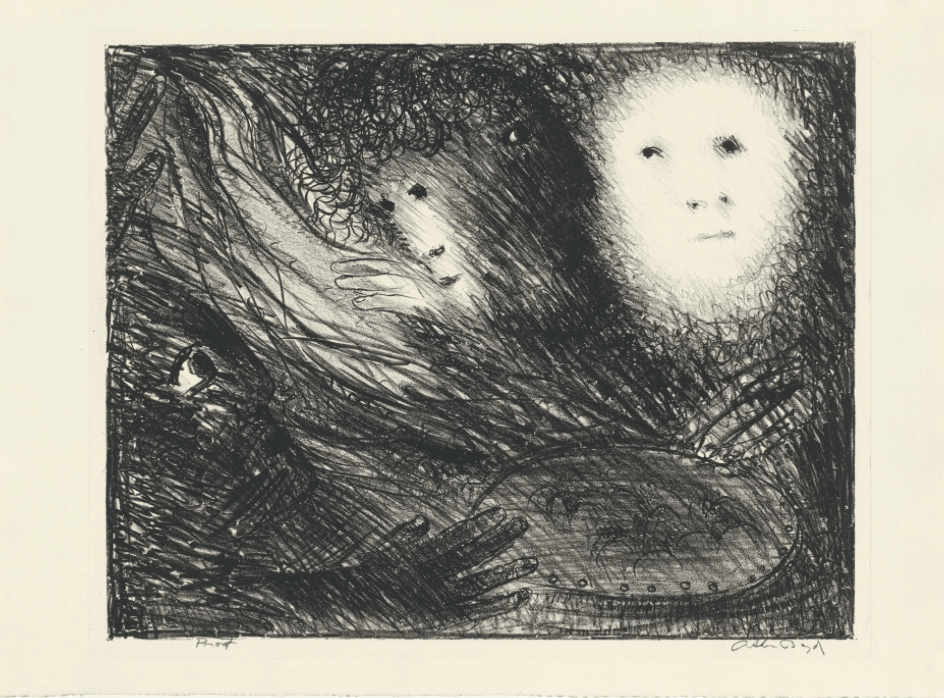
Boyd and Boase collaborated on a new edition of Boase’s book about St Francis with Boyd illustrating the text. The enthusiastic Boyd created beautiful, light-filled pastel drawings which the publisher was unwilling to reproduce in colour. Undeterred, Boyd created a series of striking lithographs on the same subjects which were used in the book. Boase has said the book required significant rewriting to align it with Boyd’s lithographs.
Boyd’s choices of subject were intentional and extraordinary. As the supporting information demonstrates, Boyd avoided the most commonly depicted subjects (such as the stigmatisation of St Francis and the preaching to the birds) and addressed some of the gaps in the major art cycles. His subjects included: Francis’ younger days, St Clare and Jacopa dei Settesoli, the friars, Francis’ interactions with lepers, the wolf of Gubbio and in nature. Boyd also introduced some subjects that continue to puzzle art historians.
Boyd’s images of St Francis are of global importance
Boyd belongs to the pantheon of extraordinary artists who have uniquely rendered St Francis of Assisi. The short-list includes Cimabue, Giotto, van Eyck, Bellini, Botticelli, Durer, Veronese, El Greco, Caravaggio, Rubens, Zurbaran, Murillo.
Further, Boyd especially belongs with artists such as Giotto, Sassetta, Gozzoli, the Master of the Bardi Altarpiece, Pisano and Berlinghieri who combined important events in the life of St Francis into cycles.
Inspired by this tradition, Boyd created the first major series of artworks about the life of Francis in over 500 years, addressing new or lesser subjects from Francis’ life in new ways. According to Tom Boase “in many ways nearer the facts than the older versions”. The combination of the breadth of subjects and range of mediums makes Boyd’s St Francis series unsurpassed. His work is timeless and has universal resonance.
Interpretation and scholarship about the Boyd images of St Francis
Boyd’s intense, emotionally expressive style and personal iconography are unique—but it is much easier to feel than read. His work has been a meal ticket for art historians and critics who have tried to take us miles from the point of the work—the life of St Francis.
There is a hypothesis that Boyd used his St Francis series to express his feelings about his late father (who is variously described as “saintly”, “traumatised” and holding some views similar to St Francis) but I’m not buying it.
While Boyd could deal with personal demons through his art practice, the Francis series is different. Boyd had an earnest intention, for over a decade, to showcase lesser-known aspects of St Francis’ life and character. Applying this frame (and studying the Franciscan sources), I can see the objective of each work.
By way of example, art historians have puzzled over the subject of the work in pastel, lithograph, and tapestry called “St Francis Removing the Rosary“.
If I was curating this exhibition, I would fill a room with Franciscan and Dominican scholars and ordinary people of faith to ask what they think of the work. To kick off the conversation, perhaps:
- St Francis is giving the rosary to another person to acknowledge the importance of the Virgin Mary? Francis had mystical experiences of Mary and was devoted to her (even naming his favourite church after her). While the rosary is associated with St Dominic, and the praying of it was not regularised until well after Francis’ death, depicting the rosary is a way to (anachronistically) recognise Mary’s importance to Francis and his understanding that the rosary is a weapon against evil.
- St Francis is returning a rosary to symbolise his preference for contemplative prayer? Praying the rosary involves the repetition of a sequence of prayers— the Lord’s Prayer, Hail Mary etc —while meditating on events or mysteries from the lives of Jesus and Mary. St Francis approached prayer as a contemplative and deeply affective encounter with God, marked by humility, silence, penitence, and devotion to Christ. Some sources say he did not like ritualised prayer.
- St Francis is returning the rosary to St Dominic? While Francis and Dominic were friends with much common ground, the Dominicans became renowned for scholarship whereas Francis opposed book learning within his Order and the introduction of convent libraries symbolised a major change in direction. In returning the rosary, this point of difference is being acknowledged.
I have my own interpretations for each of the works in the St Francis series and strongly believe that Boyd, his art and St Francis are diminished when Christian interpretations are not centred.
The NGA exhibition of Boyd images of St Francis
The exhibition is beautifully designed. The first gallery shows Boyd’s lithographs and a couple he rejected (22 in total), and it also has a wall-size video of the tapestry weavers in action. The other galleries show the 20 huge tapestries (approximately 2.5m × 3.5m), 12 pastels, 27 studies, 3 sketches, as well as a cartoon for a tapestry and replicas of the slides on which the tapestries were based. There is an NGA video screening in one room and a weaving space adjacent to the entrance.
The Gallery has created a lot of online content to support this exhibition, including a video which provides an overview of the project and useful information about weaving practice.
While the Gallery’s catalogue has excellent images of the tapestries and an impressive essay about weaving, I prefer Margaret Pont’s book “Arthur Boyd & Saint Francis of Assisi“. And, for greater depth, I recommend reading Tom Boase’s book, the Little Flowers of St Francis (Boyd’s library contained the Raphael Brown translation), Darleen Bungey’s biography of Boyd and the excellent books by Janet McKenzie and Franz Philipp. It sounds like a lot but I re-read them all plus more in about a week.
A personal response
I studied hard and came to the exhibition with a list of things I wanted to look at and some questions about Boyd’s choices of subject and medium. But God had other plans and the secular cathedral felt sacred and energised.
Without detracting from the extraordinary beauty and craftsmanship of the tapestries, the highlight of the exhibition was the lithographs. I was surprised by their power and several of them brought me to tears. The most moving was the image of Francis and Clare eating together (the tapestry is called “The Church on Fire”). Boyd did a superb job of capturing a mystical event that no doubt changed the citizens of Assisi who saw it.
The secular framing of the exhibition, particularly the absence of any explicit reference to Jesus and the failure to acknowledge the anniversary of Francis’ passing was troubling me a lot by the end of the show.
Researching the Gallery’s artworks is core business, and the Gallery should have asked Catholics and Franciscan scholars about their response to the works. Because Catholic media has not been involved in marketing the exhibition, many are unaware of these extraordinary works.
I started working on a plan to address my angst as I was finishing my visit: I would revisit all the important texts and the exhibitions of Franciscan art. I would look more carefully at the works and formulate my own thoughts on what dear brother Boyd had achieved. I would use what I learned in the next edition of my book about Francis. Perhaps I would write a poem about Boyd’s work.
Then I had another sign of the hand of God: Another visitor insisted on talking to me in the final room. He was a country chap with bright eyes and an urgent need of dialogue. He wanted help making sense of some of the images, including how they relate to Christianity. I shared what I knew and he obviously felt consoled because he said something like:
“I think I need to return to church. My whole life has led to this point. My middle name is Francis and I went to Saint Francis of Assisi school, but I didn’t know these stories.”
He had come to the exhibition without knowing these stories, yet somehow the exhibition had brought him face to face with St Francis and the Christian message. The Gallery may have been unaware of the anniversary—or of what spirit was doing through its exhibition—but the creator was not.
I tried to share this story with the curator but she never called me back.
Namaste.
Supporting information:
You might also like:
→ What is the most important depiction of St Francis of Assisi?
→ St Francis of Assisi and the wolf of Gubbio
→ Some reading suggestions: The Example – Francis of Assisi, the radical follower of Jesus
© Paul McCarthy & Iluminar.au

