First time line – Veneration of the relic of St Francis of Assisi
The bones of St Francis of Assisi — hidden for 600 years, exhibited for one day in 1978, and now exposed to the world for the first time in a special 2026 exposition. A deeply moving account of joining the line for the first time. (8 min read)
I didn’t sleep so well worrying about making the early train to Assisi on time – but it all worked out fine. I got here on time and discovered this year’s accomodation (a Franciscan hotel called Domus Pacis) is adjacent to the Basilica of St Mary of the Angels. I’m yet to clarify if it is on the land of the Portiuncula or adjacent to it. Despite not sleeping, this was the third day in a row of walking near 20 km (30K steps). It is a bit of a hike from the hotel to the Basilica of St Francis – and I did that twice – but that’s where the action is in respect of the veneration of the relics of St Francis. I walked up in the morning to try and shift the tiredness and residual jet-lag and have lunch and at my favourite place in Assisi and in the evening to venerate the relics for the first time.
I have noticed that I’m not hungry eating one meal a day and something small for breakfast. I’ve been disciplined with this and am observing the degree to which I am ordinarily over-eating. I’m hoping the combination of exercise and diet will mean I return healthier and leaner… an aspiration which has become conflated with my Lenten promise. I am definitely getting spiritual support for Lent because I celebrated the simplicity of the breakfast at the convent. I also caught an interesting post about a doctor who won a nobel prize for demonstrating that fasting causes the body to consume the unhealthy cells – fascinating and I trust that is also happening to me.
Assisi is beautiful and I love it here. I have not felt stressed today and there is comfort in the familiar.
Now for the main game…
The day I received confirmation that I would be given a voluntary early retirement, I started seeing posts in my Facebook feed about the exposition of the bones of St Francis of Assisi. I immediately started planning to participate in this experience and am in Assisi as I write this note.
I love Assisi and it is the best place for me to move forward. I had already been thinking about how Assisi could feature in my new life. I also felt my book about Francis would be incomplete without a reference to this unique opportunity to venerate the bones of the saint. So within 2 weeks I am here.
On Tuesday night I processed through the lines to honour the remains of St Francis. And what followed was a restless night full of reflections on why I was compelled to do this and how it might be helpful for me and others. I kept coming back to the astrological theme about bringing things into the light – as that is what is literally happening here.
Francis died in 1226. His remains were in another church (S. Giorgio) for 2 years after his death. On the eve of being made a saint in 1228, the remains were “hidden” by Brother Elias (for fear of theft or damage) in the basilica to be dedicated to Francis. The relics were “lost” or “forgotten” for 600 years until 1818 when they were “discovered” during an excavation. The remains were exhibited for one day in 1978 to a limited group of people, which highlights how very special the 2026 exposition is. And how interesting that the remains of the world’s most popular saint are literally being exposed to the light at this time in our history!
The exposition commenced on 22 February and it goes until 22 March. The media reports that 400,000 people are expected (I suspect this is exaggerated because I booked 4 tickets for myself – one for each day here).
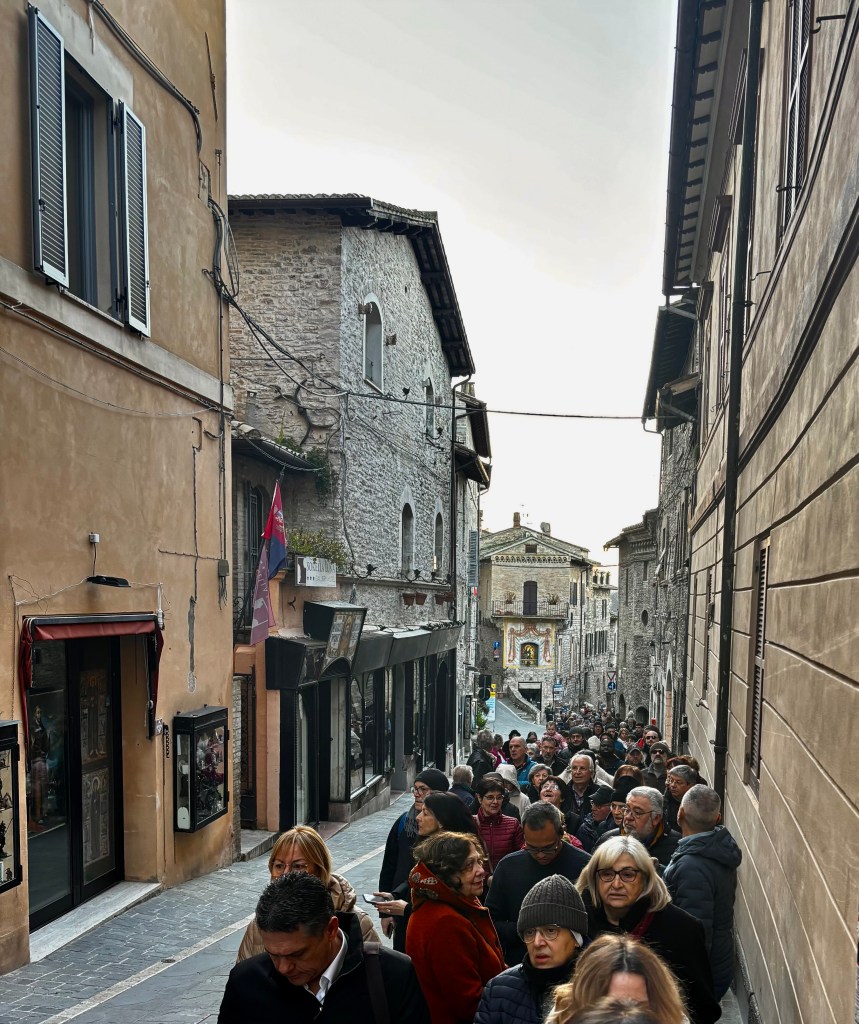
There is no doubt this has been a huge logistical exercise with significant impact on Assisi given it goes throughout almost the whole of Lent. The official website is excellent and the online process to book (free) sessions to venerate the relics or attend mass is simple. A temporary marquee has been set up on the square outside the lower basilica to process the crowds which line up on via Elias – the street that leads to the post office (and the valley). There is a stronger police presence than usual (one commentator noted that Francis required an armed guard in the last period of his life because people tried to cut cloth from his cloak etc – just like Padre Pio) and a lot of really kind and welcoming volunteers.
Three days in and most of the crowd is Italian, including from Assisi. It is obviously a big deal for them to see the remains of a saint they have honoured, in faith, for centuries.
Francis’ remains are said to be in the same condition-controlled, bullet-proof reliquary surrounded by a clear perspex container that was used in 1978. This thing is ordinarily stored in a secure environment below the spot in the crypt that is marked as the tomb of Francis and the friars. Which explains why I didn’t feel much on that first visit to the tomb/crypt.
In retrospect, the veneration process is remarkably similar to the routine at the Casa Dom Inacio (except we are mostly wearing black instead of white). You get a ticket, join a line, wait for it to be called, get corralled into groups and told to follow a process that only the volunteers seem to understand. The lines proceed into the lower basilica (no talking, no photos) and you quickly file past the saint’s remains (yours truly did put his rosary on the container). You can even leave petitions in a basket.
The pews have been removed from the lower basilica to accomodate the lines. And spotlights have been introduced which make the frescos pop. There is also a lovely booklet available that aligns the images with the themes of the exposition.
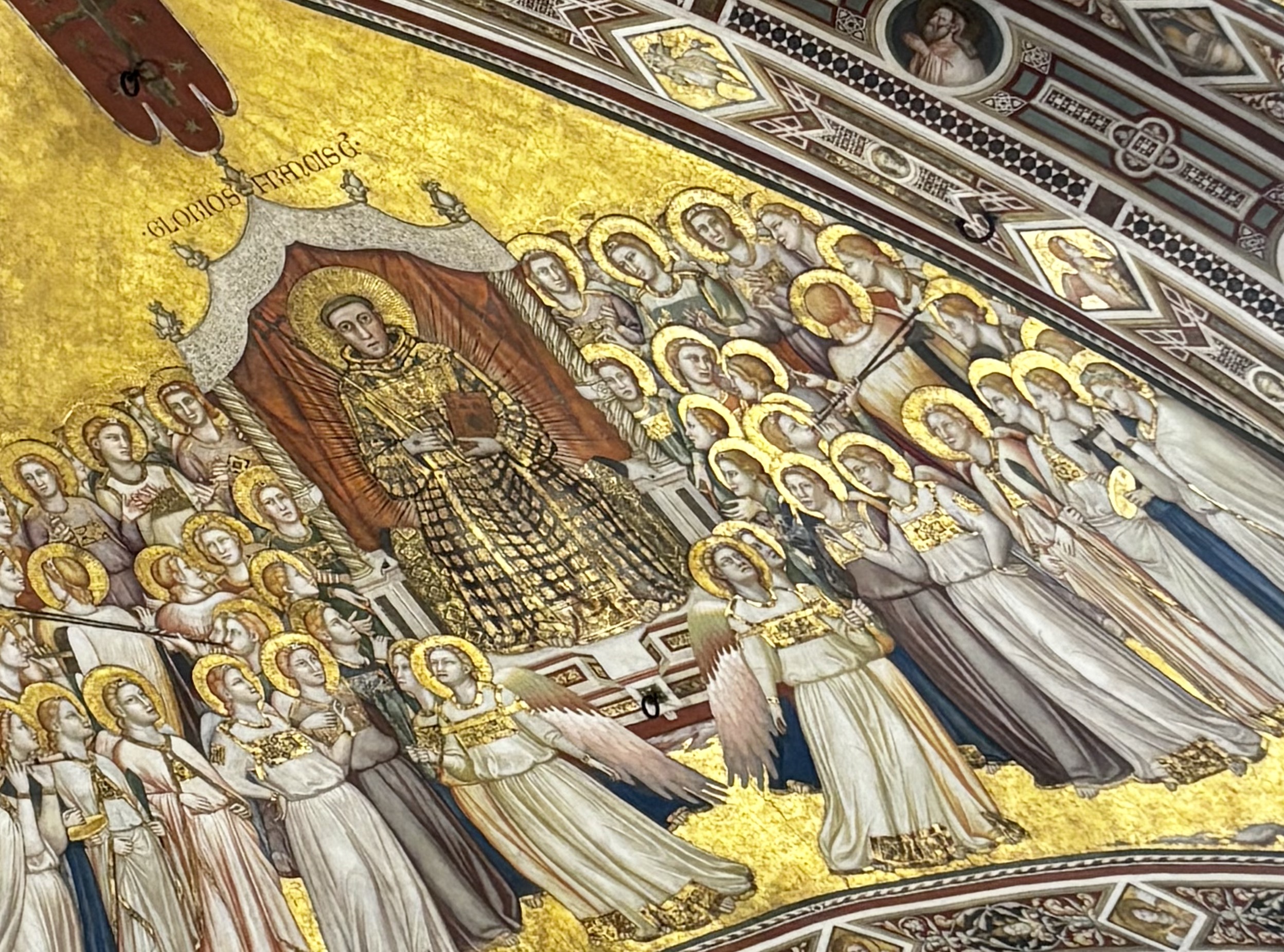
The hero image for the exposition is extracted from a fresco painted on the ceiling above the altar in the lower basilica. This work is called “The Apotheosis of St Francis” and was painted by Giotto in c 1320. Francis is portrayed with the angels in heaven. It is certainly unusual because his modest monk’s robes have been replaced with an extravagant heavenly ensemble. One scholar asserts that “since the work and the writings of St. Bonaventure, Francis has been conceived as the “angel of the sixth seal”. For this reason these scenes are bound within a framework whose figurative elements allude to the Apocalypse and whose central motif is the apocalyptic Christ on the keystone of the vault.”
As to the rationale for the exposition, the Vatican says:
“In a time marked by uncertainty, social tensions, and a search for meaning, the display of St. Francis’ relics is an event that goes beyond simple devotion.
For the Catholic Church, it represents a powerful spiritual call and for the faithful it can be an opportunity for a tangible encounter with the living memory of one of the most beloved and universal saints…
We have chosen the Gospel of John, Chapter 12, verse 24, as our interpretative key. In it Jesus, speaking of Himself, says that unless a grain of wheat falls into the earth and dies, it remains alone; but if it dies, it bears much fruit.
St. Francis is truly this seed who, in the manner of Jesus, of the saints, of the martyrs—and perhaps of all people of good will—gives himself in daily life. Whoever gives himself is consumed; there is no way around it, but he then bears fruit!”
I got a bit emotional in front of the remains of St Francis. Honestly, my first thought was “how much more are we demanding from this brother”. But I was obviously projecting because at the same time I was praying for my rosaries to be energised. And then I was thrown into a major guilt spin because I was not actually expressing my (very real) appreciation of Francis. And I didn’t really feel any energy – which I attributed to the pressure to keep the line moving.
After the face time with the bones, there is an opportunity to see a modest “exhibition” (in Italian) and to get a stamp or blessing or mass said. This was really the highlight of the evening because the priest who blessed me (and the rosaries) was an awesome channel and the energy was intensely beautiful – just like Francesco.
I have a mixture of thoughts and feelings about the exposition. I am full of gratitude for this saint but I found the exposition moving and little sad. I am particularly mindful of the impact of bringing his relics to light on the people of Assisi who carry similar DNA or who have had lives with him. And acknowledging an event like this can catalyse spiritual development, I had to keep in check my response to the spectrum of beliefs people bring to the experience.
© Paul McCarthy & Iluminar.au

