Discovering Indigenous Coogee: What’s here, what’s missing and what’s nearby
From the Koojay Corroboree on Coogee Beach to La Perouse, galleries, and cultural tours across Sydney, this essay maps ways to encounter living Aboriginal culture with respect. It also challenges Randwick Council and visitors alike to move beyond symbolism and insist on truth-telling, visibility and meaningful reconciliation. (5 min read)
One day of the year!
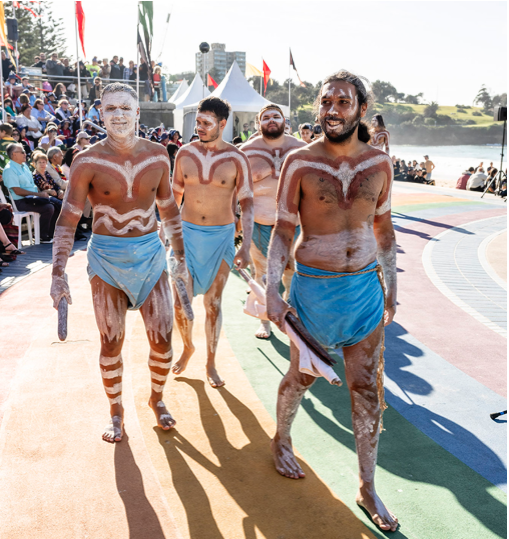
There is just one day a year, during National Reconciliation Week, when Aboriginal people are visible and celebrated on Coogee Beach. This is the day of the Koojay Corroboree, a collaboration between the Randwick Council and the La Perouse Local Area Land Council to celebrate the continuation of local Aboriginal culture and knowledge and address a specified national theme.
The word “corroboree” was adopted by British settlers from the Dharug (“Sydney language”) word “garaabara”, denoting a style of dancing. It is now considered a generic word for a meeting of Australian Aboriginal peoples. It may be a sacred ceremony, a festive celebration, or of a warlike character. It usually includes dance, music, costume and often body decoration.
The Koojay Corroboree was first held in 2015 and has grown into a significant event involving a “Welcome to Country”, speeches, song and dance (total duration of about 2 hours). It has also provided an opportunity for cultural workshops, information stalls and marketing of Indigenous works.
The occasion, National Reconciliation Week, is important because each year (from 27 May to 3 June) it recognises two milestones in Australia’s reconciliation journey:
- The 1967 successful referendum which paved the way for Aboriginal and Torres Strait Islander people to be counted in the census and gave Commonwealth Government powers to make laws for the benefit of Aboriginal and Torres Strait Islander people.
- The “Mabo” decision by the High Court of Australia which turned over the notion of terra-nullius recognising Aboriginal native title of the lands of Australia.
Apart from a footnote on a Randwick Council map of Coogee Beach and the Aboriginal flags flying at the Coogee Surf Living Club and the Coogee Bay Hotel, there is no ongoing acknowledgement of the traditional owners of the lands and waters of Coogee.
To our great shame, pending the approval of the Yanggaa Kelp Forest off Coogee Beach, the monuments and names of the parks and streets of Coogee are pretty much pale, male and stale. And even then, explanatory signage is either absent or degraded.
This is surprising given the Council’s purported commitment to reconciliation, public art, social cohesion and place naming.
Personally, I would like to see a monumental contemporary art installation by a local Aboriginal artist on the beach side of the retaining wall as inspiring as this shell wall at Barrangaroo by the late Aunty Esme Timbery from La Perouse and Jonathan Jones.
I am told there were Aboriginal carvings of sea life on sandstone in Dunningham Reserve (north headland of Coogee Beach) and it is worth sourcing a local Aboriginal guide to learn about this. I think about this heritage we have lost every time I walk over the whales, stingray and jellyfish carved by the Council on the footpath in the reserve.
What’s nearby?
About 20 minutes from Coogee is La Perouse. It is well known for having a significant Aboriginal community with ongoing connection to the lands and waters of Kamay Botany Bay. Despite horrific treatment for over 200 years, this community has endured and been a national leader in Indigenous recognition, justice and the application of cultural knowledge. A visit to La Perouse, including a guided tour of the La Perouse Museum and both sides of the Kamay Botany Bay National Park is a good way to become educated about Aboriginal history and culture.
What’s in Sydney?
My first choice is always a performance by Bangarra Dance. But if that is not possible, the City Botanic Gardens and Sydney’s major public museums showcase different aspects of Aboriginal arts and culture. In my order of preference:
Australian National Maritime Museum
Then there is Barangaroo, a waterfront precinct named for a powerful Cammeraygal woman from the early years of colonisation. Here the landscaping, artworks, and interpretive signs make a more deliberate effort to foreground Aboriginal narratives. Guided Aboriginal cultural tours along the foreshore invite you to imagine Sydney before skyscrapers, before wharves, before concrete promenades — a harbour alive with canoes, camps, stories, and ceremony. In these moments, the idea of “Sydney” stretches beyond the colonial founding date into something far older, more layered, more sacred.
Destination NSW, the State’s tourism agency, has a list of Aboriginal cultural tours, including Tribal Warrior cruise which I really enjoyed.
Because most visitors to Australia are very interested in Indigenous arts and culture, there is a big market for souvenirs and great care is needed to avoid unethical traders who steal or appropriate and distort Indigenous designs or exploit Indigenous artists. Although Australia has an Indigenous Art Code, it is best to avoid the tourist shops around The Rocks and buy souvenirs from the public institutions and art works from reputable galleries (there are 3 I use in Sydney).
Coogee must do better
Coogee has a long Aboriginal history extending back thousands of years. The area is generally associated with Bidjigal and Gadigal peoples, recognising that Aboriginal boundaries do not correspond to modern council boundaries.
Before British colonisation, Aboriginal people used the Coogee coast for fishing; shellfish and seaweed gathering; collecting birds, plants and other resources; travel between coastal headlands and bays; access to freshwater; ceremony, storytelling and cultural activity; and maintaining relationships with Country and neighbouring communities.
Following British invasion in 1788, Aboriginal people experienced disease, violence, dispossession, restrictions on movement and loss of access to traditional resources. Aboriginal people nevertheless continued to live in, visit and maintain connections with the coast.
These facts are important for everyone to know.
There is support for Aboriginal people in Coogee. About 60% of us supported the proposed Indigenous Voice to Parliament in the 14 October 2023 referendum, compared with 40% nationally. This means support for consultation with Aboriginal people about laws and policies that affect them, empowerment of Aboriginal people, and telling the truth about the past treatment of Aboriginal people and the way it still impacts on them.
The Randwick Council’s plans provide a good foundation for recognising, explaining and celebrating Aboriginal arts and culture in Coogee but they are hollow unless implemented. Let’s press the Randwick Council to do better and if this topic is of interest we can discuss it over breakfast in Coogee.
Council’s response to this blog
I provided this blog post to the Mayor of Randwick Council and received a thoughtful response identifying some other initiatives and plans showcasing Indigenous culture within the broader Council area as well as a promise to consider installation of a monumental artwork at Coogee. While I applaud these initiatives and acknowledge that Coogee is only one area within the Council’s jurisdiction, Coogee is the most well-known and visited of our Council’s beaches and therefore has the greatest potential to build understanding and support for Indigenous history and culture. It must not be overlooked.
You might also like:
→ Why you must visit La Perouse
→ Coogee’s origin story and the naming of the Yanggaa Forest
→ Sea Country and the fight for Indigenous sea rights
© Paul McCarthy & Iluminar.au

