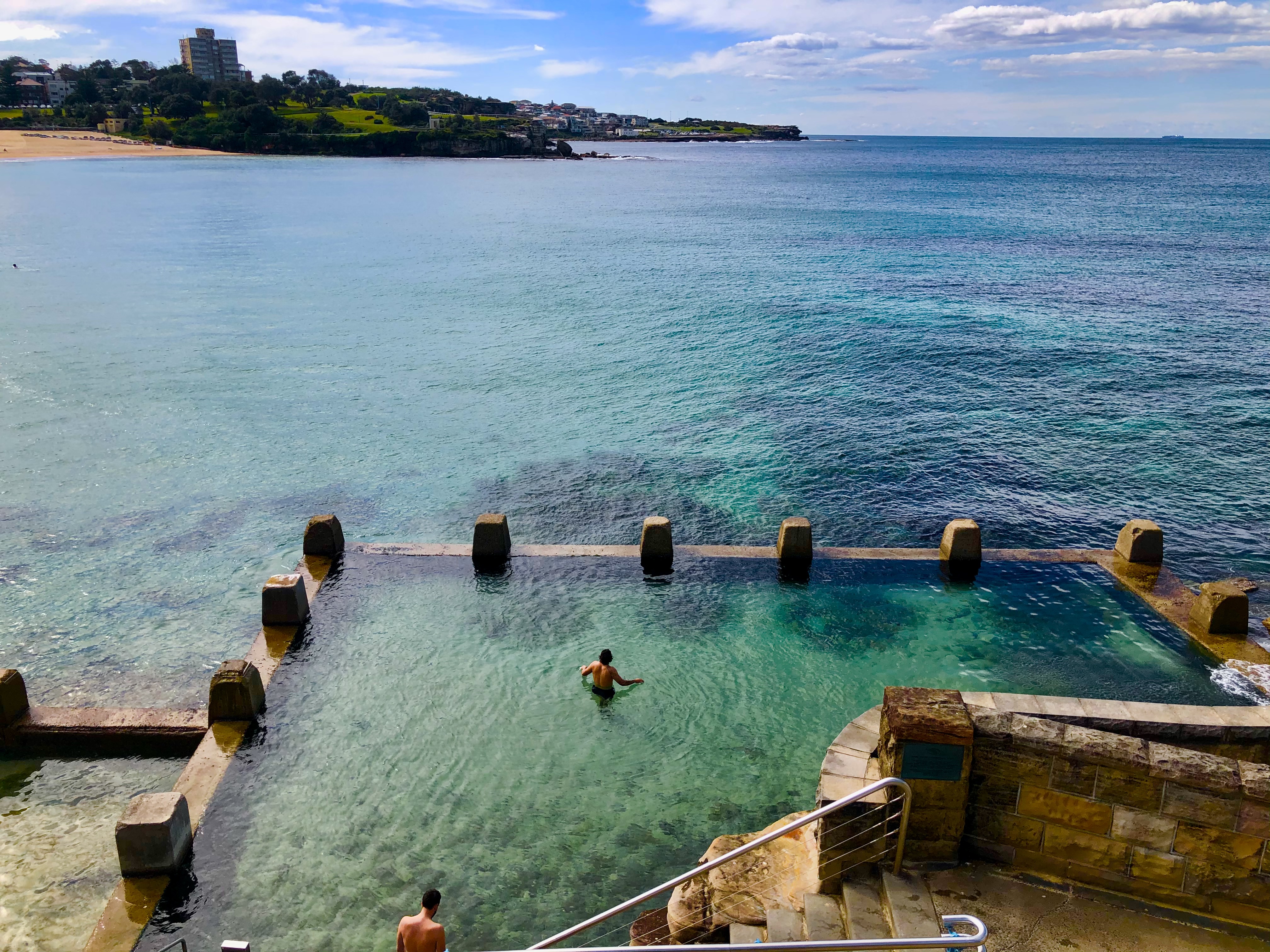
Coogee’s origin story and the naming of Yanggaa Forest
From stormwater runoff and “fatberg” debris to the quiet resurgence of underwater kelp, this piece traces Coogee’s troubled relationship with water quality and its sea forests. It celebrates the ecological and cultural significance of the proposed Yanggaa Forest, where restored crayweed and golden kelp now thrive beneath the waves, inviting us to see Coogee anew. (4 min read)
The most important issue for Coogee locals is the cleanliness of the water at Coogee Beach. But in the quest for the mighty tourist dollar, this is an issue about which there is some opacity.
I have learned the hard way not to swim in open water following heavy rain. My theory is that the run-off flows down the hills of Coogee ending up in the ocean, along with a lot of nasties it collects along the way.
While I have never been sick from swimming in the ocean pools after the rain, I do limit my face time with the water just to be safe.
In fairness, the water quality is normally good in Coogee (the most recent results are reported on the digital screens at the beach) but at times it is terrible and there needs to be a dedicated focus on public reporting of what happens to the ocean water quality after the rain.
Things could be far worse – as they once were. Coogee has a long, troubled history with sewage management dating back to 1889 when a raw sewage outlet was built at the north headland, emptying waste directly into the ocean. Though that specific outlet was diverted in the 1920s, local infrastructure issues, stormwater cross-contamination, and proximity to the massive Malabar deep ocean outfall have led to periodic pollution incidents.
Two years ago, Coogee, Bondi and Manly were forced into temporary closures when mysterious black debris/fatberg residue balls washed ashore. Investigations found these originated from land-based network pressures and the Malabar deep ocean system. Fortunately, I have not seen these balls back on Coogee Beach since 2024 but the problem is a national disgrace. The Government says it is working on a solution but this will not be fast or cheap.
Coogee is at her best on a clear, sunny day when the ocean is flat and calm. This is when the water is crystal clear and the sea life is most visible. On days like these one can readily make out darker patches in the water close to the Ross Jones Pool, past the surf club, the Women’s Pool and around to Wiley’s Baths.
These dark patches are rocks and sea forests, primarily golden kelp (Ecklonia radiata) and native crayweed (Phyllospora comosa). This forest, which covers about 7 hectares in South Coogee, is teeming with life just beneath the surface, supporting species like blue groper and giant cuttlefish, while also capturing carbon and recycling nutrients.
The forests are Coogee’s origin story. “Koojay”, after which our village is named, means “smelly place” or “stinking seaweed,” directly referencing the pungent scent of this local kelp drying on the sand. The “seaweed” originates from local rocky reefs and shallow underwater forests just offshore and is dislodged and swept ashore by heavy ocean swells and rough surf.
I have lived in Coogee almost 20 years and been bothered by the seaweed on less than a handful of occasions, most recently in January 2026 when we had a very large deposit (which was quickly cleared by Council).
Vast underwater forests of crayweed originally covered 70km of Sydney’s coast but disappeared in the 1980s, likely due to pollution. Its loss stripped local waters of a critical foundation species that provides habitat, nursery grounds and vital nutrient absorption for coastal ecosystems, supporting everything from abalone and rock lobsters to carbon capture.
For nearly a decade, “Operation Crayweed”, a cross university project, has been working to restore crayweed by transplanting healthy, fertile crayweed to boost biodiversity and rebuild a self‑sustaining ecosystem.
South Coogee has been one of the most successful restoration sites for Operation Crayweed and one of only a handful of places where restored crayweed and golden kelp grow side by side.
Leveraging the success of almost a decade’s work by Operation Crayweed and with the support of Hyundai, an international campaign to name, conserve and build awareness of the earth’s sea forests is being centred on Coogee Beach.
Appropriately, Coogee’s sea forest will be the first Australian site named under the “Forests Without Names” Project. And, it will be the first kelp forest named anywhere in the world according to Geographical.
To formalise the process, the NSW Government has invited submissions on the proposed name – “Yanggaa Forest” by 6 September 2026.
Yanggaa (pronounced “Yanga”) is a Dharawal word for lobster/crayfish, a species closely associated with crayweed habitat. The proposed name reflects the ecological importance of the forest while recognising the enduring cultural connections between people and Sea Country. Yanggaa was chosen by online vote and with advice from the Gujaga Foundation (which leads cultural and research projects in the La Perouse Aboriginal community).
There is some great information and stunning visuals about sea forests in this video for the Forests Without Names Project.
Ocean conservation is one of the key themes of the Australian National Maritime Museum where I worked for six years. If this issue is of interest to you, we could discuss it over breakfast in Coogee.

(Credit: NSW Government)
You might also like:
→ Why should you pay to have breakfast with Paul?
© Paul McCarthy & Iluminar.au

