Chasing Paolo Veronese
When Paolo Veronese – ascended master in training – one of the most esteemed painters of the Renaissance put a dog, a dwarf and two drunk Germans in his painting of The Last Supper there was hell to pay. Chasing Paolo Veronese through France and Italy reveals this was not an isolated case but a painting that drew the ire of the Roman Catholic Church in the early days of the Counter Reformation did not diminish Paolo’s ascendancy. (23 min read)
In retrospect, it was inevitable that I would end up in Venice. I’ve had many beautiful experiences there with my family and friends and alone. I know a little of its history and stories, but returning was not a priority. And yet, as I walked around the beautiful city of Verona for the first time this year, I felt an irresistible nudge to change my plans and visit Venice.
I had been chasing Paolo Veronese across Europe. And Verona and Venice, his alpha and omega, was a way to get closer to him. It was a pilgrimage of sorts, seemingly spontaneous and organic, but in reality predestined, though at present incomplete.
Do you know Paolo Veronese?
Paolo was born in Verona in 1528. His father, Gabriele Bazaro was a prominent stonemason and we know little about his mother, Caterina Caliari, except that she was the daughter of an illicit love affair between a nobleman and a commoner. Paolo’s brothers were artisans and at the age of 13 he became part of the workshop of the painter Antonio Badile. By 1551, Paolo was using his mother’s surname – Caliari – and making paintings for Venice. He moved there around this time and painted for the Republic, the Catholic Church and many wealthy families.The nickname Veronese, after his place of birth, has stuck. While he signed some paintings Paolo Veronese, most that are signed carry the name Paolo Caliari.
Veronese (1528-1588) was master painter of the late Renaissance period succeeding Titian (1488-1576) and Tintoretto (1518-1594).
Veronese is a big deal in art history but it was not always thus. Even though he was feted in the day, with impressive commissions from wealthy patrons, the state, and the church; and now with paintings in the world’s best museums (the louvre, national gallery, vatican, prado, the brera and the frick), it seems hard to believe there was a period when art scholars did note rate Paolo.
There is a faction within the art establishment that considers Veronese “the painter’s painter”. Some consider him the best colourist there has even been. There is deep respect for his skill in composition and portraiture. There is no dispute that his rendering of fabrics is sublime or that he was very good with architectural and sculptural elements. But for a long time he was considered too decorative to be taken seriously. The worm has now turned.
There are several significant monographs about Veronese, there have been many retrospectives of his work, as well as scholarly articles. I know, from personal experience, that people visit museums and churches just to see his work.
A multiplicity of factors had me chasing Paolo all the way back to Venice in 2025: An irresistible story about a painting before the inquisition; curiosity about dogs in religious paintings; an enticing trail of paintings from Toulouse to Verona to Venice to Padova to Milan; and an earnest prayer for the help from the Ascended Master “Paul the Venetian”.
Veronese in the south of France
There has long been great enthusiasm for Veronese in France. King Louis XVI owned 22 paintings by Veronese and in the 1660’s offered to buy “The Wedding Feast at Cana” – a mammoth painting by Veronese which was plundered by Napoleon in 1797 and now hangs in the Louvre Museum.
In 2025, I visited the south of France to celebrate my birthday. I took it as providential that the first art work I saw, on my first day in France, was by Paolo Veronese in 1560. It was not a painting I was familiar with and, quite frankly it was a surprise.
Called “Le fauconnier” (“The falconer”), the large oil painting depicts a person who trains and uses falcons and other birds of prey for falconry. The falconer, who is bigger than life size, dominates the painting. He’s handsome and grand in a fancy coat and white stockings. He doesn’t look like a bird man until I notice he’s got a falcon on his right wrist. I didn’t see it at first because it toned in with his fancy coat. My focus was very much on the third subject in the lower right of the painting – a white and tan hunting dog. At first I thought he was besotted with his master then I realised he was focused on the bird. Remember the dog because it is important to this story.
Hanging right next to “Le falconer” is another painting by Veronese. This one is a portrait of a Venetian senator from 1572. Remember this year because it is important too. The senator is beautifully rendered and lifelike but the painting is dominated by the most luxurious red velvet cloak that drapes perfectly.
By stealth, in one visit to Foundation Bemberg, I was already nailing what I would later learn were some of the themes of interest to art historians.
Inquisition: Do you know why you are summoned here?
Veronese: No your honors.
Inquisition: Can you imagine what the reason is?
Veronese: I can.
Inquisition: Tell us.
Veronese: I was told by the priests, or rather by the Prior of SS. Giovanni e Paolo, whose name I don’t know, told me that he had visited here and that Your Great Lordships had commanded the Mary Magdalene replace the dog. I responded that that I would have happily done this and anything else for my and the sake of the painting, except that I did not believe that the figure of the Magdalene would look good there, for a variety of reasons, which I can speak to if I am given the chance.
Inquisition: What is the subject of the picture you are speaking of?
Veronese: It is a painting of the Last Supper, with Jesus Christ with his Apostles in the house of Simon…
Inquisition: And what did you mean by the armed man, clothed like a German, holding a halberd?
Veronese: That will take longer to explain.
Inquisition: Tell us.
Veronese: Painters take the same poetic license that poets and madmen take, and this is how I made these two soldiers, one drinking the other eating, at the foot of the stairs, though both ready for prompt action. It seemed appropriate to me that the wealthy owner of this house, a noble I understand, would have hired security such as these men…
Inquisition: And the figure dressed as a jester with a parrot perched on his hand, why did you represent him?
Veronese: He is decorative, as is customary…
Inquisition: Who do you believe was at the Last Supper?
Veronese: Christ was there with his Apostles. But there was more space, so I included other figures that I created…
Inquisition: Do you think it is appropriate that the Last Supper of Our Lord includes jesters, drunks, Germans, midgets, and the like?
Veronese: No, your honor.
Verona
I had not thought about going to Verona to see Veronese paintings. My decision to visit was based on the historic architecture, including famous sites like Juliet’s Balcony and the Verona Arena, cuisine and accommodation. But when the first major artwork I saw in this town was by Veronese, I decided to go all-in. I searched for artworks by Veronese in museums and churches and tried to trace his history and visit a monument dedicated to him. Although Veronese left Verona at a young age, there is a lot on offer. The highlights are several masterworks at the Castelvecchio Museum (particularly the “Madonna and Child with Saints John the Baptist and Louis of Toulouse and two donors” (also known as “Bevilacqua Lazise Altarpiece”) from the Church of San Fermo and the “Descent from the Cross” from the Church of Santa Maria della Vittoria Nuova), an unusual hunchback sculpture attributed to Paolo’s father in the Church of Santa Anastasia and the Church of San Giorgio in Braida (which has “The Martyrdom of St George”). While I did not do it, there is a tour of sites connected to Veronese which looks comprehensive and convenient.
Padova, Milan
I chose the museums and churches to visit in Padova based on Veronese, particularly the Eremitani Museum (which has several minor works) and the Basilica of Santa Giustina (which has one of many versions of “The Martyrdom of Saint Justina”).
The Brera collection in Milan is particularly important to this story because it holds Veronese’s “The Last Supper” painted in 1580. This work is about 2.5 times smaller than “The Feast in the House of Levi” (discussed below). It contains 20 people (Jesus, the Apostles, attendants and a girl/woman, a beggar, an obvious foreigner) as well as a dog and a cat. The configuration of the scene is unusual in that Jesus is not centred and is, according to art historians, about to wash the feet of St Peter. The work is darker in tone and colour than most other paintings by Veronese and has been called a stark, late career, evolution in the artist’s style.
Other notable works in the Brera include “Supper in the House of Simon”(1570), “The Agony in the Garden” (1583) and “Baptism and Temptations of Christ” (c1582).
Venice
It was not the plan, but I dedicated a day in Venice to seeing works by Veronese.
Highlights were the recently restored jewel box Church of San Sebastiano (which is fairly described as Veronese’s life’s work, as well as the place where he is buried), the huge collection of the Gallerie dell’Accademia (including “The Feast in the House of Levi”; “Assumption of the Virgin”; “Allegory of the Battle of Lepanto”), the Church of San Pantalon (which contains Veronese’s last work from 1587 – “St Pantalon healing a Boy”) and the Doge’s Palace (which has many works by Veronese, including on the ceilings of the Collegio Hall and the Hall of the Great Council). While all these works are accessible to visitors today, it is important to acknowledge that few people would have been able to view the ceilings of the Doge’s palace, but all could visit the Church of San Sebastiano.
“Feast in the house of Levi”
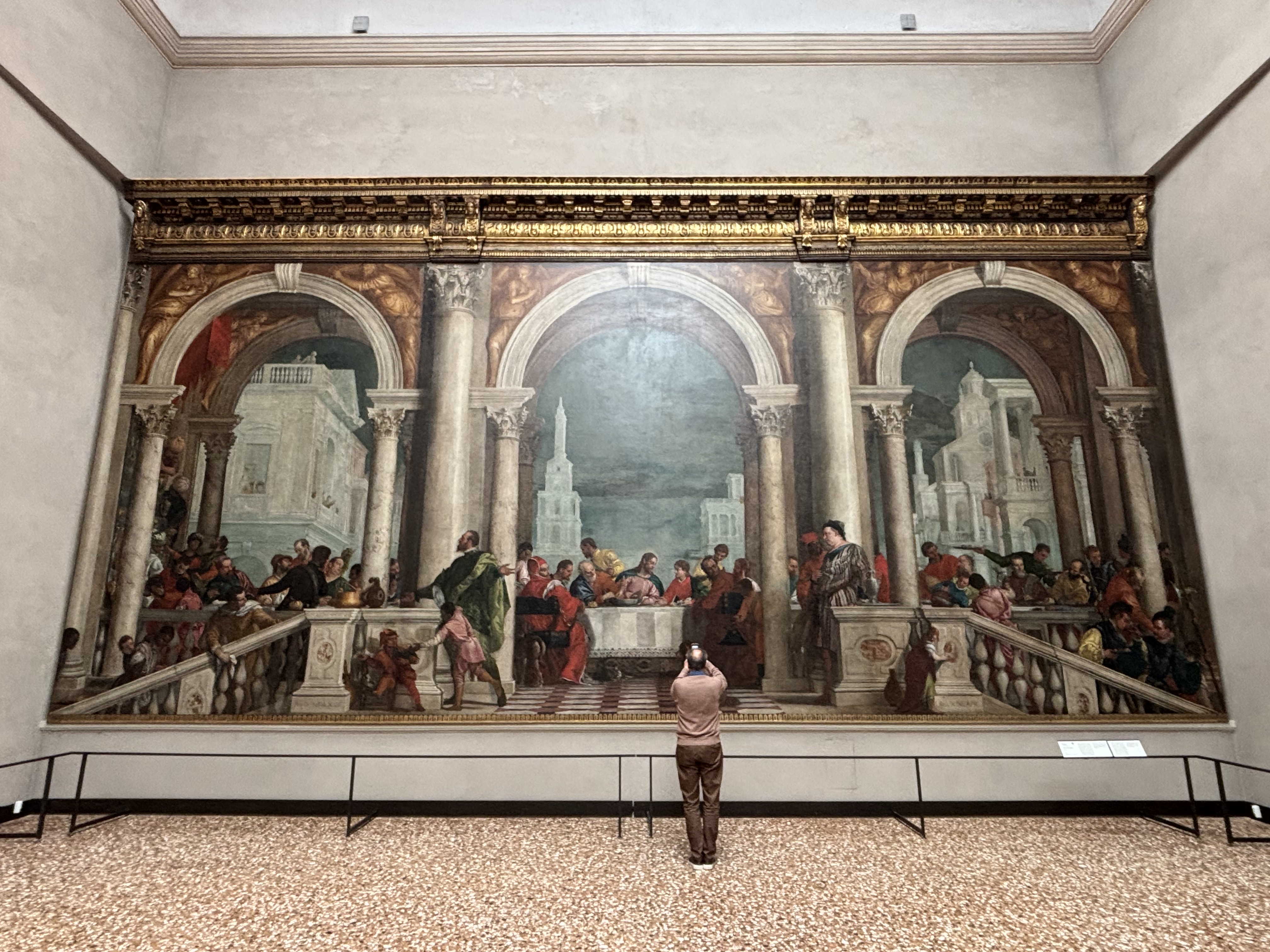
The huge painting by Veronese at the top of this piece, dated 20 April 1573 and now known as “Feast in the house of Levi”, is in the custody of the Gallerie dell’Accademia in Venice. Measuring 6m high by 13m width (18ft x 43ft), this work which was created for the refectory at a Venetian Monastery now dominates a different space.
The painting was the second last of Veronese’s famous “banquet” paintings, including
- “The Feast in the House of Simon”,1556 (Galleria Sabauda, Turin)
- “The Supper at Emmaus”, 1559 (Musee du Louvre)
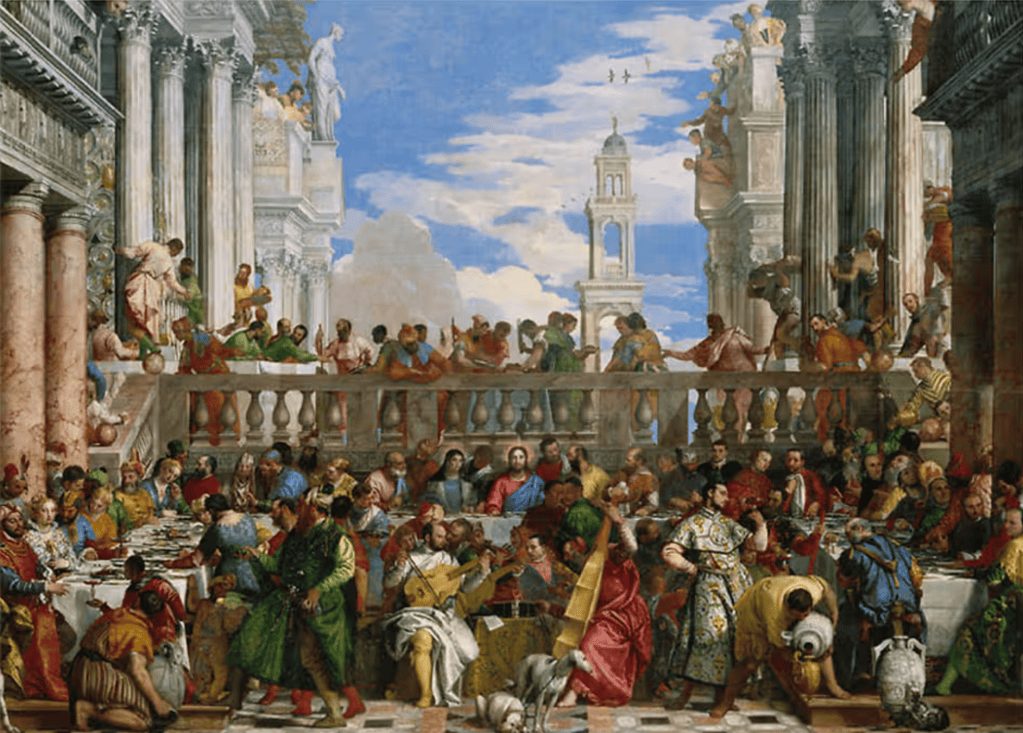
- “The Wedding Feast at Cana”,1562 (Musee du Louvre)
- “Supper in the House of Simon”, 1570 (Pinacoteca di Brera, Milan)
- “The Feast in the House of Simon (the Pharisee)”,1572 (Musee National du Chateau de Versailles)
- “Feast of St Gregory”,1572 (Sanctuario della Madonna di Monte Berico, Vincenza)
- “The Wedding Feast at Cana”,1572 (Gemaldegalerie, Dresden)
- “The Feast in the House of Levi”,1573 (Accademia, Venice)
- “The Last Supper”, c 1580 (Pinacoteca di Brera, Milan)
The painting was made for the refectory of the Monastery of SS. Giovanni e Paolo as a replacement for the painting of the Last Supper by Titian which was destroyed by fire in 1571.
The painting depicts Jesus and the apostles with almost 50 figures, including fools, dwarfs, servants and armed men dressed up in German manner. There are 2 dogs, a cat and a parrot.
The huge crowd and the ‘colourful’ characters were typical of Veronese’s other feast paintings and he was not the only artist including such subjects.
Three months after completion Paolo was summonsed by Holy Tribunal (the Italian inquisition). The painting was, at the time of the summons, called “The Last Supper”.
The record of the Tribunal provides a fascinating insight into church concerns of the time and the impact of the Council of Trent (1545-1563) which was conducted about 200 km away and was concluded a little over a decade ago. The Council paved the way for the Counter-Reformation which was personified by intense support for religious art in counter to the Protestant opposition to it.
The 25th decree of the Council of Trent was:
“every superstition shall be removed … all lasciviousness be avoided; in such ways that figures shall not be painted or adorned with a beauty exciting to lust… there be nothing seen that is disorderly, or that is unbecomingly or confusedly arranged, nothing that is profane, nothing indecorous, seeing that holiness becometh the house of God. And that these things may be the more faithfully observed, the holy Synod ordains, that no one be allowed to place, or cause to be placed, any unusual image, in any place, or church, howsoever exempted, except that image have been approved of by the bishop …”
It appears that Veronese was summonsed because of the presence of dogs, dwarfs and drunk Germans at the last supper. An extract from the transcript of the trial of 18 July 1573 follows:
Inquisition: Do you know why you are summoned here?
Veronese: No your honors.
Inquisition: Can you imagine what the reason is?
Veronese: I can.
Inquisition: Tell us.
Veronese: I was told by the priests, or rather by the Prior of SS. Giovanni e Paolo, whose name I don’t know, told me that he had visited here and that Your Great Lordships had commanded the Mary Magdalene replace the dog. I responded that that I would have happily done this and anything else for my and the sake of the painting, except that I did not believe that the figure of the Magdalene would look good there, for a variety of reasons, which I can speak to if I am given the chance.
Inquisition: What is the subject of the picture you are speaking of?
Veronese: It is a painting of the Last Supper, with Jesus Christ with his Apostles in the house of Simon…
Inquisition: And what did you mean by the armed man, clothed like a German, holding a halberd?
Veronese: That will take longer to explain.
Inquisition: Tell us.
Veronese: Painters take the same poetic license that poets and madmen take, and this is how I made these two soldiers, one drinking the other eating, at the foot of the stairs, though both ready for prompt action. It seemed appropriate to me that the wealthy owner of this house, a noble I understand, would have hired security such as these men…
Inquisition: And the figure dressed as a jester with a parrot perched on his hand, why did you represent him?
Veronese: He is decorative, as is customary…
Inquisition: Who do you believe was at the Last Supper?
Veronese: Christ was there with his Apostles. But there was more space, so I included other figures that I created…
Inquisition: Do you think it is appropriate that the Last Supper of Our Lord includes jesters, drunks, Germans, midgets, and the like?
Veronese: No, your honor.
Inquisition: Do you not know that Germany and other places are infested with heresy and that in such place they commonly fill their paintings with sacrilegious images, that denigrate the Holy Church and spread evil to the ignorant?
Veronese: Your Honor, that would be evil. I can only repeat what I previously stated, that I have followed what others, better than me, have done…
In the end, the judges decreed that the artist must correct his painting within three months from the day of the reprimand, in accordance with the judgment of the Holy Tribunal, and that the additional costs would be paid by Veronese.
In addition to renaming the work “Feast in the House of Levi”, Veronese added the figure of Levi (in red clothes opposite Jesus) and Levi’s name to the balustrade.
The painting was saved by Veronese shoe horning it into a Gospel story that may have had a crowd like the one depicted by Veronese. The new central narrative then became that of a feast hosted by Levi, a tax collector, for other tax collectors and their like. Christ’s attendance was criticised by the scribes and pharisees, leading to his answer “They that are whole need not a physician; but they that are sick. I came not to call the righteous, but sinners to repentance.” The relevant Gospel passages are:
Luke 5:29-32
29 Then Levi held a great banquet for Jesus at his house, and a large crowd of tax collectors and others were eating with them.
30 But the Pharisees and the teachers of the law who belonged to their sect complained to his disciples, “Why do you eat and drink with tax collectors and sinners?”
31 Jesus answered them, “It is not the healthy who need a doctor, but the sick. 32 I have not come to call the righteous, but sinners to repentance.”
Matthew 9:10-13
10 While Jesus was having dinner at Matthew’s house, many tax collectors and sinners came and ate with him and his disciples.
11 When the Pharisees saw this, they asked his disciples, “Why does your teacher eat with tax collectors and sinners?”
12 On hearing this, Jesus said, “It is not the healthy who need a doctor, but the sick.
13 But go and learn what this means: ‘I desire mercy, not sacrifice.’[a] For I have not come to call the righteous, but sinners.”
Mark 2:15-17
15 While Jesus was having dinner at Levi’s house, many tax collectors and sinners were eating with him and his disciples, for there were many who followed him.
16 When the teachers of the law who were Pharisees saw him eating with the sinners and tax collectors, they asked his disciples: “Why does he eat with tax collectors and sinners?”
17 On hearing this, Jesus said to them, “It is not the healthy who need a doctor, but the sick. I have not come to call the righteous, but sinners.”
Veronese’s pragmatism is deeply triggering for a 21st century progressive committed to freedom of artistic expression. His painting was, literally, 173 miles from Da Vinci’s “Last Supper” but stylistically on the other side of the planet. It was lively and colourful but it was neither profane nor heretical. It seemed very much to me like ecclesiastical politics or another agenda by a Domini carnis (“a hound of the Lord”) who had failed in the south of France.
As I stood in the Accademia examining the painting and observing the way the visitors responded to it, I had a long list of questions:
- Who was the intended viewer of late Renaissance religious paintings, given they were placed in monasteries and convents and churches on high ceilings and above altars?
- How much biblical study did painters do in the Renaissance? To what extent were they guided by the person commissioning the work?
- How many people were at the last supper and who were they? Were there servants? Were there jesters? Were there black people? Were there parrots, dogs and cats? Were there guards? Were there children?
- Was there a table at the last supper and what shape was it? Or did they sit on cushions on the floor?
- Why did late Renaissance artists contemporise the dress of characters in religious paintings? And why were the scenes placed within Venetian architecture?
- How were the models chosen for these paintings – was it for aesthetic or commercial or political reasons?
I also wondered, in particular, how the inquisition impacted on Veronese’s work and faith. Veronese did not suffer any loss of standing or orthodoxy and the trial did not curb his creation of massive, opulent, and theatrical scenes. He continued to receive prestigious commissions for grand decorative cycles, ceilings, and large-scale historical and religious canvases in Venice until his death.
Most significantly, he created another “Last Supper” painting about 7-10 years later which, as I mentioned above, had fewer people than the Levi painting but still included a dog, cat, beggar, black man and dwarf.
However, according to Michael Podger, the last two decades of Veronese’s life saw some diminution in quality. Demand for his works was such that he couldn’t paint them all himself and he didn’t keep as close an eye on his studio productions as he might have.
What was the significance of dogs in late Renaissance painting?
I love dogs and it was this aspect of the Tribunal’s criticism of Veronese that puzzled me most and set me down another rabbit hole.
The first plate in the introduction to Tamsin Pickerel’s book “The Dog – 5000 Years of the Dog in Art”, is a painting by Veronese from 1570 titled “A Boy and a Page”. Surprisingly, the accompanying text does not refer to Veronese and the book does not address “The Feast in the House of Levi”.
The essential thesis is that 5,000 years of canine representation in art serves as a direct mirror of evolving human history, societal values, and shifting emotional needs. She demonstrates how the dog’s artistic portrayal tracks humanity’s journey from survival and utility to modern sophistication and companionship.
There are two other paintings by Veronese in Pickerel’s book and her observations offer potential insights into the dogs in the Levi painting:
“Portrait of a Woman with a Child and Dog” (c1546-48). Musee du Louvre, Paris
“This is one of the most lovely details of the human-canine bond from a Renaissance work of art, and was painted by one of the greatest dog artists of all time… The extent to which he painted them in all his works – religious, allegorical and genre alike – and the incredibly lifelike presence he brought to the depictions suggest that Veronese, like Titian, had a genuine and deep felt appreciation of the dog…”
“Esther and Ahasuerus” (undated). Uffizi Galleria, Florence
“..the inclusion of one or more dogs might seem to be random – just because the artist wished to paint them – but in reality dogs had by this time become an integral part of daily life…making it natural to include them in scenes, even depicting events from history or myth”.
Veronese’s death and ascension
Veronese died on 19 April 1588 at the age of 60 years. It was the day after Easter Sunday and 15 years after he was called before the Tribunal.
Following his death, Veronese’s contemporaries and near-contemporary biographers described his character and temperament as overwhelmingly noble, joyous, and professionally independent.
The Guardian observed in 2022 (on the occasion of a major retrospective of his work by the National Gallery):
“We know frustratingly little about the man himself, but what evidence there is suggests an admirable character. He was said to be a decent man who never degraded “his position with low dealings; he always observed his promises and in every action he obtained praise””
But it also gives space to Henry James’ view of Veronese:
“Never did an artist take a greater delight in life, seeing it all as a kind of breezy festival… He was the happiest of painters and produced the happiest pictures in the world.”
“Paul the Venetian”
In “The Masters and their Retreats” (Summit Lighthouse, 2003), Mark and Elizabeth Clare Prophet provide a short biography of the Ascended Master known as “Paul the Venetian”, as well as a description of his etheric retreat, known as the Chateau de Liberte, in the south of France. An overview is provided on the Summit Lighthouse website.
In brief, it is asserted that Veronese became Paul the Venetian after his death. An Ascended Master is a soul who has mastered time and space and the four lower bodies and quadrants of matter, transmuted at least 51% of their karma and fulfilled their divine plan. Inhabiting the spirit plane, Ascended Masters may teach unascended souls in an etheric temple on the etheric plane.
Paul the Venetian is the chohan of the third ray of divine love. Most relevantly for our purposes, Paul sponsors the ascended master culture of Beauty and Truth for this age and works with all—artists, musicians, architects, designers and craftsmen—who desire to bring that culture forth on behalf of humanity
I worked with Ascended Master Serapis Bey, whose etheric retreat is over Luxor, Egypt, when I visited there in 2012. I found the process of preparing for and visiting Luxor very rewarding and of enduring benefit.
In anticipation of visiting the south of France and Italy, I sought Paul the Venetian’s intercession for myself and my friends who are artists. The results of this are yet to be made apparent.
More of a quest than a pilgrimage
This was a most unusual holiday and I was pleased to depart from my schedule and focus on Paolo Veronese across half a dozen cities. I saw and learned new things and the experience provoked deeper reading and study on return. While it morphed into a journey with an element of divine understanding, it was more of a quest than a pilgrimage – more intellectual than spiritual – but interesting, confounding and ultimately compelling.
If you are considering travelling to Italy for a sacred holiday, I would be very happy to talk through the possibilities — including how art, history and spirituality can deepen the experience.
You might also like:
→ Saint Francis of Assisi and the wolf of Gubbio
→ Unexpected cultural depths – Art history at Sydney’s eastern beaches
What is a sacred travel consult?
© Paul McCarthy & Iluminar.au

