Unexpected cultural depths: Art history at Sydney’s eastern beaches
From the impressionist painters who made Coogee worth picturing, to Christo and Jeanne-Claude’s monumental Wrapped Coast at Little Bay — two artworks, decades apart, that changed how Australians see their landscape, their culture, and each other. (9 min read)
Coogee, my favourite of Sydney’s eastern beaches, is famous for its coastline, but what I love is how it connects to something deeper: the way Australian artists learned to see this place and how they helped audiences to see it too.
When you engage with the art of Coogee and the stories around it, you start noticing that “local landscape” isn’t just background, it is a window into history and culture.
In the late 1800s, the drive to find something distinctively Australian was growing—national identity wasn’t only being talked about, it was being pictured. Australian Impressionism helped do that. It turned the countryside, the seaside, and especially the quality of Australian light into subjects that audiences could recognise as their own. The coastline in those works isn’t simply pretty; it’s a kind of belonging.
Then—less than a century later—many artists felt constrained by what “Australian art” was expected to be. That period of cultural cringe made some people want to test new forms: abstraction, new media, and public-facing work that didn’t rely on old rules. And that’s where the story broadens just a little beyond Coogee Beach.
In Sydney, major public gestures like Christo and Jeanne-Claude’s “Wrapped Coast” project at Little Bay demonstrated that artists could create mammoth, ground-breaking experiences in public space and attract new kinds of audiences and ideas, initially in the direction of cosmopolitanism and cultural independence and then shared humanity. The point wasn’t only the artwork itself, but people learning to encounter art differently, right where everyday life happens.
How I see the visual arts and art history
Visual art provides a unique window into the time in which it’s made. Whether it’s a painting, sculpture, photograph or textile, art doesn’t simply sit inside its era—it reflects how that culture experiences the world. It may record what feels urgent, what looks worth preserving, what kinds of beauty or discomfort people are prepared to face, and which stories deserve form.
When I think about art making, I’m struck by the way deep looking and artistic skill of the artist works together with their sensitivity. The artist’s craft and attentiveness defines what the work says, and the work, in turn, carries the imprint of the time and place that shaped the artist’s sensibility.
Art emerges from careful attention, experimentation, and commitment, and it may end up expressing more than the artist can fully name while they’re working.
Artists are products of their era—trained by the conventions available to them, influenced by the debates they’re surrounded by, and constrained by what materials and laws allow. But their making can also widen what that era is capable of imagining. Even if the artist isn’t consciously intending to “change society,” their art can still move thinking forward by highlighting tensions, giving form to questions people are only starting to feel, and expanding what others can feel or recognise.
I love art history and, in particular, the way it helps us to understand social and political conditions and culture. Australians have experienced several significant cultural milestones, and in my view, these moments can be traced through art—because art both reflects a society’s assumptions and helps to revise them.
In this post, I’ll share the way in which two significant milestones in art give insight into Australian history, identity and culture—and continue to be commemorated in Coogee and Little Bay.
Coogee’s centrality to the first school of Australian painting
Australian impressionism is often described as the first major school of Australian painting, and Coogee Beach is absolutely central to understanding it.
In the formation of a distinct national identity in the late 19th and early 20th centuries, Australian impressionism was significant. It portrayed the landscape in a way that made it “ours”—the countryside, the coastline, and the distinctive qualities of light were rendered with a beauty and immediacy that was initially shocking, but ultimately resonated strongly with our people. The creative output of these artists demonstrated that Australia could have its own visual language and its own artistic authority.
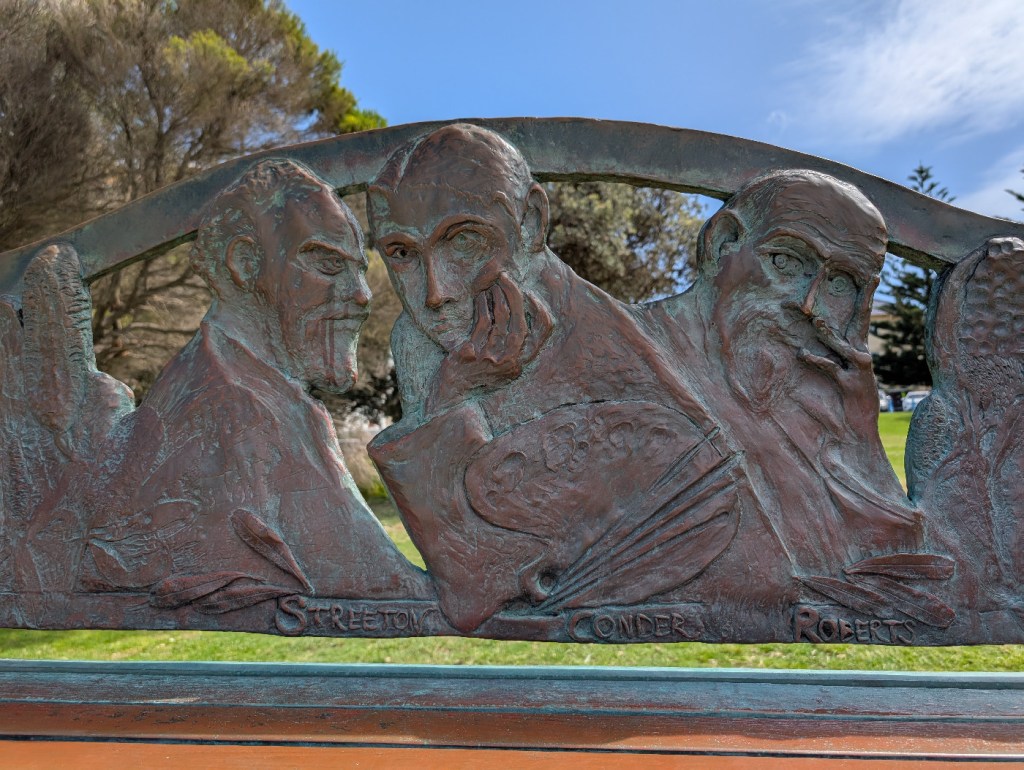
At the northern end of Coogee Beach is a monument sculpted by Eileen Slarke which commemorates the location of plein air paintings by Australian impressionist masters Tom Roberts and Charles Conder (who painted side by side in 1888) and Sir Arthur Streeton (who painted Coogee Beach in 1890, 1895, 1907).
Slarke’s monument is a peculiar, elevated bronze seat facing the ocean with the heads and names of the painters on it. Located just off the path on the lower side of Dunningham Reserve, it is a magnet for children who want to climb it. I’ve often mused on whether she is trying to communicate the elevated status of these artists or whether the accountants in Council asked her to raise it as a strategy to reduce the risk of damage.
The Coogee impressionist paintings are rarely shown together. Roberts’ “Holiday Sketch at Coogee” is the most readily accessible because it is permanently exhibited in the Art Gallery of NSW. While Conder’s “Coogee Bay” and Streeton’s “At Coogee” (1895) are permanently exhibited in the National Gallery of Victoria in Melbourne, Streeton’s “Sunny South” (1890) is in private hands, along with three paintings of Coogee Beach from 1907.
I was delighted to see three of the Coogee impressionist paintings in an Art Gallery of NSW retrospective of Streeton’s work (in 2020), and in the National Gallery of Victoria exhibition “She-Oak and Sunlight: Australian Impressionism” (in 2021).
The paintings are beautiful, interesting, and exciting in equal measure, but they are also quite different from each other. The Streeton catalogue gives a nice glimpse into the scholarship:
“The diverging temperaments of the Coogee paintings by Roberts and Conder are often noted: the tonal naturalism of Roberts’ ‘Holiday sketch at Coogee’ as distinct from the dreamier and creamier palette of Conder’s ‘Coogee Bay’. In Streeton’s ‘Sunny South’, colour most notably marks the character of the work. Streeton paints intensified blue waters, which have glistening effect. He clearly chose his moment well, having earlier grumbled to Roberts: ‘am doing a little work at Coogee, but progress is difficult; the weather has been damnable, raining all day – so monotonous and sad’. Streeton painted ‘Sunny south’ on a dazzling day, with gleaming light bouncing off white sand and radiant sea… The Sydney-based artist and teacher Julian Ashton would later note, ‘It was from Conder that Streeton learnt the value of decorative landscape and through his influence learnt to lay more stress upon selection and design’. In ‘Sunny south’, Streeton draws from Conder’s example to transform the beach scene into a theatre of colour.” (“An Artist’s City: Streeton in Sydney” by Denise Mimmocchi in Streeton, edited by Wayne Tunnicliffe, 2020).
The importance of Coogee Beach in Australian painting goes beyond the four famous paintings already mentioned. Streeton visited several times, bought a home for his parents on Carrington Road, and made many other paintings of Coogee and the surrounding districts.
The famous impressionist scenes of Coogee no doubt inspired later artists, including Elioth Gruner, Harley Griffiths, J.J. Hilder, Jeffery Smart, Sally Robinson, Reg Mombassa, and Peter Kingston. The lineage continues with numerous contemporary painters and photographers currently working in Coogee. I’ve been researching artistic representations of Coogee and have found over 50 examples to date. At some point I will create a walking tour of the spots that inspired these works.
Call it sour grapes, but I remain astounded that the Coogee paintings were excluded from the “Creating Australia: 200 Years of Art 1788–1988” exhibition curated by Ron (Dancing Shiva) Radford for the Australian Bicentennial Authority in 1988. Most likely, because this exhibition showcased a different work by Conder (from the South Australian Art Gallery where Radford was Director) on the cover of the catalogue and in the marketing.
The biggest artwork in the world
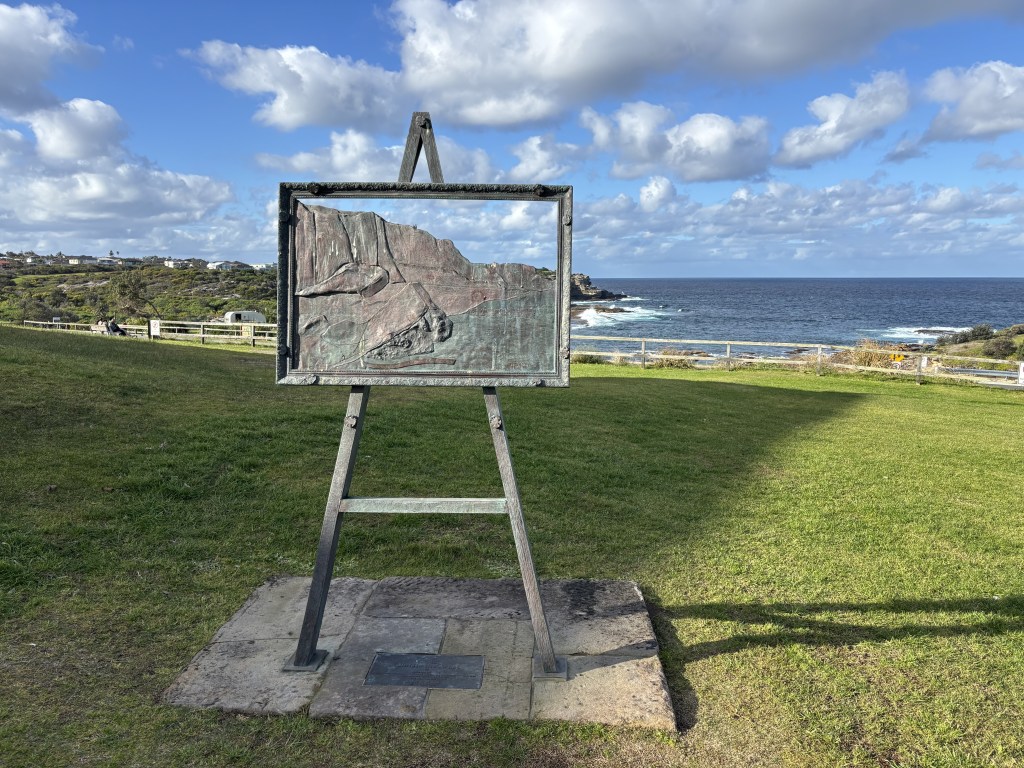
Arguably, the perfect companion to the Australian Impressionist monument at Coogee Beach is another by the same sculptor, about 15 minutes away at Little Bay. Eileen Slarke’s “Christo the Artist” commemorates the wrapping of Little Bay by Christo and Jeanne-Claude in 1969.
Christo (1935–2020) was a pioneering environmental artist who, according to the Art Gallery of NSW, literally and metaphorically helped change the landscape for contemporary art in Australia: “He showed that art could be radically public and wildly ambitious; that it could be collaborative, experiential and social. He made contemporary art a subject for discussion in households, as well as galleries and universities.”
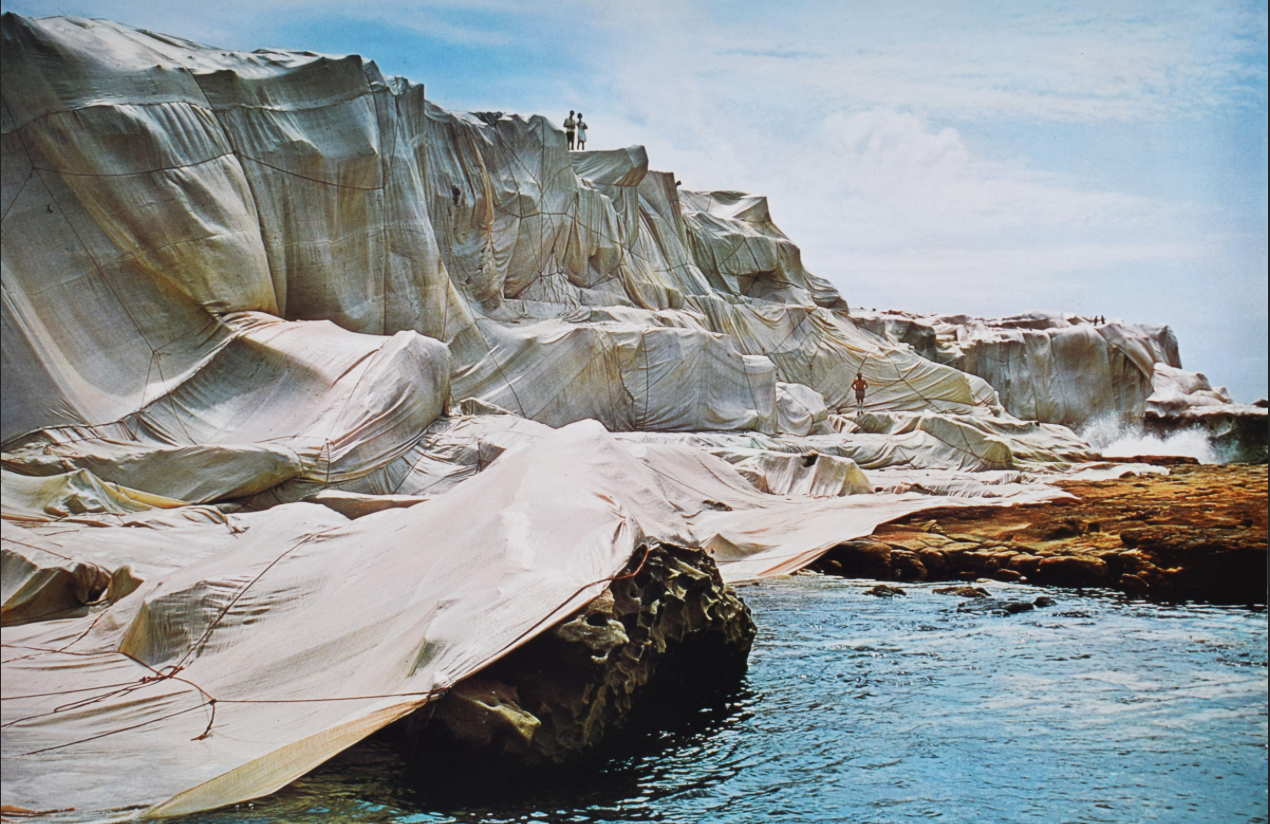
In October 1969, something quite remarkable happened at Little Bay. At the invitation of Sydney businessman and art collector John Kaldor, Christo and Jeanne-Claude wrapped 2.5 km of the coastline in white synthetic woven fibre to create something that resembled a strange arctic landscape.
Titled “Wrapped Coast – One Million Square Feet, Little Bay” the installation was mammoth: it used 93,000m² of fabric and 53.6km of rope. It was bureaucratically and logistically complex, and it took over four weeks to install, with professional rock climbers and more than 100 volunteers.
It was the largest artwork in the world at that time, and was later described by Edmund Capon, the director of the Art Gallery of NSW, as “one of the most outstanding events in contemporary art. It was not a local event, it was an international event”.
The public was astounded by the scale and audacity of the wrapped coast. There was daily media interest in the installation (views were mixed). The number of visitors is contested: one report said 250,000 visits while another said 10,000. A twenty-cent entry fee was charged on behalf of the Prince Henry Hospital.
Although the installation was in place for only 10 weeks, Capon said it had a “huge impact” on the local art scene—and that has since been confirmed by scholars.
By the late 1960s, many artists and thinkers felt trapped by the very idea of Australian identity. The cultural cringe— a sense that local work was less legitimate unless it resembled European models—encouraged a turn toward experimentation. Some artists sought new ways of working: abstraction, new media, and forms of public art. Their goal wasn’t simply to imitate international trends, but to loosen the relationship between “being Australian” and how art was supposed to look.
Kaldor—who would go on to give a further 37 public art projects to the people of Sydney, and donate modern art worth $35M to the Art Gallery of NSW—had the simple aspiration of opening the eyes of the Australian public to the latest developments in contemporary art, and making them wonder.
The intervention by Christo and Jeanne-Claude—temporary, monumental, and staged in the open—did more than showcase a spectacular artwork. It helped energise an audience for art as a new kind of experience: something to encounter in public space, something to interpret rather than simply admire, and something that could train attention toward new forms of possibility.
I was too young to see the wrapped coast for myself, but I have seen many photographs and videos of the installation. Although Christo said the experience was totally aesthetic, I think it was political and inspiring. Political, in the sense that it was entirely self-funded, a gift to humanity. And inspired in the way it invited audiences to see more in something that was actually veiled from them.
Christo’s passing generated a huge amount of reflection and writing around the world, including in Australia. LIFE magazine, which sent a reporter to Little Bay, wrote a lengthy piece called “Christo and Jeanne-Claude’s first wrappings 1968”. It referred to the wrapping of the Kunsthalle Museum in Bern, Switzerland; Fountain and Wrapped Medieval Tower in Spoleto, Italy; and a 5,600 Cubic Meter Package in Kassel, Germany. I was initially put out that there was no reference to Little Bay in the LIFE article—until I realised there was also no reference to the wrapping of the Arc d’Triomphe and Pont Neuf in Paris, the Reichstag in Berlin, and several other major projects. It forced me to acknowledge, with embarrassment, my own national pride and prejudice – precisely the issues the internationalisation of Australian art sought to address.
Going deeper
If you’ve read this far, you might be noticing something I feel strongly: art doesn’t just live in galleries or festivals.
Our artists weren’t only making “pictures” or “installations”—they were inviting people to practise a new way of seeing Australia: first by insisting it was worth picturing, and later by making art feel adventurous, public, and possible.
I would love to talk with you about art, history and our local artists over breakfast in Coogee. Together we can sort out a bespoke plan for visiting Coogee and beyond.
And if you’d particularly like to focus on the Australian Impressionist thread, we can visit the Coogee monument together first, then continue into the next chapter of the story over breakfast.
If that sounds like your kind of morning, I’d be happy to tailor it to your pace and interests.
You might also like:
→ Coogee’s origin story and the naming of the Yanggaa Forest
→ Why pay to have breakfast with Paul
© Paul McCarthy & Iluminar.au

