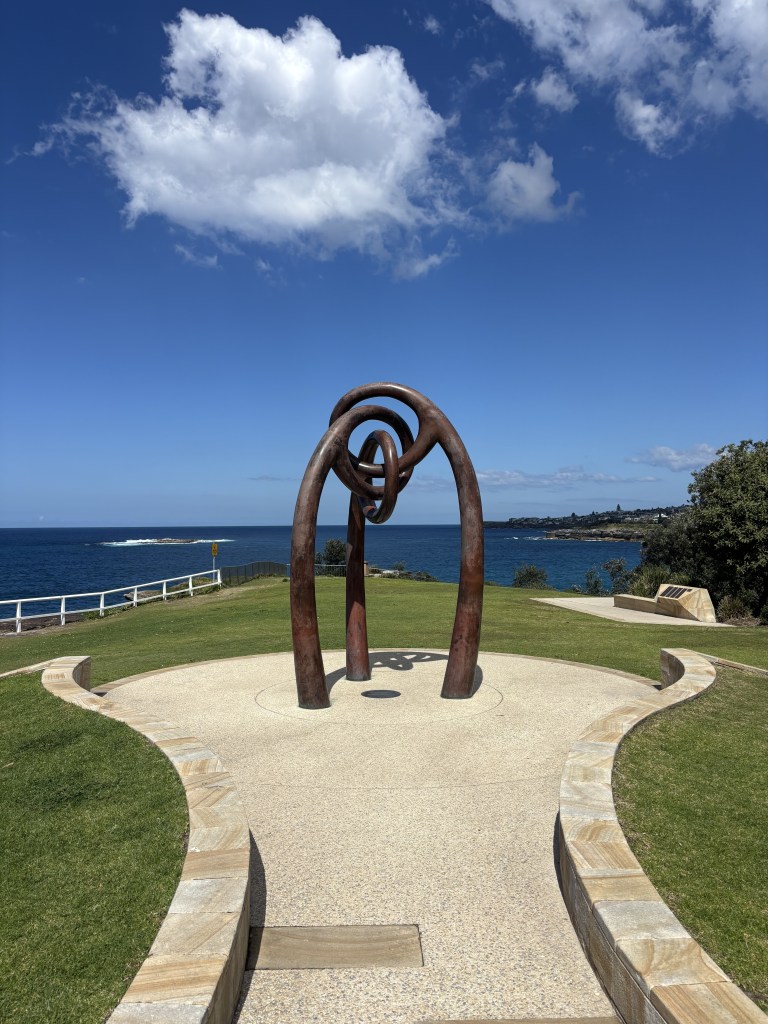
“Reclaiming Spirit” by Sasha Reid. Dunningham Reserve, Coogee
Coogee has 4 monuments to the 2002 “Bali bombing” while other local deaths go unacknowledged
Dunningham Reserve at Coogee holds four monuments to the 2002 Bali bombing within a few square metres — an unprecedented concentration of grief for a community that lost 20 of its own. With time comes perspective: who else deserves to be remembered here, and why haven’t they been? (4 min read)
In Dunningham Reserve, on the north headland of Coogee Beach is a 4 metre high bronze statue called “Reclaiming Spirit” by Australian artist Sasha Reid. Unveiled by the NSW Premier in October 2003, the statue is a monument to those injured or killed in the bombings in Bali the year before. The plaque for the statue states:
The linked figures in this sculpture signify family, friends and community. Bowed in sorrow and remembrance, they comfort, support and protect each other. The figures also symbolise life, growth, hope and our strength in unity.
A few metres away is a low sandstone wall, called “The Place of Reflection” which has the names of the 43 New South Wales (and 1 Tasmanian) victims of the Bali bombing.
And another few metres towards the beach, on the inside of the art deco archway marking the entrance to Giles Baths is a bronze plaque with the photos, names and ages (13 to 47) of 20 local residents (11 women and 9 men) killed in the bombing. This plaque, unveiled in April 2003, states:
On Saturday 12 October 2002, Kuta Beach on the Indonesian Island of Bali, a popular holiday destination for generations of Australians was shattered by a terrorist attack. The horrific bombings claimed the lives of hundreds of innocent people, including 88 Australians.
Sydney’s Eastern Suburbs (where Coogee is located) were devastated by the tragic loss of twenty local residents and the injuries to many more.
The community of the City of Randwick remembers all the victims and dedicates this site to those local residents who lost their lives.
And a further few metres away is another monument from April 2003 renaming the headland “Dolphin Point” in memory of the 6 members of the Coogee Dolphins A Grade Amateur Rugby League who died in the Bali bombing. The players names are on the plaque along with the following:
The common foundation of any great club is spirit and like the game they played, a Dolphin’s spirit never dies. They will always be remembered by their families, friends and the community in which they lived.
There are also memorials to the Bali bombing in Canberra (at Parliament House), Melbourne (Lincoln Square, Carlton), Perth (Kings Park), Gold Coast (Allambe Memorial Gardens) and even Cronulla. There are also monuments in London and Bali and a Peace Museum is currently under construction on the bomb site.
The four memorials to the same people within a few square metres at Coogee is surely unprecedented and the obvious question is why?
The number of deaths (88 Australians, 43 people from New South Wales, 20 people from Randwick City (within which Coogee is located) and 6 Coogee footballers) is part of the explanation. In total, 202 people from more than 20 countries died and hundreds were wounded.
Another is proximity and familiarity. Bali is about 6 hours flying from Sydney, 4 hours from Perth and 2.5 hours from Darwin. Many Australian surfers began visiting Bali in the 1970s and it quickly became a popular holiday destination. According to the National Museum of Australia, by 2002, around 20,000 Australians visited Bali every month: families, sporting clubs and holidaymakers.
An ABC journalist highlighted the shocking nature of the attacks:
The force of the blasts was so great that for about a kilometre around the scene, plate glass windows of shops and big stores were shattered. And the normally smiling Balinese, who would usually be offering to sell you their goods, are standing outside their shops or watching the rescue effort in stunned disbelief.
Political context is also important. The bombing in Bali happened about a year after the Twin Towers came down in New York. Australia’s Prime Minister (“Little Johnnie” Howard) was in Washington with George W Bush in the days after September 11 and actively championed the USA’s “war on terror” making Australia a target and amplifying fear in the process.
Notwithstanding the impact of the Bali bombing on the Coogee community, with the passing of time one must wonder whether 4 memorials are still needed, especially given the memorial ceremony held on the headland each year.
I doubt this will change in my lifetime but I believe it is important to draw attention to those who are not memorialised – the local Aboriginal people who died as a consequence of invasion and all the people who have died from shark attacks or drowned at Coogee Beach or falling from the cliffs or rocks at Coogee. Memorialising these people is long overdue and can bring healing and educate others.
A memorial of a different kind
Visitors to the Bali bombing memorials will likely notice a statue of the Virgin Mary nearby, along with a small garden and various votives. For some people, this community shrine is directly related to consolation of the Coogee community in the aftermath of the bombing and the “war on terror”. The story is well told by the Museum of Lost Things and scholars and I have previously shared my own experience but the short version is that shortly after the Bali bombing a local business owner noticed that the afternoon light hit the fence on the headland in such a way that it looked like an apparition of the Virgin Mary. The story was taken up by the mainstream media and attracted thousands to people to Coogee, many of whom were convinced it was a genuine apparition leading to prayers, votives and processions. Unfortunately, the fence was destroyed by vandals and after it was repaired the apparitions stopped. Nevertheless, devotion to Mary continues, especially for those experiencing times of trouble.
Namaste
You might also like:
→ The flannel flower at the heart of Coogee
→ Discovering Indigenous Coogee – What’s missing?
© Paul McCarthy & Iluminar.au

