The flannel flower at the heart of Coogee
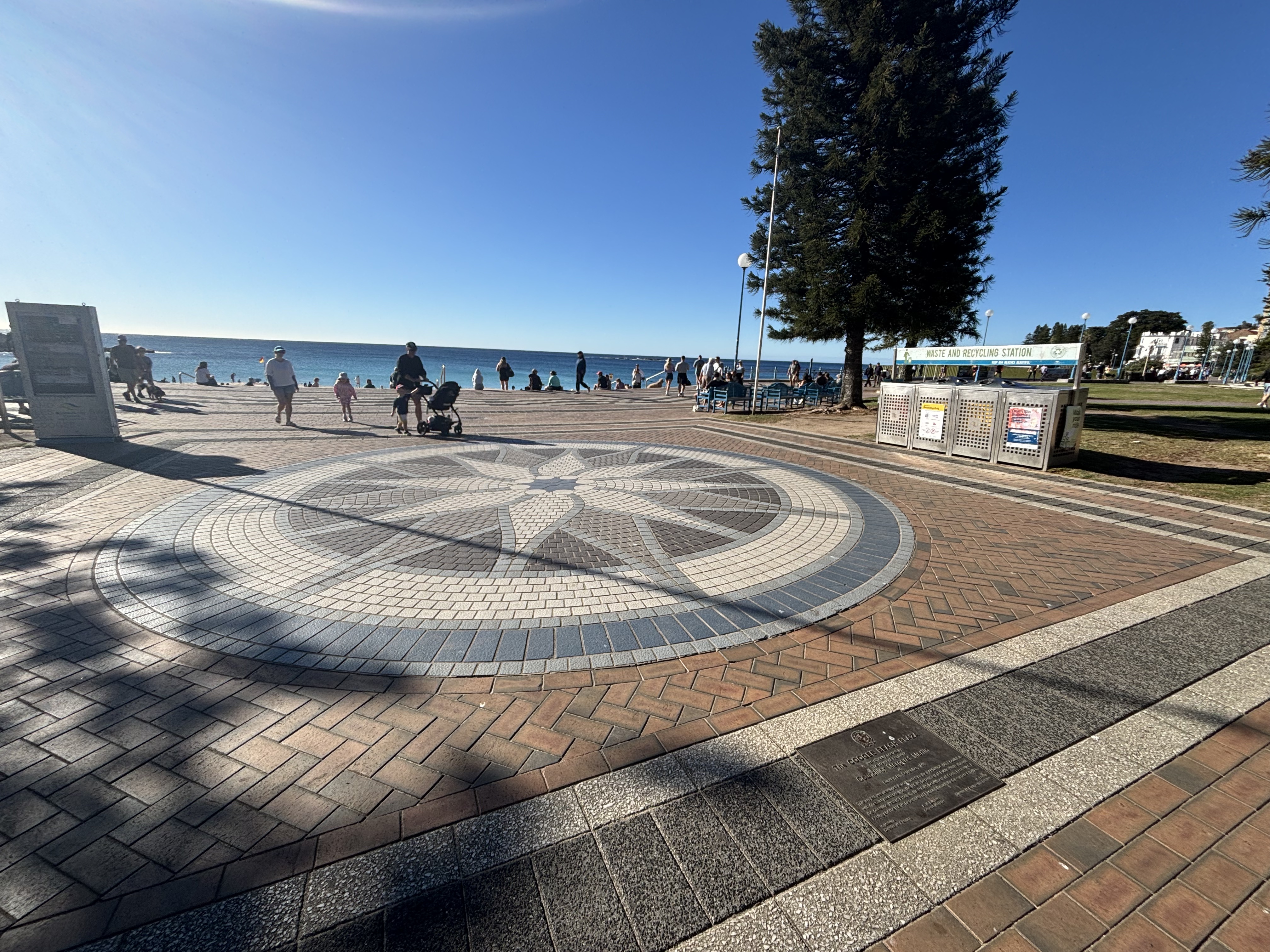
A large flannel flower is set into the paving at the heart of Coogee Beach — officially recognised as public art, yet easy to walk across without a second glance. It sits at the centre of a precinct transformed in the 1990s by a monumental redesign: a four-year project that closed a major road, removed brutalist structures from the beach, and created an entirely new public space connecting sea, reserve and town. This post explores what landscape architect Bruce Mackenzie may have intended by placing the flannel flower at its heart — and why the question remains beautifully open. (8 min read)
Have you noticed the large flannel flower in the paving at Coogee Beach?
It is easy to walk over it without giving it much thought. There is no prominent sign beside it and no artist’s name set into the design. Yet Randwick City Council identifies the flannel flower motif as one of the public artworks in the Randwick area.
It is also much more than an isolated pattern in the pavement. The flower sits at the centre of the plaza at Coogee Beach, where the beach, green reserve, shops and main roads meet. It is part of the way the whole area was designed and experienced.
That raises an interesting question: was the flannel flower simply a decorative choice, or does it give us a clue to the thinking behind the major redesign of Coogee in the 1990s?
A major change to the public space
The redesign was a substantial project over 4 years. It changed the relationship between the beach and the surrounding streets and created a new, unified public area for walking, sitting, gathering and enjoying the view.
The work involved more than laying new paving. It was a huge undertaking involving:
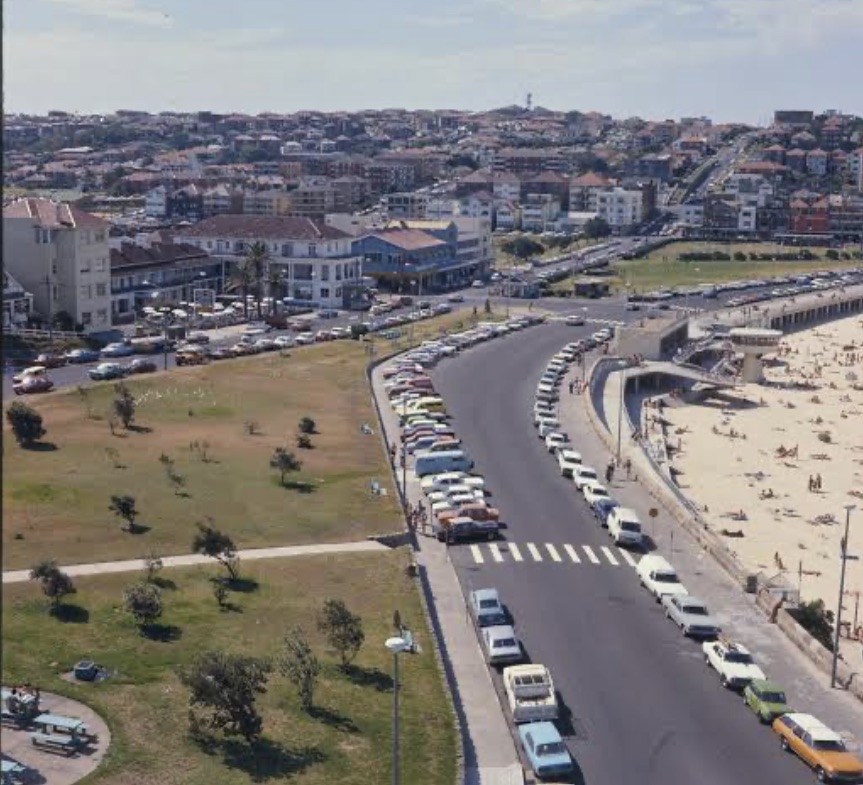
- removal of obtrusive structures from the beach (like a brutalist shark tower and space age walkways)
- closure of a major road (Beach Street) to create the wide promenade linking the reserves at either end of the beach
- installation of an amphitheatre in the centre of the promenade (now edged by the Coogee Rainbow) as the focus of the beachfront and an informal meeting place.
- the greening of Goldstein Reserve, and particularly the reinstatement of about 200 Norfolk Island pines lost from the eastern beaches due to detergents in the off-shore sewerage system.
The plan included decisions about buildings, facilities, traffic, parking, pedestrian movement, safety and the needs of the Surf Life Saving Club. The final result was necessarily a compromise between competing needs.
That point is important. When we look at the finished space today, it can seem as though it was always meant to look this way. In reality, a public place such as Coogee Beach is shaped by many decisions about what belongs there, what should be removed and how people should use the space.
Landscape architect Bruce Mackenzie was responsible for the redesign but his draft and final masterplan are not available online. However, Mackenzie devoted a substantial chapter to Coogee in his 2012 book, Design with Landscape.
Mackenzie’s book provides useful insight into the project and into the compromises involved in creating a public space. However, he does not mention the flannel flower motif. That omission leaves an intriguing gap. I have not found evidence that proves he intended the flannel flower to carry all the meanings that might now be attached to it. Even so, the motif seems too central to dismiss as an afterthought.
Designing with the Australian environment
Mackenzie’s writing shows that the Australian environment was important to his approach to landscape design. In Design with Landscape, he argues that Australia has a relatively short European history and has not always drawn on the strengths of long-established traditions and customs.
He also reflects on the compromises that occur when a masterplan is put into practice. A plan may begin with a strong idea, but the final result is shaped by practical demands, competing interests and the need to make the place work for the people who use it.
Those observations help us understand Coogee. The redesign was not simply about making the precinct look attractive. It was about creating a public place that responded to the beach, the coastline and the Australian setting, while also meeting the practical needs of a busy community space.
The flannel flower fits naturally into that way of thinking.
Why a flannel flower?
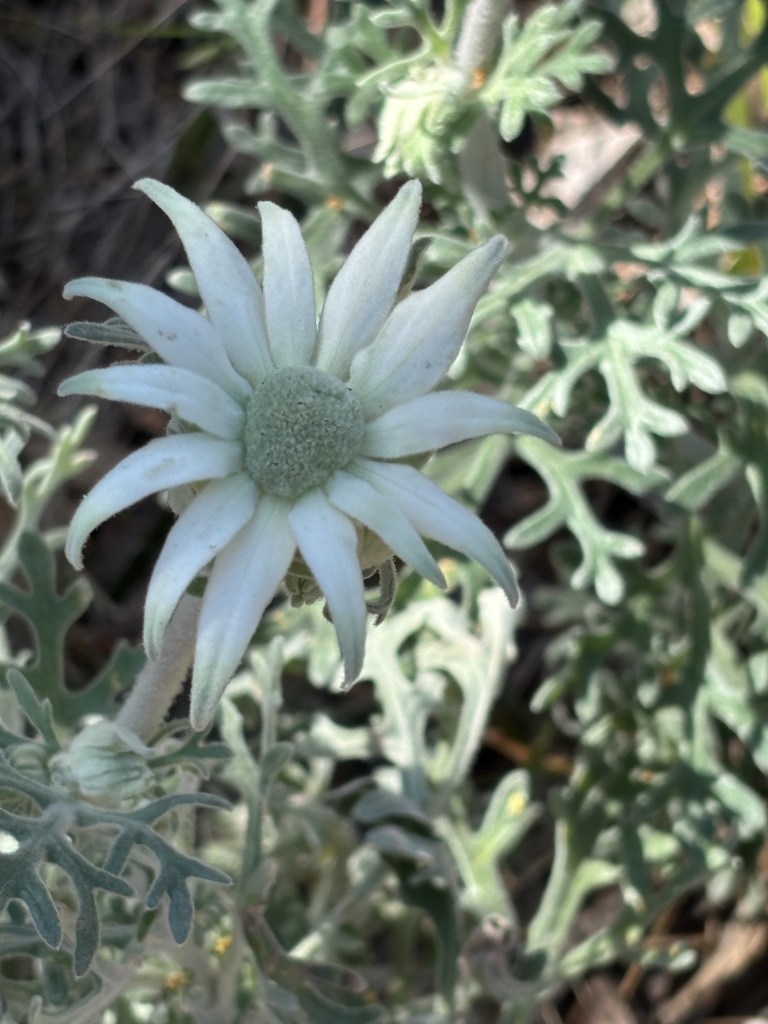
The flannel flower is a native Australian wildflower found in coastal heath, scrub and dry sclerophyll forest. Its pale flower and soft, felt-like appearance make it distinctive, but it is also part of the coastal environment surrounding places such as Coogee.
The motif at Coogee is large and visible when viewed from above. It is not hidden in a corner or attached to a wall. It occupies a central position in the paving, directly in the public space between the beach and the town.
That location matters. The work is not only something to look at; it is something people walk across, gather around and pass through. It is part of the experience of the precinct.
This is why I wonder whether the flannel flower was intended to connect the redesigned space with the natural environment. It may have been a way of bringing a local Australian plant into the heart of an urban setting and reminding people that Coogee is not just a collection of roads, shops and facilities. It is also a coastal landscape.
As I said, Mackenzie’s book does not mention the motif, and I have not found a document explaining what it was meant to represent but the design gives us a reasonable basis for asking the question.
A story of healing and renewal
The flannel flower also has cultural significance for some Aboriginal people.
The ABC has reported that the flower is known as Talaratingi and is linked to a significant Dharawal story. In that story, a young girl named Tiana travels to an important place and realises that people have not been caring for Country. The story carries important lessons about remembering laws and protocols, looking after Country and listening to the wisdom of young people.
The ABC account also describes dew from the flannel flower, collected before dawn, as a Dharawal treatment for severe grief. The story includes themes of healing and renewal. It explains the return of the flannel flowers and links their appearance to the name Talaratingi, meaning “star of frost”.
These cultural meanings should not be presented as proof of what Mackenzie intended. The Dharawal story belongs to its own cultural context but it does give the flower another layer of meaning. Ideas of healing, renewal, responsibility and care for Country resonate with the broader question of what a public space should do. A successful public place is not only functional. It can also help people feel connected to their surroundings and to the history of the place where they are standing.
Public art hiding in plain sight
The flannel flower is a good example of public art that does not announce itself.
Many people expect public art to be a sculpture, mural or installation with a title and an artist’s name. The Coogee motif is different. It is built into the paving and has become part of the ordinary landscape. People can enjoy it without necessarily realising that it is a recognised artwork.
Its lack of a prominent signature may be one reason why its story is not well known. There is little readily available information about the work or its relationship to the redesign of the precinct. Even Mackenzie’s detailed account of the Coogee project does not mention it.
That makes the artwork particularly interesting. It is officially recognised as public art, but its intention is uncertain. We know what it looks like and where it is located. We know that it forms part of a major redesign. We know that the project involved practical compromises and that Mackenzie placed importance on responding to the Australian environment.
What we do not know is whether the flannel flower was deliberately chosen to express those ideas.
An unanswered question
The safest conclusion is not that the flannel flower definitely underpinned Mackenzie’s redesign of Coogee. The evidence does not go that far.
However, Mackenzie must have had reasons for centring the flannel flower.
Perhaps it was chosen because it is a beautiful Australian plant. Perhaps it was intended to represent the coast and its natural environment. Perhaps it was part of a broader idea about connecting people with the landscape.
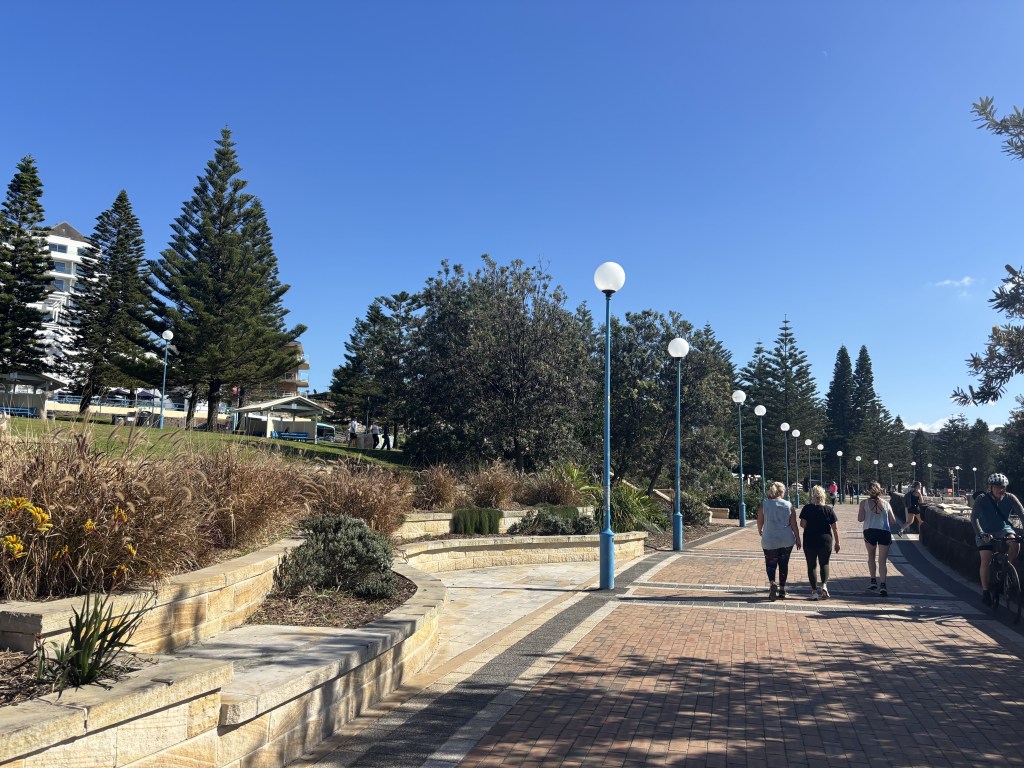
But I assert that Mackenzie knew that the seeds of the flannel flower can survive for decades in a dormant state and then suddenly awaken for reasons that are not predictable. And that he likely also knew the significance of the flannel flower to the Dharawal people. If I am correct, the work expresses his optimism for the evolution of Australian landscape design and a more naturalistic approach to Coogee in future and we can already observe the beginning of this with the sandstone terraces (2014-15) and indigenous plant garden at the northern end of the reserve. It seems to me that the time of flannel flower consciousness may have arrived as it was named Australia’s most amazing wildflower for National Science Week 2026.
Whatever the original intention, the work now forms part of Coogee’s identity but it is a reminder that the spaces we use every day have histories that are not always visible.
The next time you visit Coogee, look down as well as out to sea. The flannel flower in the paving may be telling us more about the place than we realise.
And if the flannel flower is of interest, I often see it on the walking track to Henry’s Head in the Kamay Botany Bay National Park, about 20 minutes drive from Coogee.
You might also like:
→ Why Coogee is the best place to swim in Sydney
→ Where the Coogee coastline is coming back to life
© Paul McCarthy & Iluminar.au

