Why Coogee is the best place to swim in Sydney
Coastal swimming is in the DNA of Sydneysiders. We are tribal about our beaches and fiercely loyal to our pools. But with so many choices across the harbour and the eastern seaboard, one place stands above the rest — close to the city, rich with history, and unmatched in the sheer variety of ways to get into the water. This is the case for Coogee. (13 min read)
Ask a Sydneysider where they swim and you will learn something about them. Some want beaches where they will be seen, others want to feel like they escaped, some want the best exercise and others want to believe they have discovered something. Coogee people know they have it all.
Coastal swimming is not a leisure activity for Sydneysiders — it is a ritual. We are tribal about our beaches, loyal to our pools, and mildly contemptuous of people who use them incorrectly.
The argument about which beach is best is as old as European settlement here and will never be resolved to everyone’s satisfaction. But I am going to make it anyway.
Without doubt, Coogee is the best place to swim in Sydney. Not because its beach is the largest or the most famous, but because no other location in Sydney offers so many swimming options, so much history layered into the act of swimming, and so much that rewards the curious visitor who takes the time to understand what they are looking at.
The beach: safer than it looks, and why
The 400-metre patrolled sandy beach at Coogee is the obvious starting point — wide, gently shelved, and generally calmer than a beach of its exposure should be. The reason is Wedding Cake Island lying about 900 metres offshore. The island refracts incoming swells, redistributing their energy and keeping average wave heights below a metre. No bar forms at the shore except after major storms. It is, in short, a naturally sheltered swimming beach in one of the most beautiful settings Sydney has to offer.
What the beach cannot protect against is the rip and undertow. Ocean pools were invented, in part, precisely for this reason: their walls exclude sharks, and the sheltered water removes the hazards that still account for many of Australia’s surf rescues and coastal drownings.
Coogee has more ocean pools than any other beach in Sydney — and each one is a piece of history as well as a place to swim.
A history of who was allowed in the water
Before the pools, there was the open ocean and bathing regulations that governed exactly how, when and in what costume one was permitted to swim.
Daylight bathing in public was banned in New South Wales until 1902, when Randwick Council became the first in the state to legalise it. The anxiety that preceded and followed this decision — about sharks, public decency, and the social order — shaped the pools that Coogee has today. As few people then wore bathing costumes, safeguarding the respectability of sea-bathers involved the provision of gender-segregated pools screened from public view. By the 1880s, Coogee had a women’s pool on one side and a men’s pool on the other.
When daylight bathing was finally legalised, demand for ocean pools did not diminish — the sheltered water was safer, and many swimmers preferred it. Coogee’s historic pools constitute an argument for the idea that swimming is not simply exercise, but history, community, and sometimes grace.
McIver’s Baths — the Women’s Pool
There is no other pool quite like McIver’s anywhere in Australia. It is the last remaining women-only ocean pool in the country.
That phrase — last remaining — carries weight. It is the end of a long tradition of gender-segregated bathing since the 1870s. What began as a restriction enforced by colonial respectability has become something else entirely: a sanctuary for women who swim there and cherish it.
The baths were dedicated to the exclusive use of women and children in 1876 and the pool itself was constructed in 1886. It is substantially cut from the rock shelf and sits on a sandstone platform between the Pacific and a soaring cliff, entered via a steep, winding path down from Grant Reserve south of Coogee Beach. Entry today costs $2.50.
The first two women to ever win an Olympic gold and silver swimming medal, Fanny Durack and Mina Wylie, were both Sydneysiders who swam at McIver’s not long before they were denied official funding to compete at the 1912 Olympics. Undeterred by this setback, they self-funded their travels to Stockholm, where they were victorious. Rose McIver was another great local swimmer, and her family ran the Ladies Baths until the Randwick and Coogee Ladies Amateur Swim Club took over the lease in 1922.
The pool’s gender segregation has been contested by men at various times. In the 1940s, the Mother Superior of Randwick’s Brigidine Convent led a successful opposition to calls to enforce mixed bathing. Fifty years later, local resident Leon Wolk took a complaint to the NSW Anti-Discrimination Board, alleging that the pool’s exclusion of men was discriminatory. The board refused his complaint, citing the history of the pool, the high regard in which it is held by various female communities, and the fact that three other nearby rock pools offered mixed bathing. To counter similar future complaints, the NSW Government granted McIver’s an exemption from the state’s Anti-Discrimination Act. Rogue men still occasionally attempt to gatecrash the pool, but Council rangers are on call to ensure they leave.
The definitive account of what McIver’s means to the women who swim there is Lynne Spender’s The Women’s Pool — which offers a collection of voices from the pool’s community to capture its atmosphere, history, and solidarity.
I am not permitted to visit McIver’s. But I am glad it exists, and I am glad there are women prepared to defend it.
Wylie’s Baths
Wylie’s was established in 1907 by Henry Alexander Wylie — a champion long-distance and underwater swimmer, a local resident and celebrated figure in Coogee. His daughter Wilhelmina (better known as Mina) learned to swim here; she and her friend Fanny Durack went on to become the world’s first female swimmers to win silver and gold medals at the Olympic Games in Stockholm in 1912. In 1911, Wylie’s was the site of the first Australian Swimming Championships. Annette Kellerman also trained here. A bronze statue of Mina Wylie in a neck-to-knee bathing suit welcomes visitors to the baths today.
The pool, which is located south of Coogee at Grant Reserve, was carved below the high-tide line, so it is flushed twice daily by the sea. A hundred timber stilts elevate the east-facing heritage-listed deck overseeing the pool. The view to Wedding Cake Island and the Pacific from that deck is, by common agreement, one of the finest in the world.
Wylie’s is the favourite pool of most people who have swum seriously in Sydney. Chris Baker devotes some of his most lyrical pages in Swimming Sydney to it — his 52nd swim of the year there, the Christmas tree enshrined in the middle of the water each December, the resident octopus and other stunning marine life, the wake of a dear friend whose ashes were scattered close by, and his conviction that there is no better view in the world. I share his general admiration for Wylie’s but my own favourite is elsewhere.
Ross Jones Memorial Pool — my pool
As I wrote in My life in Coogee, the morning is mine at the Ross Jones Pool. As I dive into the water at the southern end of Coogee Beach and float on my back, I am at one with the ocean. I emerge from the pool with sparkling eyes and a deep sense of peace and renewal.
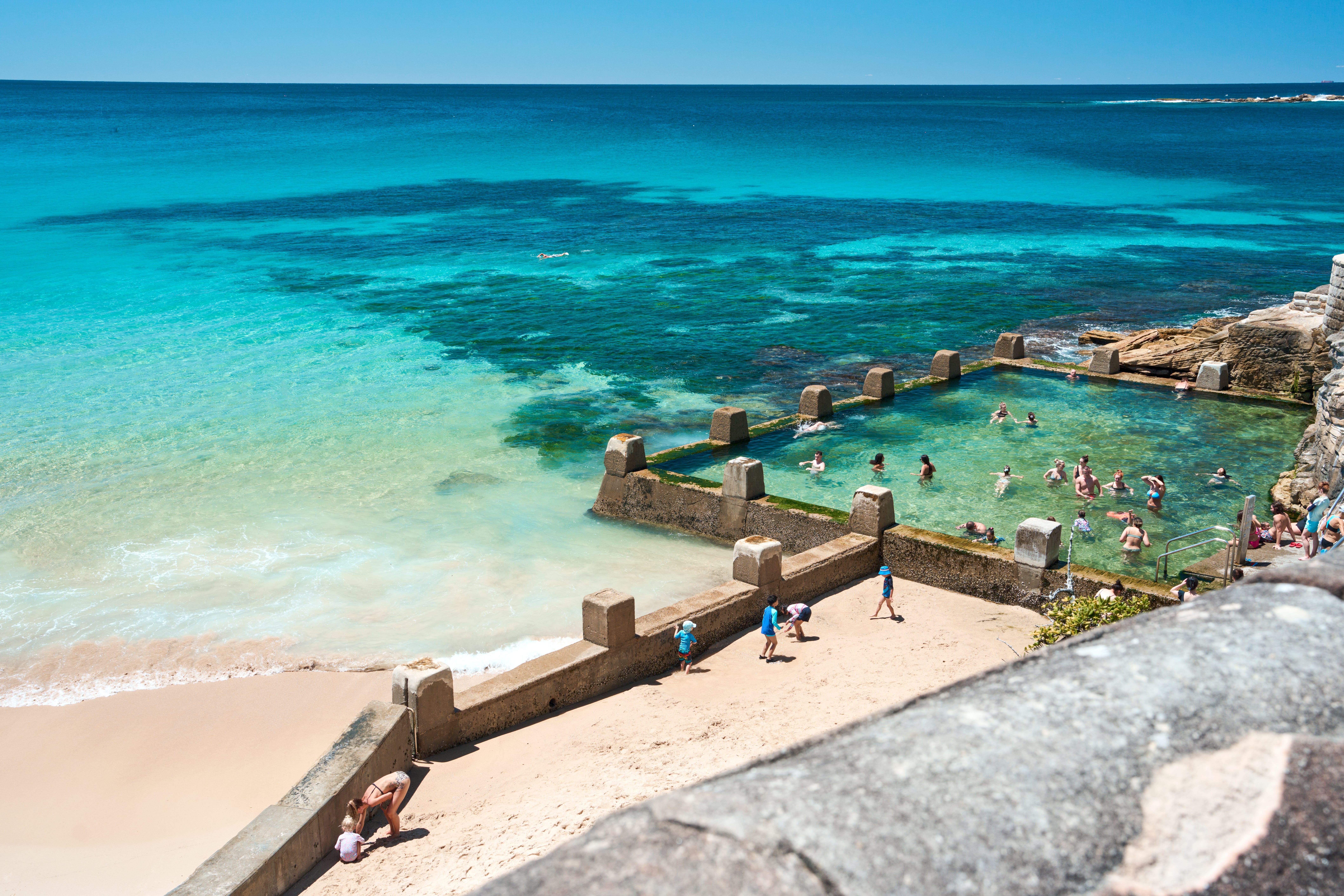
The Ross Jones Pool has a unique design (see header photo): the top of the walls resemble the crenellations of a sandcastle. It is a short pool (less than 20 metres), about chest height and filled by the action of tides and waves. It is nice for doing laps in the mornings and is home to the Coogee Penguins, the winter swimming club, whose members are committed swimmers and great to watch on Sundays.
Ross Jones is not Sydney’s most famous pool but its story is one of the most quietly moving in Coogee’s history.
As Des Walsh relays, Coogee Beach was barricaded with barbed wire and tank traps and there were observation and machine gun points on the headlands following the outbreak of war with Japan in 1942. When the war ended, Federal funds were available to clear the beaches.
Lou Bedford, a veteran of both World Wars and a Military Medal holder who was then a Surf Club Trustee, persuaded elected officials that the Club could assist with the clearance work and the funds saved could be applied to building a pool. The club cleared the obstructions and the pool was built.
During the pool’s construction, Ross Jones died. He had been President of the Club during the Depression and successfully steered it through serious financial challenges. He had also been an Alderman, a solicitor and involved in many voluntary and sporting associations. The Council dedicated the pool to him in 1947.
Giles Baths
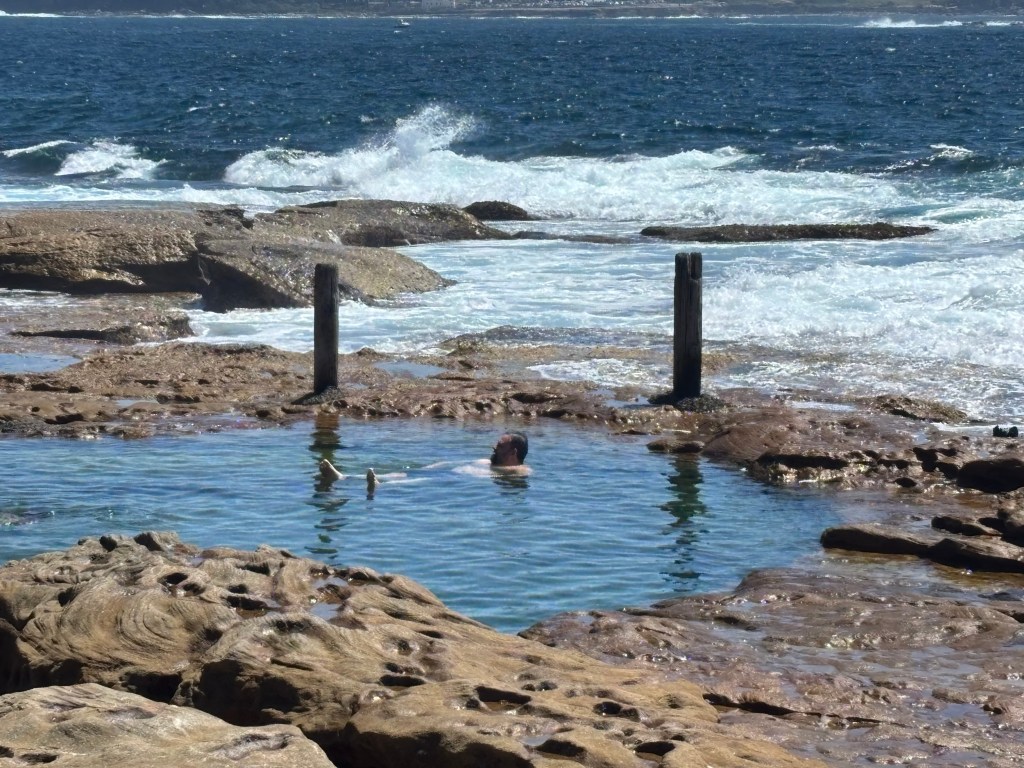
Giles is the largest of three ocean rock pools in the Sydney region. It is mostly natural rock and one of the most layered places in Coogee.
Men’s bathing began at what was then called “the Bogey Hole” in the late 19th century. By 1929, a grand arched Art Deco building opened on the headland above the ocean pool built by Mr O.E. Giles. The baths offered a pool fed by salt water, hot sea baths, hydrotherapy, massage, electricity treatments and sunbathing.
Violent storms in the 1970s significantly damaged the building precipitating its closure. A lone Art Deco archway is all that remains, and it now stands as a memorial to 20 local residents killed in the 2002 Bali bombings.
Chris Baker, in Swimming Sydney, describes a January visit to Giles that captures its particular character. He arrives on a day when the “Ekman transport” effect — a process by which wind moves surface water and draws significantly colder water up from ocean depths — has dropped temperatures overnight and rolled a mist onto the beach like a fog. His companion Sally dives bravely from the rock platform without hesitation and surfaces smiling, gasping “That’s fresh!” Baker writes of the cold water renewing them in a way that feels miraculous — cold water triggering an endorphin that diminishes the body’s shock to pain.
I only swim at Giles, which is located at the northern end of Coogee Beach, when the tide is low. It can be slippery when the tide is high and is best avoided in the mornings. But be sure to take your goggles because the sea life here is beautiful.
Ivo Rowe Pool, South Coogee
The Ivo Rowe Rockpool is one of the smallest ocean pools along the Coastal Walkway south of Coogee to Maroubra. It is a natural, shallow rock pool and perfect for wading or cooling down on a hot day. Be careful as the rocks in and around the pool may be slippery. The best access to the rock pool is via Bunya Parade in South Coogee. It is an easy two kilometre walk from Coogee Beach.
The pool is named after a local who helped maintain it.
Coogee Diggers Pool
For days when the Pacific is doing something impressive or inadvisable, Coogee has an indoor option. The Coogee Diggers Pool at Byron Street offers a 25-metre heated indoor pool open every day of the year from 5:30am on weekdays. A membership is required to use the pool and gym (a weekly trial is available) and this supports Australian veterans.
“Australia’s most beautiful seaside resort”
Coogee was a seaside attraction from as early as the 1820s but visiting became much easier with the completion of a tram line in 1883. The Coogee Palace Aquarium and Swimming Baths opened in 1887 and were described as ‘a most exquisite addition to Sydney’s places of entertainment’. The large dome of this building was (and remains) the most distinctive building on Coogee Beach.
No account of swimming at Coogee is complete without mentioning something that is no longer there. In 1924, construction began on an English-style amusement pier extending over 180 metres into Coogee Bay. It opened in 1928 to a great crowd promising a 1400-seat theatre, a 600-capacity ballroom, a 400-seat restaurant, shops and a penny arcade. It survived a cyclone during construction but it did not survive Coogee’s surf, which soon took its toll. Diminishing crowds during the depression and mounting damage saw it demolished in 1934. A shark-proof enclosure attached to the pier opened in 1929 introducing the era of night surfing; it too was demolished during World War II.
The pier was an aspiration towards a Victorian British seaside resort that never suited the place. Australians wanted to be in the water and on the sand, not promenading and looking from a folly.
Why it matters
Coogee’s water places, and also its reserves, have a plethora of stories which are interesting of themselves but also speak to our broader national story. We can use our beaches to illustrate and reflect on issues such as national identity, wars and defence, sport and athleticism, class and gender, societal rules, community service, water safety, pollution, tourism, environment and heritage conservation, green space, public art and even pets.
Caroline Ford, in her essential history Sydney Beaches, puts it precisely:
“Each of Sydney’s beaches is physically, socially and culturally distinct; the extent of adjoining parkland and car parks, the proximity of houses and even the accessibility for beachgoers were mapped out by historical decisions that weighed possible private interests and expense against public demand. Each beach has its own culture, partly determined by historical factors and local demographics that have evolved over more than a century.”
Coogee fits that description better than any other beach I know.
Ford concludes her book by observing that floating in the gentle swell at the northern end of the beach, you are the beneficiary of close to two centuries of surging forces between political, commercial, private and public interests. Yet in the battle for the beaches it was Sydney’s beachgoers who fought for, and won, the right to free beaches. Their determined actions would have an enduring legacy on a city and nation’s relationship with its coast. They are at the heart of our beach history — and at the heart of what makes Coogee, of all Sydney’s beaches, the best place to swim.
Please reach out if you would like guidance on Coogee’s bathing options or to understand Australian history through the lens of the beach. These are the kinds of things we can discuss over breakfast.
You might also like:
→ The flannel flower at the heart of Coogee
© Paul McCarthy & Iluminar.au

