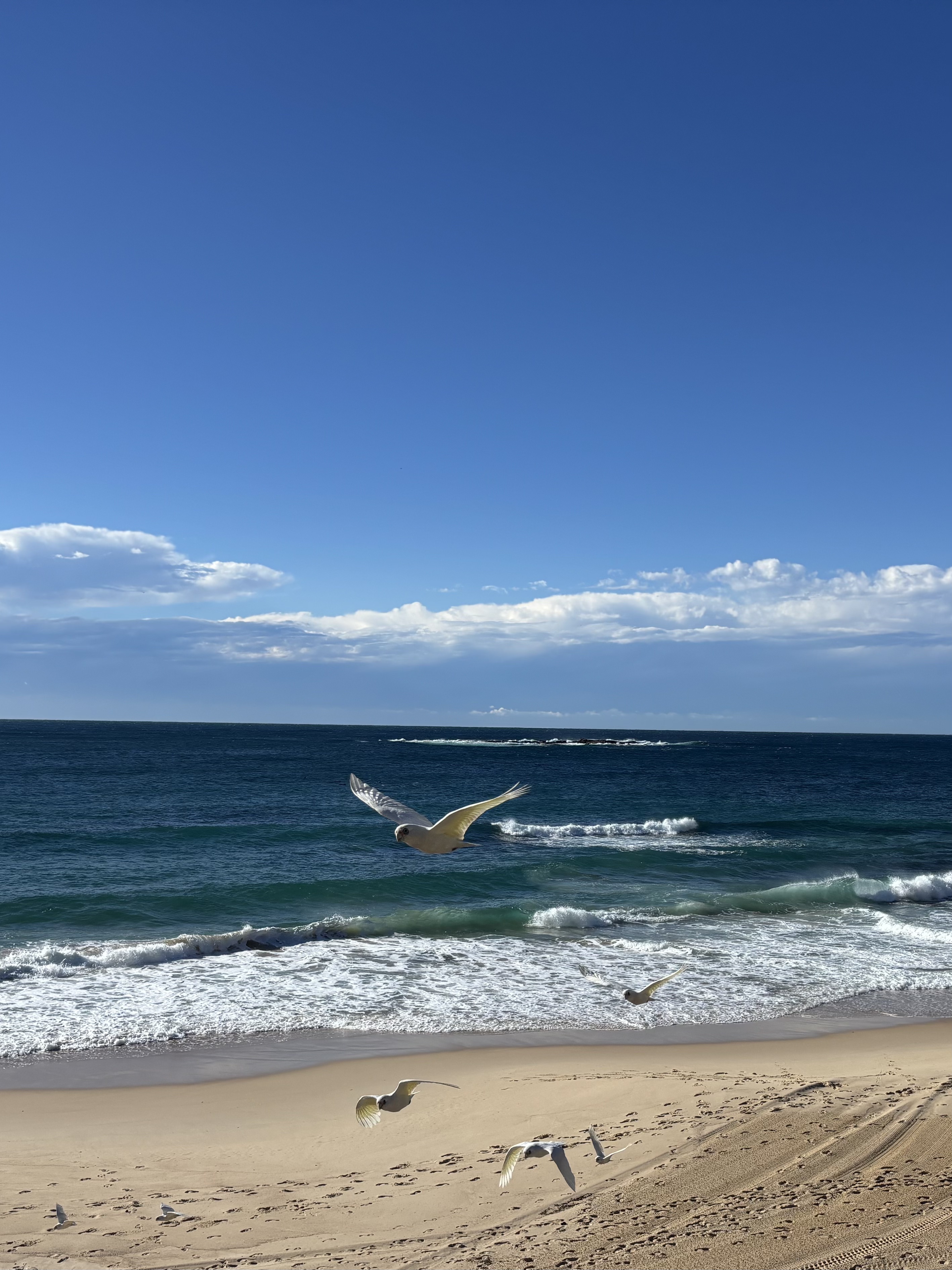
The case for renaming “Wedding Cake” Island
From royal icing and colonial nostalgia to a stranded pig and ocean swims, this essay traces how Coogee’s offshore landmark became “Wedding Cake Island” – and why that name no longer fits. Blending history, geology, and local lore, it argues for restoring the simpler, truer name: Coogee Island. (5 min read)
A Randwick Council sign in the Trennery Reserve says:
“Why is it called Wedding Cake Island? No-one really seems to know for sure – so use your imagination! Perhaps the white spray from breaking waves over its low shape is reminiscent of white icing on a wedding cake. Or perhaps hundreds of seagulls frosted the cake with their whitened droppings over the edge of the rocks!”
The invitation from the Randwick Council to reflect on the name of the island was irresistible and has inspired this post.
The village of Coogee was established in July 1838. Less than 2 years later, Queen Victoria married Prince Albert in London.
Victoria’s wedding cake was a single-layered “plum” cake – a fruit cake in the English tradition. It was 35cm high and 3m wide and weighed about 136kg. The cake was ornamented by large sculptures of Britannia, the royal pair in Roman costume, flags, one of Victoria’s dogs and 2 turtle doves. But it was the white icing (subsequently known as “Royal Icing”) that made it remarkable.
Royal icing is a hard white icing made from egg whites and powdered sugar laid on top of marzipan to stop it discolouring. According to my research, the pristine white icing of Victoria’s wedding cake was considered a technical marvel because, previously, icing was a greyish, translucent glaze or a boiled sugar topping.
Victoria’s wedding cake, made by Messers Gunter of Berkeley Square, was exhibited to over 20,000 people before it was sent to the palace. One academic, Emily Allen, argues the cake caused a media frenzy and was a successful device to build loyalty to the crown.
It took several months for the Australian press to report on Victoria’s wedding and those initial stories did not mention the cake. However, within a generation it had done its job. The first iced wedding cake in Australia was made in 1858 to mark Victoria’s daughter’s wedding and that set a trend for elaborate iced cakes at Australian weddings and instilled a new mental picture of a wedding cake.
It is not far-fetched to imagine an early settler making a joke about the island a kilometre off Coogee Beach looking like a wedding cake. And for it to stick. And we are still talking about it.
By the 1840s Coogee was a favoured resort of Cockneys who, at the time, comprised the majority of Sydney’s emigrant community. Despite the establishment of the Australian nation on 1 January 1901, political and cultural ties to Britain remained strong and the “British to the bootstraps” mentality fuelled an aspiration in the 1920s for a seaside village in the Victorian British tradition in Coogee, complete with absurd follies like the Coogee Pier and various other tourist attractions.
“Wedding Cake Island” was officially named by the State’s Geographical Names Board in 1977. The records indicate this name was assigned on the basis of “longstanding use” in the community and no information was recorded about the origin of the name. Shamefully, no one contemplated the name given to the Island by the Traditional Owners.
Wedding Cake Island is the natural focal point as one looks from Coogee Beach to the great blue ocean. Curiously, the Island seems to follow as you walk from Dolphin Point to Trennery Reserve. It is psychologically compelling too, perhaps because it can be easily seen but not touched so we don’t really “know” it. But some have gotten close to it.
Getting close to the island
Farm animals: In October 1922, a pig (let’s call her “Rebecca” rather than “Porky Crusoe”) was found stranded on the island by a local fisherman. How Rebecca got there, and what became of her is not known. In a newspaper article about this incident, the island is simply referred to as “Coogee Island”.
Swimmers: The Coogee Island Challenge is a popular ocean swim event held at Coogee Beach in April and November, featuring a 2.4km course around Wedding Cake Island. The swim is competitive rather than recreational and attracts hundreds of participants. Swimmers give the island a wide berth but are rewarded with stunning headland views and reef glimpses. The Spring 2025 winner completed the course in 29 minutes, 39 seconds.
Lifesavers: Wedding Cake Island has played an important role in the folklore and history of the Coogee Surf Club. A small group “picnic” on the Island on ANZAC Day is well known and most insightful about the challenges of landing on the island when the tide and swell are high and avoiding the sharp barnacles and sea urchins on the rocks, as well as the eels.
Experts: In 2008, the Coogee Surf Club obtained an expert report on Wedding Cake Island for its Centenary Book which affirmed the popular view that the island is responsible for the relatively safe swimming conditions on Coogee Beach. It is worth quoting in full:
“The Island or reef rises 22 metres from the Continental Shelf and lies slightly south east of Coogee Beach at a latitude of 33° 55′ 42″ S, longitude 151° 16′ 00″ E.
Wedding Cake Island (or as it was called for many years Ginger Cake Island) actually comprises two islands (one a particularly small protrusion).
It is a sandstone rocky outcrop hardened by intrusions from sub-volcanic eruptions millions of years ago and inundated during the retreat of the last great Ice Age.
It is approximately 100 metres in length running north east to south west and 60 metres wide, with an area of 6000 square metres, some 900 metres to the south east of the centre of Coogee Beach. The island is in fact the top or remnant of the rocky ridge that runs down the southern side of Coogee Beach.
It was inundated at the time of the melting of the last great Ice Age, when sea levels rose 120m between 18,000 and 6,500 years ago. The rise in sea levels also flooded the river valley to the north of Coogee which in turn became Sydney Harbour. The steep coastal terrain that extends a few kilometres seaward off the Sydney coast was all flooded and today forms a rocky sea bed, with some high points, visible as reefs such as Wedding Cake Island.
The Island’s impact on Coogee Beach through the aeons of time has been to refract the waves turning them from travelling in a north-easterly direction, that is following the south easterly wind pattern, to east south east. The refraction redistributed the wave energy, substantially lowering the waves in lee of the island and along Coogee Beach. Because the waves average less than 1m they maintain a steep reflective beach, with no bar, typical of all such low energy beaches. The absence of a bar means that the beach drops off into relatively deep water, typical of all reflective beaches. The term reflective refers to wave running up and ‘reflecting’ back seaward off the steep beach face. Only following high seas when the beach is planed down will a small bar form adjacent to the beach”.
Musicians: One of the tracks I include in my post for the Bondi to Coogee walk is an iconic instrumental piece from 1980 called “Wedding Cake Island” by Midnight Oil. The Oils lived in a house in Coogee and it has been contended that lyrics were written for the song – referencing property developers – but were omitted because they could have created legal issues.
Visual artists: There is a long tradition of painting Coogee Beach. While the island is out of frame in the famous Australian Impressionist paintings, it is centred in many contemporary works aligning with our understanding of its importance, such as this exceptional painting by Robert Eadie in the library of the National Art School in Sydney.
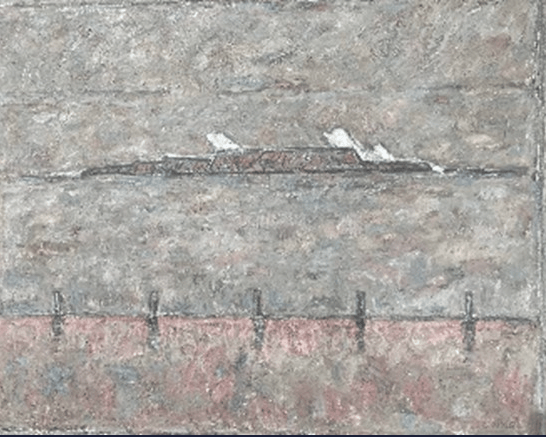
So, stitching the threads of this piece together, I think it is time to reinstate “Coogee Island” as the name of this important land mass. This would honour the traditional owners, banish the British and avoid what will inevitably be a meaningless culinary reference.
Any person or organisation, public or private, can request a change to the Geographical Names Board. I think the time has come.
You might also like:
→ Aussie Music for the Walk from Bondi to Coogee
→ Unexpected cultural depths: Art history at Sydney’s eastern beaches
© Paul McCarthy & Iluminar.au

