From ‘souvenir’ to ‘fine art’ – Indigenous women triumph
At La Perouse, finely wrought “souvenirs” of shells reveal a powerful story of Aboriginal women’s artistry, resilience and sea-country knowledge. Tracing shellwork from mission-era trinket to museum-collected fine art, this essay honours the women whose bridges and slippers quietly remake Sydney’s history. (7 min read)
In my favourite book about La Perouse, “Botany Bay – Where histories meet”, Maria Nugent explains that when Cook’s Landing Place reserve was established in Kurnell in 1899 visitors generally got there by boat from La Perouse, Botany or Sans Souci. The extension of the tram line to La Perouse in 1902 and the introduction of excursion steamers in 1906 and a ferry in the 1920s, made La Perouse the most popular departure point.
Nugent reports that business savvy members of the La Perouse Aboriginal community earned income by making and selling their art to the tourists, particularly boomerangs and shell work. Community exploited the prominence of Botany Bay on Sydney’s tourist itinerary but it was also an “attraction” in its own right.
The shellworks and boomerangs were initially encouraged and promoted through missionary networks and sold beyond La Perouse – on the streets of Sydney, at Circular Quay, Paddy’s Markets – and exhibited at the Royal Easter Show.
Nugent says that during the first half of the 20th century, souvenirs became one of the main sources of income for local Aboriginal people and proved vital to their survival. The trade contributed to Aboriginal families’ ability to resist repeated pressure to leave La Perouse.
In her field guide to La Perouse, Aunty Maxine Ryan says that shellwork drew on deep cultural relationships with the coastal environment. Aboriginal women collected shells from local beaches and transformed them into intricately decorated objects.
The shellwork techniques were passed down from mother to daughter, often working together at home. The designs and patterns created using different types of shells and layouts are inherited and continued, with individual family styles recognised and understood. Nugent reports that the cardboard and fabric required were [initially] collected as scraps and off-cuts from local factories and hosts.
The La Perouse Museum says that the shellwork is uniquely associated with Aboriginal women of La Perouse and that it grew from a long tradition of skilled fisherwomen crafting shells into fishing hooks.
Shellwork artists and sisters Mavis Longbottom and Lola Ryan also shared cultural knowledge running shellwork workshops in Sydney schools and correctional centres.
Aunty Maxine Ryan believes that across the generations, shellwork has embodied both resilience and continuity, supporting families while affirming cultural identity and deep connection to sea country.
Aboriginal artist Jonathan Jones, working at the Art Gallery of NSW in 2014, noted: “While shell art wasn’t considered ‘traditional’ cultural practice, this continuation of traditional knowledge of country enabled artists to maintain the skills at harvesting particular shells at specific beaches and bays during different seasons and environmental events.”
Aboriginal women began by making and selling shell baskets in the 1880s and then made tourist offerings (boxes, baby booties, animals, Sydney landmarks such as the Opera House, La Perouse Mission Church, Centrepoint Tower and the Sydney Harbour Bridge). Nugent asserts: “The process of Victorian-era curios to a Sydney souvenir was complete when a shell Sydney Harbour Bridge hit the stalls”.
No one knows how many Sydney Harbour Bridges have been made by the women of La Perouse and it is important to say that this work is continuing.
There are shellwork Sydney Harbour Bridges in the collections of the La Perouse Museum, the Art Gallery of NSW, the National Gallery of Australia, the Australian National Maritime Museum, the Australian Museum, the Powerhouse Museum, the Museum of Contemporary Art.
It appears that the first public institution to collect the La Perouse shellwork was the Powerhouse Museum. In 1986 it acquired 4 Sydney Harbour Bridges made by Mavis Longbottom and Lola Delia Ryan.
The most well-known maker of shellwork, including of the Sydney Harbour Bridge, is the late Aunty Esme Timbery. The Timbery family have been famed for their shellwork since Timbery’s great-grandmother, “Queen” Emma Timbery, produced shellwork objects for an exhibition of Australian manufactures in England in 1910.
Aunty Esme became the inaugural winner of the Parliament of New South Wales Indigenous Art Prize in 2005, with two shelled bridges. For a story about shellwork and the Sydney Harbour Bridge, the Australian Museum interviewed Esme and her daughter Marilyn Russell (who is also a shellwork artist) in 2015 and showcased the healing nature of the work.
According to Jonathan Jones, “…Timbery and others re-craft the country’s history. The subjects and objects embraced by the La Perouse artists speak to the region’s cultural realities and connection to country: the Sydney Harbour Bridge represents Aboriginal peoples’ ability to transcend boundaries, and its shelled manifestation provides a richer, alternative understanding of the Sydney landscape.”
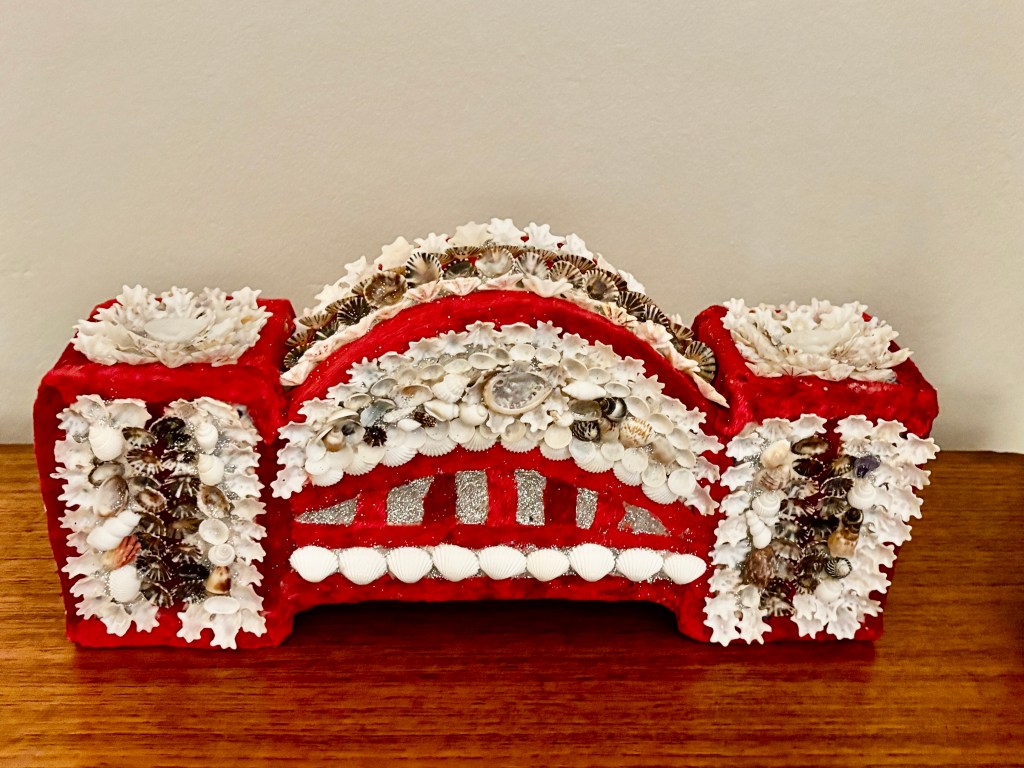
One of the first pieces of Aboriginal art I purchased was a Sydney Harbour Bridge shellwork sculpture from La Perouse artists (photograph below). Ignorant of the tradition of “souvenir” making at the time, art historians laughed. I interpreted the bridge as a political commentary on resilience and the triumph of tradition over modernity. I thought it intentionally kitsch, but was impressed by the artistry and how much work was involved in finding the shells. My piece has 367 shells (there should be 368 but I broke and lost one) arranged in perfect symmetry. There are at least 5 different kinds of shells and I am ashamed to say that I cannot name them all. I am even more ashamed that I don’t know the artist’s name. I was told it was Aunty Esme but there is no obvious mark which confirms this.
It has long bothered me that, apart from the Powerhouse Museum (whose charter includes “applied arts”), our major cultural institutions were slow to recognise the importance of this work and many did not collect it until Aunty Esme won the Indigenous Art Prize in 2005. Racism, sexism or a lack of awareness or courage???
“Not a souvenir”, a retrospective on the work of contemporary Aboriginal artist Tony Albert, is currently showing at the Museum of Contemporary Art in Sydney. This may well be the best exhibition I have seen this decade. Albert’s work deals with the commodification and misrepresentation of Aboriginal peoples, particularly through mass-produced caricatures on souvenirs. I may write a separate post on this issue but the key point I want to make is what is considered excellence in art making is always evolving.
Robert Hughes famously said that Aboriginal art was the last great movement of the 20th century. He said this about painting from the Western Desert. He was shamefully late in recognising Indigenous art (it gets no mention in “The Art of Australia” or “The Shock of the New”) and one wonders if he would acknowledge brilliant contemporary artists like Albert.
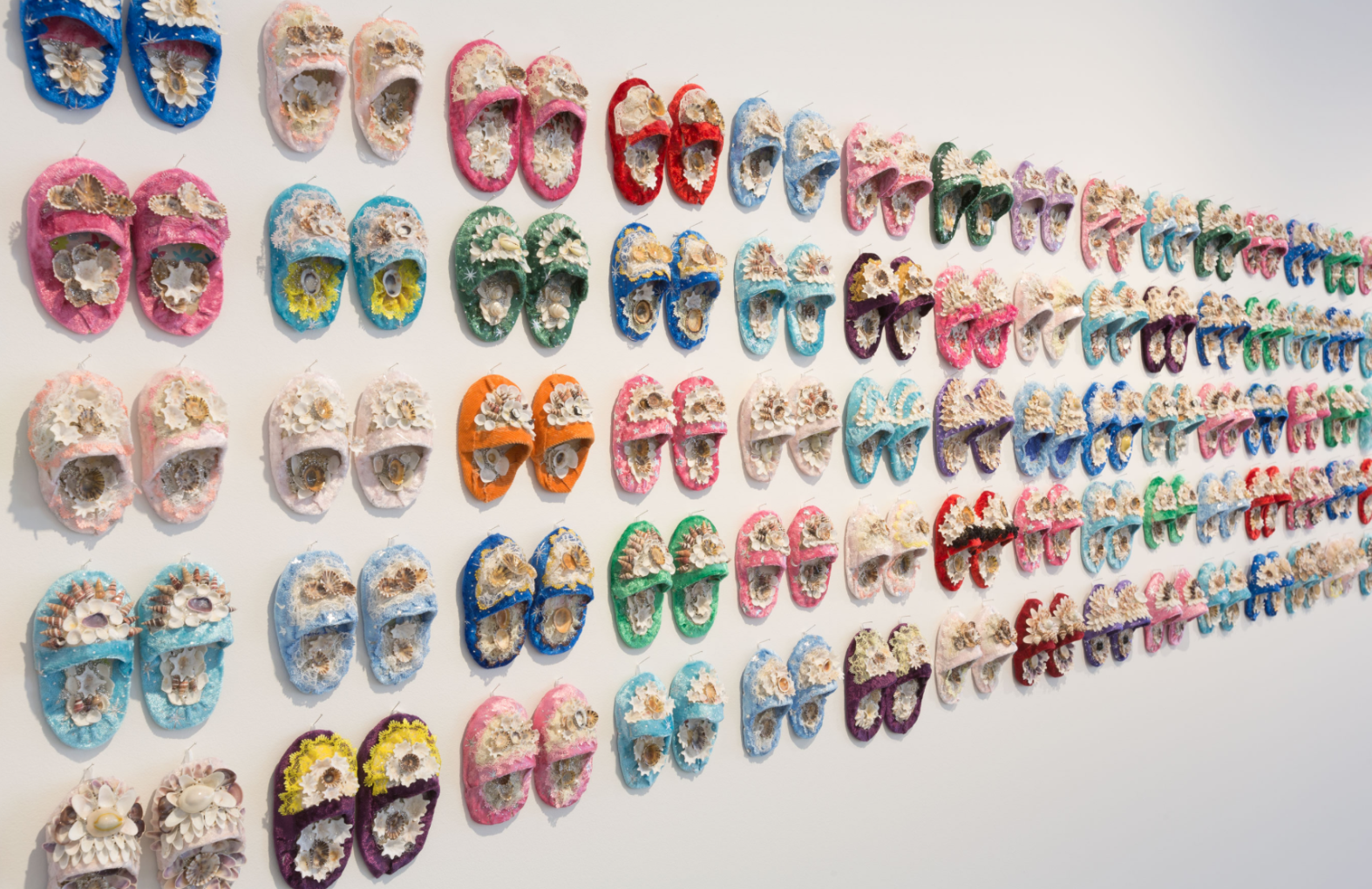
While I was at the MCA for the Tony Albert exhibition, I revisited a work by Aunty Esme called “Shellwork slippers” (the image at the top of this article). That work was made in 2008 following the Australian Government’s apology to the Stolen Generation.
Aunty Esme’s work is beautiful, powerful and technically excellent but, in my view, it also affirms the inherently (and in this case overtly) political nature of shellwork by the women of La Perouse.
This is how the MCA labels the exhibit:
“a memorial to the Stolen Generations − Aboriginal children who were forcibly removed from their families and communities by church and state in the 19th and 20th centuries. The mass of children’s shoes is a poignant reminder of the grief and dispossession experienced by First Nations peoples as a result of colonisation”.
“The slippers are a reminder of the trauma of dispossession and disempowerment but they are also an affirmation of a community that has survived; of its strength, and of the warmth of the family and the community as a whole.”
When you visit La Perouse be sure to check out the “Souvenir” exhibit at the La Perouse Museum which includes some beautiful examples of shellwork and boomerangs made by local Aboriginal people. And reach out if you would like to discuss how to get your own harbour bridge.
Namaste.
You might also like:
→ Why you must visit La Perouse
→ Sea Country and the fight for Indigenous sea rights
© Paul McCarthy & Iluminar.au

