Some Ignatian holy sites in Barcelona
While Loyola, Pamplona, Montserrat and Manresa are the most well known Spanish places in the formation of Ignatius of Loyola, I have come to see that it is just as important not to neglect Barcelona. The city holds its own cluster of Ignatian stories and holy sites that still seem to shimmer beneath the modern streets, quietly connecting us to Ignatius across the centuries. (7 min read)
Ignatius of Loyola
Ignatius of Loyola (1491–1556) was born into a noble Basque family in north‑eastern Spain. As a young man he served as a page in the court of King Ferdinand and then as a soldier to the Duke of Navarre. In 1521, he fought valiantly but was seriously injured in a battle in Pamplona.
During his long recovery at the family castle he was given little to read other than stories of the lives of the saints, and in that enforced stillness he also received extraordinary mystical graces. Gradually, something in him turned toward God and he chose a holy life, symbolised for me by his surrender of his sword to the Virgin Mary at the Monastery of Our Lady of Montserrat (near Barcelona), and his subsequent months of begging, penance, prayer, fasting and, ultimately, ecstatic insight in the neighbouring town of Manresa.
Travelling via Barcelona in 1523, Ignatius set out as a pilgrim to the Holy Land. On his return he followed a challenging path of study in preparation for the priesthood while sharing “The Spiritual Exercises” with others. His new way of guiding souls was provocative; he was imprisoned several times for lengthy periods and appeared before civil courts and the Inquisition at least sixteen times, though never found guilty of heresy.
While studying at the University of Paris he led several fellow students through the Exercises and conversions soon followed. In 1534 they formed “The Company of Jesus” (the Jesuits).
Ignatius was ordained in 1538, and in 1541 he was elected Superior General of the new order. From Rome he quietly governed, prayed and dreamed, and the Jesuits grew from a small company of ten to more than a thousand priests on four continents by the time of his death in 1556. He was canonised in 1622 after almost 1,600 people testified to healings and miracles through his intercession.
Barcelona
In all of this, Barcelona is not merely a footnote. Ignatius passed through the port and then lived in the city from 1524 to late 1526, and when I wander its streets I try to imagine the young pilgrim‑student threading his way through its alleys and churches.
During those years in Barcelona, Ignatius humbled himself in ways that continue to move me. In order to enter the priesthood he had first to learn Latin, so he placed himself under the guidance of the teacher Jeroni Ardèvol and attended classes with boys aged eight to fourteen for about two years. The work was difficult for him, and the humiliation must have been sharp, but he persisted, allowing his desire for God to outweigh his pride.
Ignatius’ home base in the city seems to have been the house of a widow, Inés (or Agnès) Pascual. Most scholars now place her home in or near today’s Carrer dels Cotoners, not far from the bustle of the Ribera quarter. From this modest lodging come reports—preserved in early sources—of remarkable mystical phenomena: at prayer Ignatius was sometimes enveloped in an intense white light, and on at least one occasion he was said to have levitated. These accounts need to be held with caution, yet they have accompanied his story for centuries and speak to the way those around him perceived the depth of his prayer.
There is another story associated with Barcelona that I find revealing of how Ignatius’ holiness has been remembered. Alfred J. Herbert, in his book Raised from the Dead: True Stories of 400 Resurrection Miracles (1986, Tan Books), recounts a case from around 1524 in which Ignatius is said to have raised a man called Lessani (or Lesano) from the dead near the street of Belloc.
More firmly grounded in the sources is Ignatius’ presence at the great Gothic Basilica of Santa Maria del Mar. There he begged alms and sought spiritual guidance for himself, even as he also began to guide others. Standing in that vast stone nave today, it is not hard to picture a thin Basque pilgrim at the doors, his hand outstretched not only for bread but for whatever God might be offering him in that season of his life.
Barcelona also became one of the first places where Ignatius’ apostolic work took recognisable shape. He listened to people, counselled them about spiritual matters and, as far as we can tell, began to direct the Spiritual Exercises informally among those who were drawn to deeper prayer. His zeal, however, did not always reassure the authorities, and there are references in the early documents to interrogations and possible legal proceedings connected with his activities in Spain, including Barcelona. As with the reports of levitation and white light, it is difficult to reconstruct precise details at this distance, but these fragments hint at the combination of suspicion and fascination that his radical way of life inspired.
When I walk through Barcelona now, I carry with me a mental map of Ignatian places I have seen and others I still hope to find on some future visit: the areas around Carrer dels Cotoners where Inés Pascual once welcomed him, and the sites linked—sometimes firmly, sometimes more tenuously—to his early apostolic experiments and the questions they raised among church and civic officials.
In 2025 I revisited Montserrat and Barcelona with a particular focus on St Ignatius. I happened to be in the Abbey praying for the first Jesuit pope, Francis, at the moment of his passing, which made the pilgrimage feel especially poignant. On each visit to Our Lady of Montserrat I look out for the sword that Ignatius laid down to mark his transition to a holy life on 25 March 1522, but it is only in recent years that I have come to understand that the one in Montserrat is a replica.
Two holy sites in Barcelona I visited in 2025
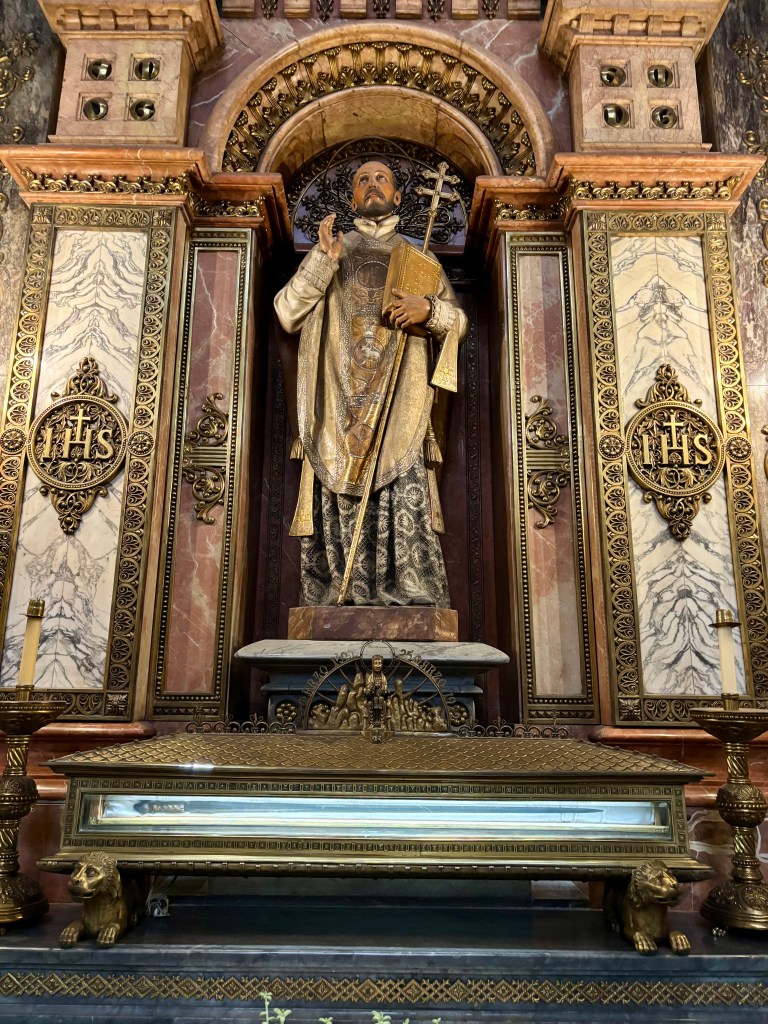
On this year’s trip to Barcelona I finally found the original sword on the altar of St Ignatius in the Jesuit Sacred Heart Church (Iglesia del Sagrado Corazón) on Casp Street (Carrer Casp) in the Eixample.
There is a pamphlet available from the church explaining the sword’s provenance and how it came to be at the Sacred Heart Church. The most interesting statement is this:
“Ignatius was never a soldier. Prior to his conversion, as a nobleman and gentleman of the Duke of Navarre, he had an enemy, Francisco de Oya, who wanted to kill him, probably because of personal resentment due to love conquest. After two petitions to King Charles the first, in 1519 Ignatius was granted the weapon license to defend himself. The sword is therefore defensive, long enough to keep the enemy away. Ignatius, even after leaving behind this lifestyle, was never willing to hide these dark episodes.”
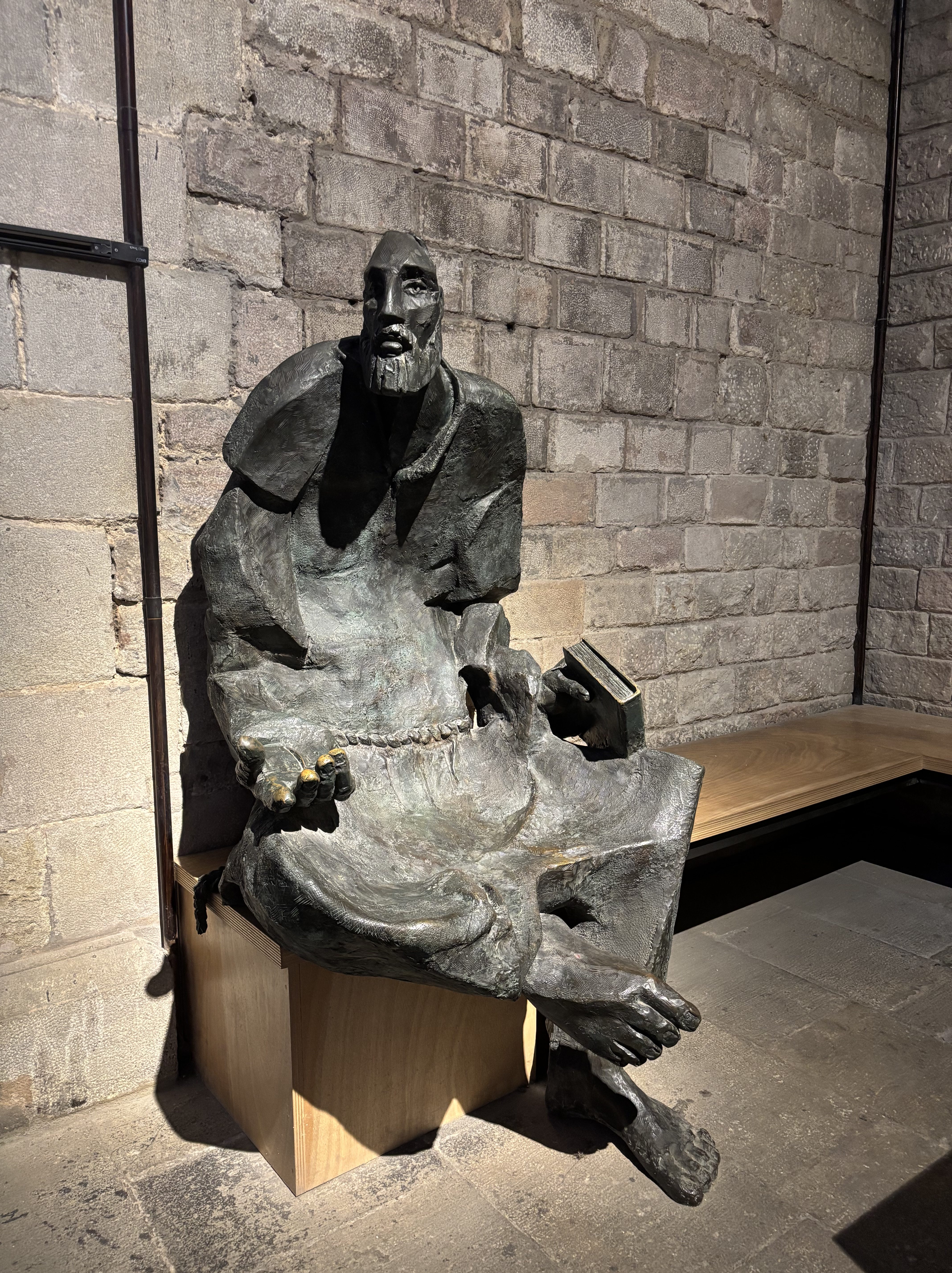
It was a relief of sorts to stand in the presence of Ignatius’ actual sword, to see the steel he once carried and then laid down, but I did not feel a strong energetic connection with that particular place. In contrast, I was drawn again and again to the chapel in the Basilica of Santa Maria del Mar that depicts Ignatius begging, tucked within the stones of the Ribera.
I was deeply moved by a beautiful statue of Ignatius begging by Estanislau Feliu Maspons (2017) in the church, and to discover that the statue also marks the first Jubilee year of the Camino Ignacio.
It was St Ignatius who first inspired and supported me on pilgrimage, and it felt deeply satisfying to seek out some of the places in Barcelona that still honour him, while leaving others on my map for a future return. If you sense a nudge toward sacred travel yourself, and would like to explore your own aspirations, I would be glad to be in conversation with you.
You might also like:
→ What is a sacred travel consult?
© Paul McCarthy & Iluminar.au

