The bells of St Brigid’s Coogee
St Brigid’s bell tower has long defined Coogee’s skyline, yet its bells remain strangely silent—and perhaps even absent. Tracing parish history, sacred symbolism, and the lost art of bell ringing, this piece wonders what it would mean for Coogee to be held again in a daily circle of resonant, healing sound. (9 min read)
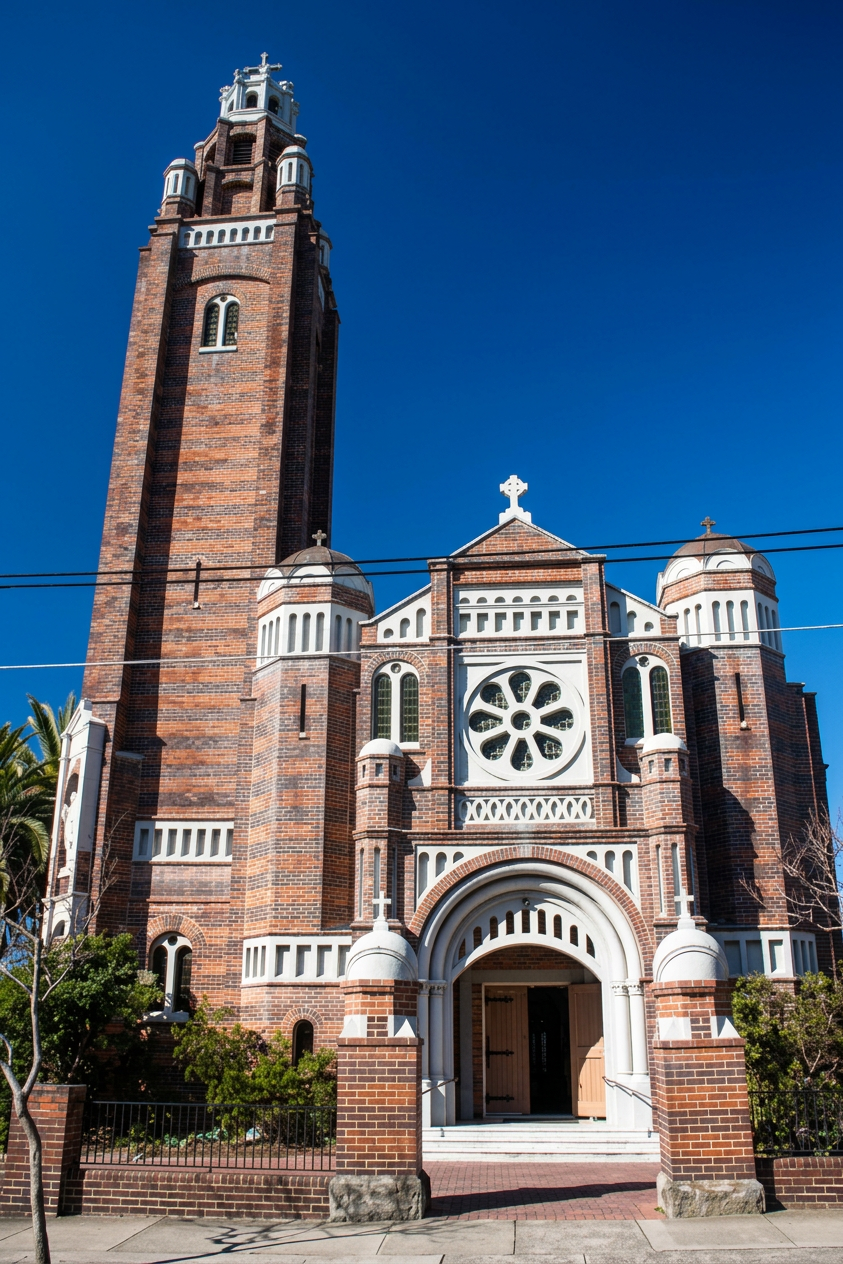
The most striking structure on the Coogee skyline is the bell tower of St Brigid’s Church, on the corner of Brook and Waltham Streets. The tower was an important marker for pilots flying into Sydney, as well as symbol of faith. But is it another white elephant?
I have lived in the shadow of this tower for almost 20 years and prayed in this church many times but I have never heard the bells ring. The silence of the bells is echoed in the history of this issue. Given the prominence of the bell tower, the dearth of publicly available information about the bells is remarkable.
Before I tell you what I found out, let me share a little context.
St Brigid’s Church officially opened in 1922, about a decade after the establishment of Coogee as a separate parish. The first Parish Priest was Fr Edward McGrath MSC who would later become Eileen O’Connor’s spiritual director and collaborator in Our Lady’s Nurses for the Poor.
Prior to the establishment of the parish there were about 100 Catholic families in Coogee, growing to 1500 in 1919. This growth was the main driver for the building of St Brigid’s Church.
The church was named in honour of the Brigidine nuns of Randwick (who later administered the parish’s primary school), as well as St Brigid of Kildare (Ireland). The charism of St Brigid centres on radical hospitality (welcoming all travellers, the destitute and the hungry without judgement or reservation), compassion for the poor and oppressed and co-leadership. As a 5th century abbess, her spiritual gift embodied deep connection to the earth, a passion for peace-making, and a unique model of shared authority between women and men in the early Irish church.
The architect for St Brigid’s Church was Albert Edmund Bates (also responsible for St Brigid’s Convent in Red Hill, Brisbane in 1903; St Augustine’s Church in Balmain, Sydney in 1907; extension of the North Sydney Council Chambers in 1926; and Somerset House at 44 Martin Place, Sydney in 1938) and it was the biggest project in the career of the builder, Albert Travis. The foundation stone was laid in March 1921 (two months after the passing of Eileen O’Connor) and the church was completed 10 months later.
St Brigid’s Church has been on the register of the National Trust of Australia since 1987 with the register citing its bell tower, altar and “Byzantine” (Romanesque) style. The polychromatic brick work (light and dark bands) is considered unique in Sydney.
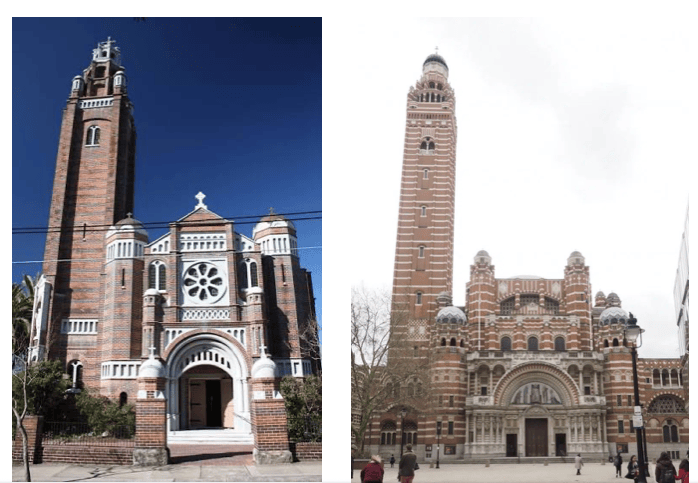
At the direction of the parish priest (Fr James Gilbert MSC), the church design was inspired by Westminster Cathedral, London but on a much smaller scale. St Brigid’s measures about 24 metres across, whereas Westminster Cathedral is 47 metres. The tower of Westminster Cathedral is 87 metres high, while St Brigid’s is about 30 metres. There is only one bell in Westminster Cathedral (called “St Edward’s Bell”) and we will get to St Brigid’s bells soon.
In 1995 a local newspaper reported that the future of St Brigid’s was in doubt because of the cost of the extensive repairs it required. An architect found “The tower is in poor condition, especially the upper portion, which is unsafe. General mortar erosion on the church’s exterior means there is a possibility of falling bricks…”. More than twenty years later, it was reported that in 2016-17, St Brigid’s underwent significant restorations and renovations, including work to the tower. Neither of these reports referred to the bell(s) themselves.
In writing this post, I asked St Brigid’s for information about if/when the bells were installed and various details, including their names. The parish secretary said they are still looking for the records and do not know the answers to my questions. However, an electrician recently entered the tower to work on lighting and did not see any bells. What we do not know is if he went into the upper sections of the tower.
It seems absurd to have a church whose defining feature is a bell tower but no bell. And equally absurd to have bells but be unaware of them or their history. I must get to the bottom of this.
Pope Innocent III (1198-1216) is credited with regulating the use of church bells in the Catholic liturgy. The blessing of a major church bell (historically called the “baptism of bells”) is a solemn sacramental rite traditionally reserved for a bishop. The requirements for the ceremony include specific placement, ritual washings with holy water, and anointing with sacred oils, incense and psalms. A saint’s name is also assigned to each bell. There is an interesting video of the recent baptism of the bells of St Patrick’s Cathedral in Parramatta illustrating the ceremony.
For completeness, we should acknowledge the broader functions of church bells in medieval times, including timekeeping, warning of approaching danger, curfews, fires or enemy invasions, and announcement of community events and major milestones such as births, weddings, and funerals. It was also believed that church bells were hostile to lower, dense astral entities and that a heavy tolling bell could disperse demonic tempests, hail, and lightning.
The esoteric and occult traditions view church bells as powerful energetic resonators that bridge the physical and spiritual realms. In esoteric symbolism, the bell’s hollow dome represents the vault of heaven or the feminine receptive principle, while the striking clapper signifies the active, masculine creative voice or phallus, producing a union that manifests divine consciousness into matter.
There is a most interesting story about a ledger from 1324 that details the precise timing requirements for bell ringing, including which bells should sound together and in what sequence. Found in Canterbury Cathedral in 1897, the ledger listed 17 daily ringing sessions that did not correspond to any known religious calendar. Interestingly, a Latin phrase (translated as “for the health of the people”) was repeated throughout the ledger and there is an annotation from 1550 indicating this pattern of ringing was discontinued in 1550 due to the reformation. The ledger is now lost but key pages were photographed in 1897, archived and then digitised and published in 2004. It has been argued that fragments of similarly precise bell ringing instructions were found across Europe indicating arcane awareness of the public health potential of the bell sounds. Interestingly, a consistent 90 minute repetition of the bells (which is consistent with monastic prayers) is now known to support well being.
Church bells are generally made of “bell bronze” which is a combination of tin and copper. The mixture enhances sound quality, resonance, hardness and durability, allowing it to withstand repeated striking without cracking. Bells are made across a wide range of sizes (and thus strike tones). A bell rings multiple frequencies at once at several different hertz values, with peak frequencies (and loudness) depending on the bell’s geometry and tuning.
In the 17th century, founders like the Hemony brothers worked with mathematicians to tune precise musical overtones, creating the first true carillons. In England, “change ringing” (the ringing multiple tuned bells in mathematical permutations) evolved into both a community art and a secular sport.
In researching this article I discovered there is an Australian and New Zealand Association of Bell Ringers which sets standards, offers training and facilitates collaboration in bell ringing between churches to create a harmonious soundscape. St Brigid’s is not a member because “it does not have a peal of change ringing bells and never has”. However, ANZAB suggested St Brigid’s may have (or have had) a single static bell or a carillon or even hemispherical bells. Who’d have thought there could be so many options.
I found a 2021 survey of bells and bell ringing practices of churches in NSW which asked questions about church bell types and frequency of ringing. The study concluded that bell ringing is still heavily practised in NSW but with denominational and locational differences. Surprisingly, bell ringing by Catholic churches has increased over the last generation but, unfortunately, the authors would not tell me the names of the churches that participated in the study so I do not know if St Brigid’s was involved.
The authors of the 2021 study argue for more investigation of the community and heritage value of church bell sounds in areas where bell ringing has declined. They argue that bell ringing could be considered a ‘public’ resource as any individual within the aural realm is affected by it, raising issues of auditory identity and ownership of these sounds: “Many contemporary questions still arise pertaining to bell control, religious freedom, ownership of public sounds and decision-making, which may involve bells that are either predominantly rung in a functional manner (denominationally directed) or rung as an expression of artistry, joy and for social reasons (change ringing)”.
I was then led down another rabbit hole about the removal of bells from the public realm following the French Revolution and during the World Wars. The public was told the metal in church bells was needed for the war effort. Yet, there is now evidence that it was bells with 432 hertz which were targeted for destruction. The cycle of bell ringing was lost or disrupted which adversely impacted on community health and wellbeing.
Why does all this matter? I want to hear church bells in my neighbourhood every day. And St Brigid’s has an inactive bell tower that could be used for this purpose. Given the re-emerging knowledge about the benefits of certain sounds, there is an opportunity for a different emanation of the church’s compassion and goodwill to be transmitted along with its prayers.
Local history is one of the things we can discuss over breakfast in Coogee. Also, reach out if you would like the references from my research for this blog.
Namaste.
You might also like:
→ The flannel flower at Coogee Beach
© Paul McCarthy & Iluminar.au

