Dharawal Resting Place: Bringing Aboriginal ancestors home to Country
Since 1970’s Aboriginal Australians have been pressing for the repatriation of the ancestral remains held in museums. Twelve years after the La Perouse Local Aboriginal Land Council sought the return of 32 sets of remains from the Australian Museum, these ancestors were finally buried in the Dharawal Resting Place in the Kamay Botany Bay National Park. While Australia has a long way to go to redress this abhorrent practice, experts have recently identified the important heritage values of the Dharawal Resting Place: connection, restitution, reflection and education and proposed important improvements. A visit to Dharawal Resting Place brings several layers of history together in one small coastal landscape and shows Aboriginal connection to Country as continuing and present. (10 min read)
At the edge of Sydney’s Kamay (Botany Bay), a short walking track leads to a place of profound Aboriginal significance: the Dharawal Resting Place.
Located within Kamay Botany Bay National Park at La Perouse, the Resting Place is not simply a cemetery or a walking destination. It is a living cultural landscape: a place of family connection, continuing Aboriginal identity, memory, education and restitution.
Formally created in 2005, it is one of the few recognised resting places for repatriated Aboriginal ancestral remains and exists within a broader historic cemetery and traditional burial landscape.
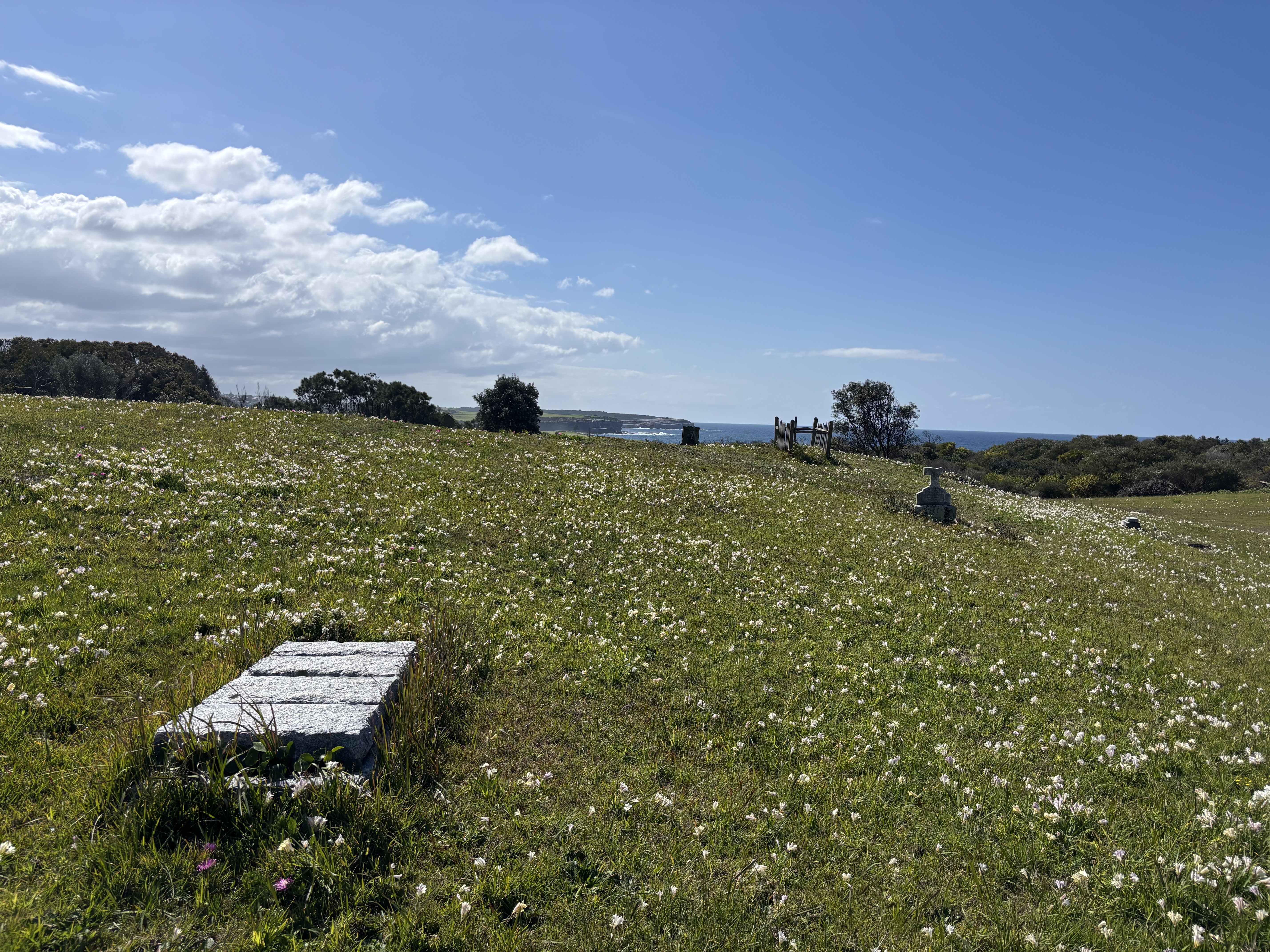
The Dharawal Resting Place covers about 18 hectares of coastal cliffs, sandstone, dunes and heath but is centred on the old Coast Hospital Cemetery, which is carpeted with freesias in the springtime filling the air with the odour of sanctity.
The Coast Hospital Cemetery was established in 1881 for patients who died of infectious diseases. A second cemetery section was added in 1897, and burials continued until 1952. Most of the thousands burials were non-Aboriginal hospital patients, but Aboriginal people from the La Perouse Mission and other communities were also buried there.
The Resting Place was chosen, in part, because it includes the areas in which Aboriginal people were known to have been buried historically, and where their remains have been disturbed and spread through the digging up of the old cemetery.
But there is also a much longer history of Aboriginal burials in the Dharawal Resting Place area, although the location and extent of those burials are not fully known.
It is a place where Aboriginal people can maintain relationships with ancestors who died locally, ancestors traditionally connected with the wider landscape, and ancestors who have been brought home through repatriation. Remembering them may involve visiting graves and memorials, telling family histories, caring for the place, participating in approved ceremonies, and ensuring that the site remains protected for future generations.
Heritage values of the Dharawal Resting Place
In July 2025, the NSW Government issued a Management Plan for Dharawal Resting Place developed by experts in collaboration with the La Perouse Aboriginal community. The plan has a lot of interesting information and identifies many important actions which need to be taken but I was most interested in the expert assessment of the heritage values of the site and its importance to community:
A place of connection: The Dharawal Resting Place is a place of connection to Country, family and ancestors. It contains the graves of Aboriginal people who died during the La Perouse Mission era, as well as the remains of people returned from museums. It may also contain older traditional burials beneath the dunes. The place is also connected to everyday cultural practice. Archaeological evidence includes stone artefacts, an open campsite and a small midden. The coast, dunes and freshwater environments were places for fishing, gathering, walking and teaching. This combination of burial places, archaeological evidence, coastal resources and continuing community use makes the site a cultural landscape rather than a single isolated heritage feature.
A place of restitution: The Resting Place represents the determination of Aboriginal people to correct the historical removal of their ancestors. Throughout the nineteenth and twentieth centuries, Aboriginal human remains were taken from graves and burial places, often without consent, and placed in museums and scientific collections. They were treated as research material or specimens rather than as people with living descendants and continuing cultural obligations. Repatriation reverses that process. It returns ancestors to Country and allows communities to care for them according to cultural responsibilities. The management plan records the principle clearly: ancestors should not be taken from the land and stored in boxes; they should be returned so they can again be part of the Country from which they came.
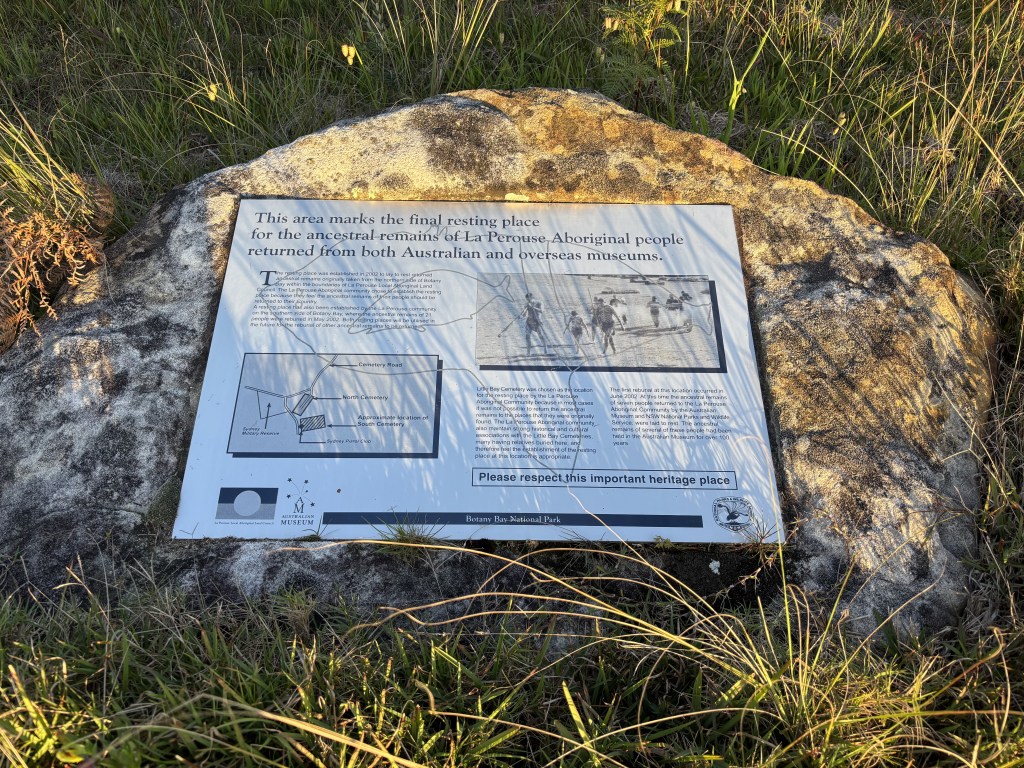
A place of reflection and education: The Dharawal Resting Place is also a place for reflection and learning. It can teach visitors about Aboriginal life before and after colonisation, the history of the La Perouse community, the treatment of Aboriginal people by government and scientific institutions, and the continuing authority of Aboriginal communities to care for ancestors and Country. This educational role is intentional. The visible plaque near the repatriation area was designed to acknowledge the returned ancestors and encourage public respect. Unlike many repatriation sites, which are kept private or located in remote areas, the Dharawal Resting Place has a publicly accessible interpretive presence.
Repatriation policy
It took decades of advocacy by Aboriginal and Torres Strait Islander communities before Australia took action to repatriate human remains from museums.
Indigenous communities began seeking the return of their ancestors in the 1970s and 1980s.
By the 1990s, the Commonwealth Government was providing funding and practical assistance for research, consultation, travel and the return of remains.
A national strategic plan was agreed by all governments in 1998 and the Return of Indigenous Cultural Property Program was established.
By 2009 Australia supported the United Nations Declaration on the Rights of Indigenous Peoples (Article 12 provided international recognition of the right to repatriation) and in August 2011, the Australian Government consolidated its domestic and international arrangements into the Indigenous Repatriation Program which is ongoing.
As a matter of policy, it is now established that repatriation sites provide a culturally appropriate final resting place on Country and they should ideally be located as close as possible to the location from which the ancestors were taken.
La Perouse community ancestral remains in the Australian Museum
In December 1990, the La Perouse Local Aboriginal Land Council asked the Australian Museum to repatriate ancestral remains from the area.
The Australian Museum identified 32 sets of remains, many of them donated by people who had come across them accidently while in the area, others from archaeological excavations, from the National Parks and Wildlife Service, and from exchanges with other museums.
A report on the scientific value of the remains was requested by the Australian Museum. Of the 32 sets of ancestral remains, it was recommended that 29 should be returned. The other three were identified as having significant scientific value, but after further negotiation, it was agreed that these too should be returned.
The Australian Museum negotiated with other institutions including National Museum of Australia and the Shellshear Museum at the University of Sydney, to identify further remains from the La Perouse area, resulting in five additional sets of remains being identified.
The original burial locations of many ancestors were not known. This is a common problem in repatriation work. Records may be incomplete, collecting histories may be vague, and remains may have been removed from Country long before modern communities were able to seek their return.
Repatriation was hindered by the difficulty of finding suitable reburial sites, with remains ultimately buried in Dharawal Resting Place (incorrectly described as Little Bay Cemetery in some documentation) and two locations on the south side of Kamay.
The repatriation area at Dharawal Resting Place was prepared by the New South Wales Parks and Wildlife Service and in June 2002 the first repatriation of 7 ancestors was undertaken. A further repatriation of 6 ancestors was undertaken in May 2005 and further ceremonies have occurred since. This means at least 13 ancestors have been returned to country in La Perouse.
Notably, a plaque installed on a sandstone boulder placed next to the repatriation area explains the repatriations and the significance of the broader cemetery. This was a significant move given the high cultural sensitivity of the location and was intended to foster respect and recognition among the broader public through education.
How does this compare with the national picture?
The La Perouse repatriations were part of a wider change in Australian museum practice that gathered momentum from the 1990s onwards. Aboriginal communities increasingly challenged the idea that museums, universities or governments should retain ancestral remains for scientific study. Repatriation became understood as a matter of cultural authority, dignity, spiritual responsibility and the restoration of relationships with Country.
National figures for repatriation vary according to source and action taken. In April 2025, reporting based on Australian government figures stated that 1,775 First Nations ancestors had been returned from overseas collections. Separate figures cited in 2024 reported that Australian museums had returned more than 2,700 Aboriginal and Torres Strait Islander ancestors over approximately 30 years.
The scale of the national task remains considerable. For example, the South Australian Museum has reported holding almost 5,000 ancestral remains. The museum describes these remains as being held temporarily until they can be returned to Country.
Against that national background, the La Perouse case is important for several reasons. It was among the early community-led repatriation processes in New South Wales; it involved cooperation between Aboriginal organisations, museums and government agencies; and it resulted in a permanent, publicly acknowledged reburial place. The Dharawal Resting Place demonstrates that repatriation is not complete when remains leave a museum. It also requires a suitable place on Country, community authority, ceremony, protection and long-term care.
Why visit the Dharawal Resting Place?
The site is worth visiting because it brings several layers of history together in one small coastal landscape. I’ve walked this track a dozen times and it rewards repeat visits as your understanding of the history deepens.
Visitors can see the Coast Hospital Cemetery and its weathered headstones, walk through coastal heath and dunes, look across the sandstone cliffs and ocean, and learn about the area’s Aboriginal and colonial histories. The landscape also contains traces of earlier land uses, including World War II fortifications and evidence of the substantial changes made to the dunes during military works and later development.
Most importantly, there is an opportunity to understand Aboriginal connection to Country as continuing and present—not simply as something belonging to the distant past. The place is cared for and visited by Aboriginal families, and the repatriation area remains part of an ongoing process of bringing ancestors home.
The walk can be combined with the nearby Cape Banks walking track, although visitors should treat the Dharawal Resting Place as a cultural and memorial site rather than merely as a scenic extension of a coastal walk.
Finding the area of remembrance
The Dharawal Resting Place occupies a large amount of land on the top of the La Perouse side of the Kamay Botany Bay National Park.
The resting place includes traditional burial places of Aboriginal ancestors, as well as the old Coast Hospital Cemetery.
Within the cemetery there is a discreet monument dedicated to the Aboriginal people whose remains were repatriated and buried there. The monument is located on the far eastern (coast) side of the cemetery on a rise about 150 metres from the entrance.
Unfortunately, the route to the Coast Hospital Cemetery and Dharawal Resting Place is not signposted. The easiest way to find it is via the Cemetery Track entrance from Cape Banks Road. The path is flat and takes only a few minutes.
The whole cemetery is significant
The old Coast Hospital Cemetery contains the graves of people who died locally, including Aboriginal people associated with the La Perouse Mission and surrounding communities. Historical and genealogical research has, so far, identified at least 62 Aboriginal people buried in the two Coast Hospital Cemetery sections, although the number is likely much more.
The cemetery principally served the people who died at the old Coast Hospital so it contains many non-Aboriginal burials. Its significance is layered rather than exclusive: it is a historic hospital cemetery, a place containing Aboriginal family graves, and part of a wider Aboriginal cultural landscape.
Many of the graves in this cemetery are not represented by an obvious headstone. Some graves are damaged, overgrown and difficult to distinguish. The whole area should be treated as culturally important and with utmost respect. Remain silent and reverent. It is illegal to dig or disturb the ground or touch, move or collect stones, artefacts, shells, bone or other material.
The Dharawal Resting Place carries the marks of disruption: graves with no visible headstones, dunes levelled for military works, uncertain cemetery boundaries, hikers, golfers and pistols within earshot.
But it is also a place of action and renewal. Aboriginal Elders and the La Perouse Local Aboriginal Land Council successfully sought recognition and protection for the area. Ancestors have been returned. Families continue to visit. Knowledge is being restored across generations. The place now gives the wider public an opportunity to learn—not by turning Aboriginal ancestors into objects of curiosity, but by recognising their personhood, their descendants and their continuing place on Country.
A visit is therefore best understood as an act of respectful attention. Walk gently, listen carefully, and leave the Dharawal Resting Place as you found it: protected, quiet and connected to the people whose ancestors rest there.
You might also like:
→ Why you must visit La Perouse
→ Discovering Indigenous Coogee
→ Sea Country and the fight for Indigenous sea rights
→ Why pay to have breakfast with Paul
© Paul McCarthy & Iluminar.au

