Iran: extraordinary beauty, culture, refinement and hospitality
Travel | Sacred Travel | Iran
23 September 2019
Six weeks ago I had one of the best holidays of my life — a guided tour of Iran visiting Shiraz, Persepolis, Esfahan and Tehran. Here is what I found: extraordinary beauty, warm people, sublime tile work, and not a single Persian cat. (10 min read)
Six weeks ago I had one of the best holidays of my life! It was a guided tour of Iran visiting Shiraz, Persepolis, Esfahan and Tehran.
Facebook is banned in Iran, along with other essentials like western credit cards and travel insurance. I had presumed the prohibitions had something to do with Muslim fundamentalism but, in fact, they are caused by sanctions imposed by the world’s largest “free market” — the United States of America.
The sanctions mean that companies like Facebook, Mastercard, Skyscanner, Telstra and Alliance Insurance cannot do their business in Iran. And we, dear travellers, are the lesser for it.
There have been US sanctions against Iran, off and on (mostly on), since 1979. They were briefly lifted in 2016 and then reimposed by Trump the Idiot (hereafter “the idiot”) in 2018. The sanctions are intended to cause maximum harm to the ordinary people of Iran (on the assumption citizens will rise up against the government) and to reinforce the geopolitics of the Middle East which, in turn, upholds the interests of Republicans in the US.
The trip was inspired by the idiot. For a year, the newspapers in Australia had been speculating about the likelihood of fresh conflict between Iran and USA. I felt I had to go before something very bad happened. As I had missed out on the ancient sites of Syria, there was no way I was going to miss out on Iran!
I had no concerns when I booked my flight and tour. But those pesky newspapers sure worked their magic on my loved ones. Well-travelled friends and colleagues gently told me to “be careful” in Iran. Others told me directly not to go at all. After repeated nightmares of my upcoming trip, my mother offered me an all-expenses-paid trip to Sweden instead. And the ever-risk-adverse DFAT told me to reconsider the need to travel and to stay away from the Iranian borders at all costs.
The cumulative impact of the fears of others started to weigh me down. So I sorted out my affairs — I re-wrote my will, paid all the bills, made donations, tidied the house and backed up my files at work. I also sorted out a local diplomatic contact for emergencies.
Whenever I met someone who’d been to Iran, I asked them about it. Some of my questions were shockers: “Can I wear a baseball cap or would I look like an American?”. “Is it ok to make eye contact with a woman who works in a store?”. “Will I get into trouble for bringing a rosary into the country”. The recurring response was “It’s not what you think”.
And then I started to interrogate my tour company about what to expect at the Iranian border.
I had decided to apply for a visa on arrival in Iran as I did not have enough time to apply for the visa from Australia. But I discovered late in the piece that if I had applied from home, I would have had to declare every country I had visited in the last 10 years.
For reasons that are still somewhat opaque to me, Israel and Iran are sworn enemies. And if there are any Israeli stamps on your passport you are not eligible to enter Iran. Even though I had no such stamps, I became concerned about what I would say if the border police asked me if I’d been to Israel. Of course, I would tell the truth, but blah blah.
So I started praying — a lot.
In retrospect, a visa on arrival is the best way to visit Iran because the tour company provides what is akin to a type of sponsorship. And getting a visa on arrival is not so hard. You first register to pay a fee and provide proof of your travel plans at one desk, provide proof you have travel insurance at another desk (only one European company defies the sanctions to offer this product) and then pay the fee at a third desk before getting your approval back at the first desk. The queue is twenty times quicker than LAX and you don’t even get your passport stamped.
I think I lost 10 kilos as soon as I was through immigration at Tehran airport. And my guide, who was waiting for me outside baggage claim, made it so easy. I changed a little bit of money, got a local SIM card and was ready to go. One of the best aspects of my tour was that everything was included — so I didn’t need much Iranian cash. Despite the good counsel of the Lonely Planet, one can freely use euro and US dollars in markets and hotels all over the country.
Tehran’s traffic is notorious but if one arrives on Friday the pollution is not so bad. I spent a lot of time in traffic and found it to be the most perfect metaphor for civic power. Iran, like Australia, has traffic laws. In Australia, we pretty much do what the laws require of us while simultaneously telling ourselves we live in free country. In Iran, it seems that very few people follow traffic rules. I don’t just mean they speed, I mean they drive the wrong way down one-way streets and ignore pedestrian crossings and red street lights. This stereotypically “oppressed” country is freer, in practice, than Australia if the roads are anything to go by.
And let’s deal with the sartorial oppression of women next. From mainstream media, to what’s on sale in Australia’s better bookstores, the predominant images of women in Iran range from a black veil to the chador (the full black sack). The reality could not be more different. While there is a black sack option worn by a minority, most of the women I saw had smart clothing with loose fitting, beautiful veils of various colours and with their hair showing. Their faces were beautifully made up, the faces lively and engaging and almost everyone was smiling. The contrast with conservative Qatar, where I had been a few days earlier, could not have been greater.
Iranian people have a reputation for being very hospitable and that was exactly my experience. My tour guide, Abbass, was soon like my brother from Iran. And he introduced me to his friends – men and women – who were so lovely, welcoming, curious and very polite. The workers in the markets and hotels were all friendly and professional and I was even welcomed in the mosques.
If there was a television program that brought ordinary Americans to Iran and created an opportunity for them to make friends with the locals, there would be an immediate de-escalation of tension between the countries for sure! There is no way any reasonable person would not like the Iranians, especially the ones that live in the smaller cities.
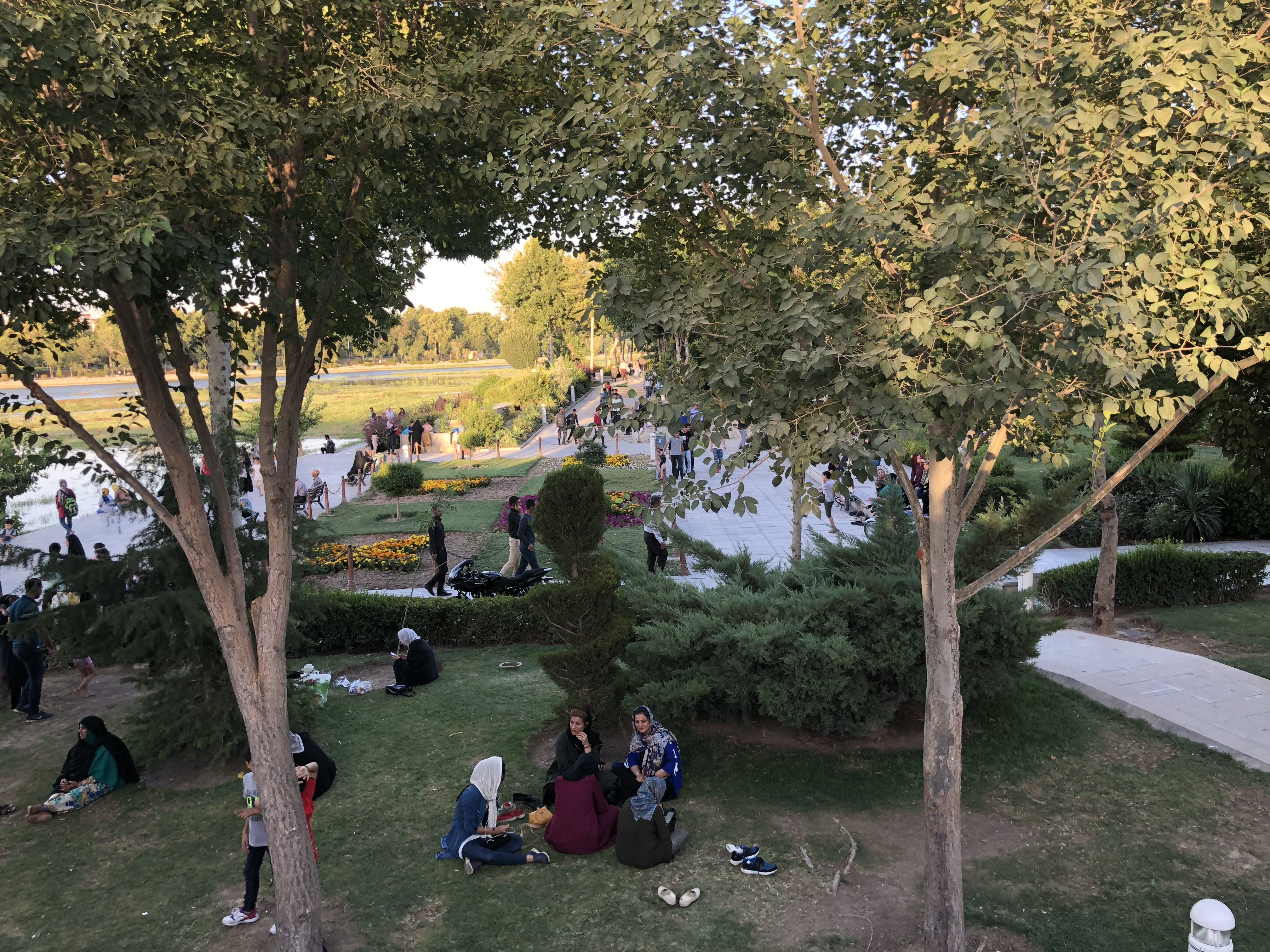
Like Armenia, the families in Iran use the public realm to picnic and stroll and be together. It is, and feels, so safe. And it makes me nostalgic for the Australia of last century. The photo at the head of this article gives a sense of Iranian city life – it was taken by the river is Esfahan at about 9pm on a weeknight. These people work to live.
I posted a lot of travel photographs from the sites I visited in Iran – the markets, carpets, craft, streets, parks, museums, religious and archeological sites. And I was genuinely surprised by how many of you messaged me to say you felt called to visit Iran because of these photos.
Most certainly, a visual and spiritual highlight was the beautiful tile work on the mosques and other important buildings. This rich, sophisticated and refined aesthetic tradition is hard to do justice in photographs but I have found a piece of writing about a sense of it:
“Whatever one’s faith, whatever one’s background, exploring the mosque is a transcendental experience. The inside of the soaring dome is mesmerising, an apotheosis of the tileworkers’ art, whose intricacy is so hypnotic it draws the eye unwaveringly into the centre of shimmering golden arabesques that melt into myriad constellations. The gloriously tumbling muqarnas stalactites in iridescent turquoise and the exquisite ornamentation of the haft-rangi, seven coloured tilework by Ali Reza Abbassi, the miniaturist and calligrapher supreme, set the monument ablaze in white script on midnight blue...” (“Islamic Empires: Fifteen Cities that define a Civilisation” by Justin Marozzi, 2019)
The first site I visited was a shrine in Tehran. It was, as you’d expect, stunningly beautiful in turquoise, greens and white. But it was also energetically active like a Christian shrine. Indeed, I felt the presence of spirit instantly and was rewarded with a materialisation of two bearded saints in my spirit photographs – one of whom, I’d say, was buried in this shrine. This was such a blessing and a positive omen for my journey which was, from beginning to end, an absolute pleasure.
If your heart feels opened by my experience of Iran, I can recommend the most wonderful guide to you. And if you are curious to know a little more about this country, then watch Joanna Lumley’s television series called The Silk Road. Coincidentally, she visits many of the places I did right down to a lovely little cafe in Shiraz.
I would be remiss in not mentioning the food which was, for a vegetarian, tasty and nutritious. But the drinks are really something. As alcohol is not served in Iran, especial care is taken to create the most delicious and beautiful drinks of rosewater, saffron, lemon, seeds and syrups. So refined, delicate and satisfying… just like this most beautiful country and race of people.
Namaste.
PS. In advance of you pressing me for any negatives, the biggest one is that I did not see a real Persian cat in the whole of Persia. In fact, I saw only one painting of one. I’m told they exist but they are lazy and high maintenance. Next time I visit I’m going to find one for sure.
© Paul McCarthy & Iluminar.au

