Photographing the unseen
For more than twenty years, Paul McCarthy has been photographing materialisations of spirit at sacred sites across the world — from a crucified Jesus above a Montreal shrine to St Francis Xavier in Japan. Here, for the first time, he shares twelve of these images and the stories behind them. (12 min read)
For more than twenty years I have been photographing what I can only describe as the materialisation of spirit around the world. Until now, I have shared these images only with a small circle of friends and guides. The reluctance was not about embarrassment. It was about use. I have never seen these photographs as commercial objects. They are tools for transformation and I did not want them reduced to curiosities or arguments.
What has changed is not my caution but the weight of the record. The images have accumulated, across places and traditions, with a consistency that has become difficult to ignore. At a certain point, withholding them began to feel less like prudence and more like avoidance. I am not offering them as conclusions. I am saying simply that they are worth seeing with an open heart and an open mind.
I have a Roman Catholic and Christian Spiritist framework. I do not set out to capture anything unusual. I travel, I pray, I visit shrines as a pilgrim. Then, at specific moments, I hear a clear inner directive: take the photograph now. Only later — sometimes that night, sometimes months or years afterwards — does the materialisation become visible in the image. The story that follows is one of those moments.
It did not begin with faces. Long before materialisations appeared in my photographs, I was capturing orbs and other light phenomena — luminous spheres, columns of light, what I can only describe as the presence of the unseen. One of the earliest of these I can date is the beams of light orbs I photographed in Brasil in 2008, on my first visit there. Over the years that followed I captured orbs and light in more than ten countries. A selection of these photographs is published on my espiritofoto website but many others remain unpublished. The faces came later. The camera, it seems, had been learning to see.
The Crucified Jesus, Kahnawake, Montreal, 2013
In 2013 I visited the shrine of St Kateri Tekakwitha at Kahnawake, on Mohawk territory near Montreal. Kateri is the first recognised Mohawk Catholic saint. The church is modest with a quiet presence. I walked, prayed, and, as I usually do at such places, took a few ordinary photographs as records of the visit.
Filled with gratitude for St Kateri and the lovingly tended shrine, I decided to leave a small quartz crystal in the grounds in appreciation. As the ground was covered in snow, I decided to pummel it into the earth up against the church wall under a poster of St Kateri. To remember this experience, I immediately took a photo of the spot.While I could see beautiful orbs of light in the photograph, and was appreciative of this, I did not think anything more about it.
Several weeks later, I was awoken early by a booming voice in my head saying “you’ve missed something very important in the top right hand corner of the photograph”. While I was not expressly told which photograph I intuitively knew it was this one.
At first I saw nothing. It appeared to be an ordinary photograph, but the instruction had been too strong to ignore. I zoomed in. Slowly. I moved across the frame, following an intuitive pull rather than a plan. As I did, the form of a figure began to emerge.
There, in the centre of the sky, was the crucified Jesus wearing the Crown of Thorns!
Not an impression, not a trick of light that disappeared when I changed the angle. A consistent figure, stable under magnification. When the full form resolved,
I fell to my knees on the floor. The response was not theatrical. It was physical. Something in me recognised what I was seeing before my mind could catch up.
Several years laterI returned to the shrine. I asked to speak with a priest, and I showed him the photograph. He studied it carefully. He was courteous, attentive. After a time he shook his head and said, in effect, that he could not see what I was describing. I did not argue with him. I simply noted the fact.
Two acolytes were also present. They asked if they might look. Both of them, independently and without prompting, saw the figure of Jesus immediately. They described what they saw before I spoke. The priest still could not see it. I cannot explain that difference in perception. I record it because it has become a recurring feature of this work: some people see the materialisation at once; others do not see it at all.
Eleven Other Images: A Brief Tour
Over the years, similar materialisations have appeared at other sites. What follows is a brief tour, not an exhaustive account. Each of these images can be viewed in full at this link (repeated at the end of this article).
St Gregory the Illuminator, Yerevan, Armenia, 2018. Leaving the Cathedral of St Gregory the Illuminator in Yerevan, I heard the familiar inner instruction: “Take the photo now.” I turned, raised the camera and clicked once. In the top right of the frame, a bearded male figure later became visible, materialised above the architecture. When my Armenian guide saw the image, she was moved to tears. She did not analyse it. She simply wept.
Jesus and Padre Pio, San Giovanni Rotondo, Italy, 2013. At Padre Pio’s shrine in San Giovanni Rotondo, I photographed a reliquary and moved on. Nothing unusual happened at the time. Months later, at home, I zoomed into the image and saw two faces present in the reliquary area: one I recognised as Jesus, the other as Padre Pio. I had prayed, privately, for a sign if this work was authentic. Within minutes of seeing the faces, I received a Facebook post with photograph of Pio and Jesus that confirmed what I was seeing. The following year I returned to San Giovanni and attempted to reproduce the photograph from the same angle. I could not.
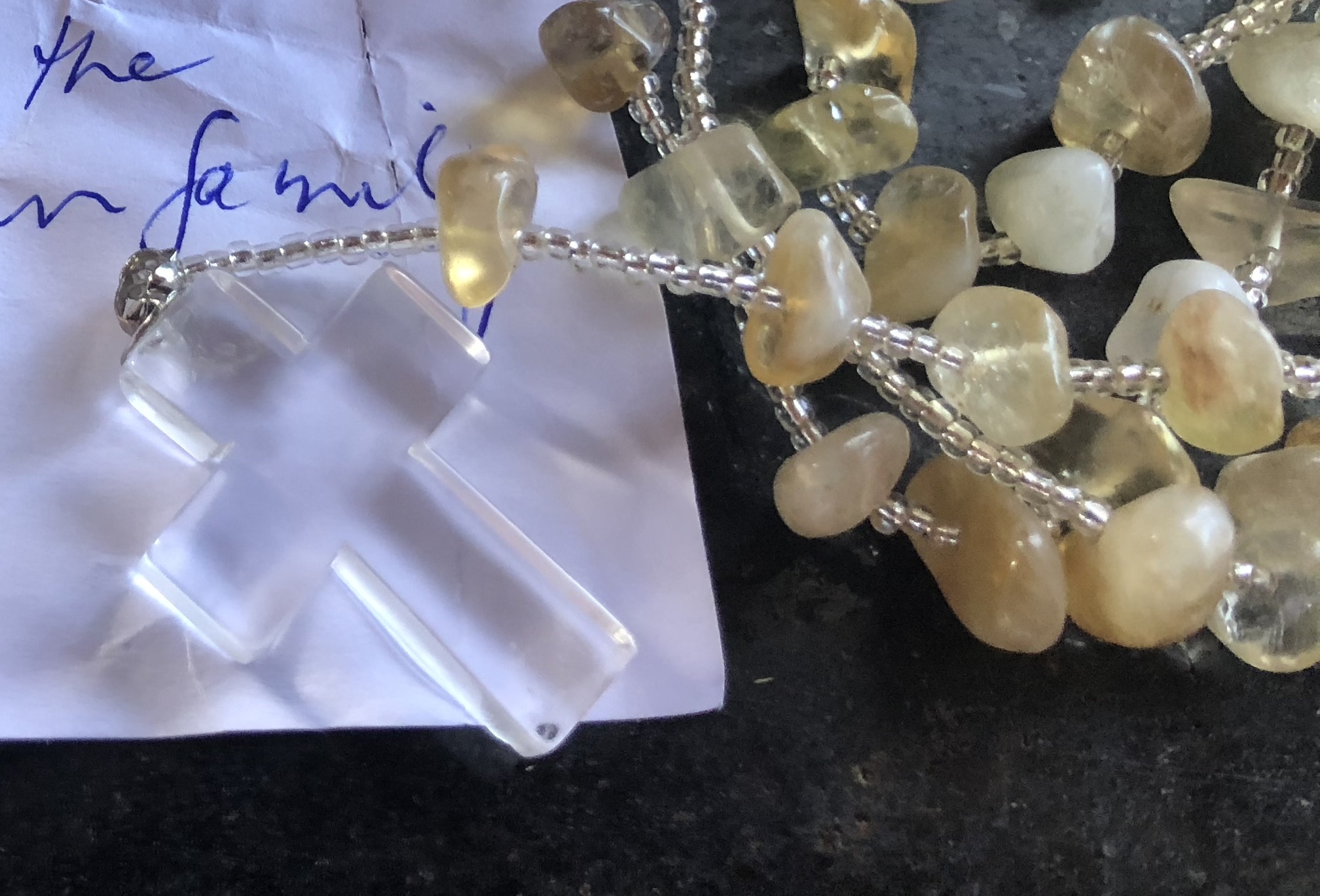
The photograph at the top of this article is the most personal of the thirteen. I wrote a prayer at the Casa Dom Inácio, where I had purchased the rosaries. I placed a rosary on top of the prayer, took a photograph as a practical record, and thought nothing more of it. When I looked at the image years later, I saw that Jesus had materialised over the cross of the rosary. There was no shrine, no sacred site, no crowd of pilgrims. Just a prayer, a rosary, and a camera. I have come to understand that this is the point. The presence confirmed in these photographs is not confined to shrines. It, like the benevolent spirits, travels.
Carmelite Nuns, Avila, Spain, 2014. On the day before I was due to travel to Lourdes, I visited the Carmelite convent in Avila. I took a photograph of a letter written by St Teresa kept in the museum. Two female figures had materialised in my photo. One I recognised immediately as St Bernadette Soubirous: the same young girl in a headscarf I knew from Lourdes iconography. The second figure remained unidentified for years. Much later, in prayer, a voice told me it was St Benedicta of the Cross — Edith Stein, the Jewish philosopher and Carmelite nun killed at Auschwitz. I later found a contemporary photograph of Edith Stein that matched the figure in the image with striking precision.
Overlighted by St Rita, Cascia, Italy, 2015. In Cascia, at the shrine of St Rita, I was photographing my friend Jan. I took a short sequence of images as she stood in front of an image of St Rita. In one frame Jan’s nose had its usual shape. In the next, taken moments later, her nose appeared elongated and angular, matching the distinctive profile of St Rita’s face. Nothing else in the scene had shifted in a way that could account for the change. I describe this as Jan being “overlighted” by St Rita.
Blessed Virgin Mary, Chartres, France, 2015. At Chartres Cathedral I was drawn to a reliquary of the Virgin’s Veil. After taking a photograph, I felt prompted to zoom in more than I usually would. As I did, a female figure emerged within the frame, with a distinct posture and drapery. The following day, in the crypt, I found a fresco image of Mary whose composition — angle of the head, position of the hands, flow of the garments — matched the figure in the photograph with notable accuracy.
St Francesco di Paola, Paola, Italy, 2023. At the shrine of Francesco di Paola, I photographed the entrance to the church and thought little of it. On later review I saw not one but four faces evident in the image: Francesco di Paola himself, a crucifix, and two male figures I identified as King Louis XI and King Charles VIII of France. Both kings are historically linked with Francesco and are known to have sought his intercession. Italian friends with a lifelong devotion to Francesco examined the image and independently confirmed the identifications.
Kuthumi / St Francis, Assisi, Italy, 2024. Arriving at the Basilica of St Mary of the Angels, I heard the clear directive to take a photograph immediately, before I had time to look around. I obeyed. In the resulting image, a figure materialised whom I identify as Kuthumi Lal Singh – the final incarnation of St Francis of Assisi. I had carried a quiet, unspoken desire for an image of St Francis for years. I had never voiced it. The appearance of this figure felt like a response to a question I had not dared to ask aloud. It also confirmed my work on the other incarnations of St Francis.
A Muslim Saint, Tehran, Iran, 2019. At a Shia shrine in Tehran, the first sacred site I visited in Iran, I took a photograph under inner instruction. A figure later became visible in the image whom I tentatively identify as Saleh ibn Musa al-Kazim. The atmosphere at the shrines in Iran carried the same consoling presence I recognise in Catholic sites. Across the traditions, something felt the same. I have not, however, been able to find a historical portrait that would allow me to confirm the identification with certainty. I hold this one as unresolved.
St Mark and the Lion, Venice, Italy, 2016. In Venice, again guided to raise the camera at a particular moment, I captured a frame in which both a human figure and an animal presence materialised. When I reviewed the image, the composition matched the classical iconography of St Mark with his lion remarkably closely: the relative positions, the angle of the bodies, even the sense of movement between them.
St Francis Xavier, Yamaguchi, Japan, 2024. At the Francis Xavier Memorial Park in Yamaguchi City — the site of the former Daido-ji Temple where Xavier undertook his missionary work and regarded as the birthplace of Christmas in Japan — I took two photographs 29 seconds apart. In both a figure of St Francis Xavier materialised. I have visited many sites connected with St Francis Xavier, including venerating his incorrupt body in Goa. When I saw this image, I had no doubt as to the identity of the figure.
Materialisation in Padova, Italy, 2026. At the Basilica of St Anthony in Padova, I photographed a relic in the Chapel of St Francis of Assisi. On review, a face had materialised over the relic. It did not resemble the Francis of Assisi I know from iconography. Instead, it appeared to be St Francis de Sales. This raised a question: why would another saint appear over this particular bone? I took the question into prayer and listened, but no clear answer has emerged. I include this image precisely because the interpretation remains open. It is an honest example of the limits of my understanding.
On discernment
Across all of these stories, one pattern is constant: I do not decide when to take these photographs. I am directed. Often I have no idea what, if anything, has appeared until much later. In Avila it took years, and a quiet inner statement, to recognise Edith Stein. In San Giovanni Rotondo the faces of Jesus and Padre Pio only became visible when I zoomed into the image at home. Perception also varies between viewers. At Kahnawake, the priest who examined the photograph could not see the crucified Jesus, while the two acolytes saw him at once. In Tehran, the identification of the figure remains uncertain, and I say that plainly. In Padova, the question of why Francis de Sales might appear over a relic of Francis of Assisi remains unanswered. I offer these images not as arguments to be won or lost, but as an invitation to look with an open heart and an open mind.
Seeing for yourself
All these stories, with the original photographs and fuller accounts, are gathered at espiritofoto.carrd.co. I do not consider the images mine in any possessive sense. They were given. I am sharing them now because I believe they have the capacity to open something in those who see them, in ways I cannot predict. Please respect this work by not copying or selling the photographs but feel free to share the blog post.
If you feel drawn to speak about your own experiences of spirit, I offer one-to-one consultations about sacred travel in person in Sydney or online. I can reached via my website – https://www.iluminar.au
You might also like:
→ The path that led to iluminar
→ How can medieval practices of pilgrimage and veneration of relics heal the modern mystic?
→ Energising the rosary beads on pilgrimage
© Paul McCarthy & Iluminar.au

