Finding Xavier in Malacca
The church, the relics and the overwhelming energy of St Francis Xavier in Malacca — and what it means to visit the same saint in multiple places across the world. (5 min read)
The drive from Singapore to Malacca takes up to 4 hours. One reaches the border at Johor Baru in about 45 minutes from the Queen Street Bus Terminal and it then takes half an hour to get off the bus, exit Singapore, get on the bus and enter Malaysia. The process is straight-forward but irritating, especially if one is keen to reach the destination and jet-lagged from a 10 hour delay in leaving.
Malacca is quite a lot closer to Kuala Lumpur than Singapore but to get to KL cheaply one must fly with one of those airlines that has had planes disappear or crash in recent years. Singapore is very safe and clean and modern and welcoming.
Malacca is very humid. The vegetation is lush and tropical and the buildings in the historic centre are charming.
The people are very friendly. Almost everyone smiles at us and several want to talk. I feel very much at ease with the people here.
St Paul’s Church
The remains of the Church of St Paul are the most important site in Malacca for a pilgrim. The church was founded by the Portuguese in 1521, twenty-four years before Xavier’s first visit. Located on the only hill in the area, the church was visible from the sea and the marker for sailors that they had reached Malacca. They described it as a crown on the hill.
St Paul’s was initially dedicated to Mary and called it Our Lady of the Hill (Nossa Senhora da Annunciada) or Mother of God (Madre de Deus). It began as a chapel and was progressively enlarged through the addition of a second storey, a tower and burial vault. The church was deeded to the Society of Jesus (the Jesuit Order) in 1548 and the title was given to Xavier on behalf of the Society.
The church was venerated by the Portuguese because Xavier said mass and prayed there. There are reports of Xavier being observed in ecstasy in this church with his whole body raised above the ground during prayer. It was in this church that Xavier prophesised the defeat of the Archinese and this was also where he conducted the famous dis-obsession of the teenager Joao Fernandez. But even more significant, the church was the tomb of Xavier’s incorrupt body from March 1553 until it was transferred to Goa, India. The site of the burial is identifiable by a hole in the ground.
In 1953 a marble statue of Xavier was erected on the site to commemorate 400 years since his passing. The morning after the blessing of the statue a large casurina tree fell on it and severed the right arm. The decision was taken not to replace it in recognition of the miracles achieved by Xavier’s right arm – in his lifetime and after it was detached from his relic in 1614.
In 1641 when the Dutch took control of Malacca they renamed the church and used it for their reformed religion. They used it for 100 years until a new church was built at the base of the hill. The church then became part of the fortress and various modifications were made, including the addition of a cannon. The site was also used as a cemetery.
The church at the beginning of the British occupation of Malacca was used for storing gun powder and ever since then has stood in ruins. In the early 20th century, some excavations were done and various Dutch tombstones were affixed to the walls.
Although the energy over the place where Xavier was buried was strong, the significance of the site is not respected by the authorities. There are buskers and artists doing commerce in the former church and it looks like it may be the home for a street person. There is no sense of awe or reverence for this sacred site, although I understand it is different in the week around the feast of Xavier.
Church of St Francis Xavier
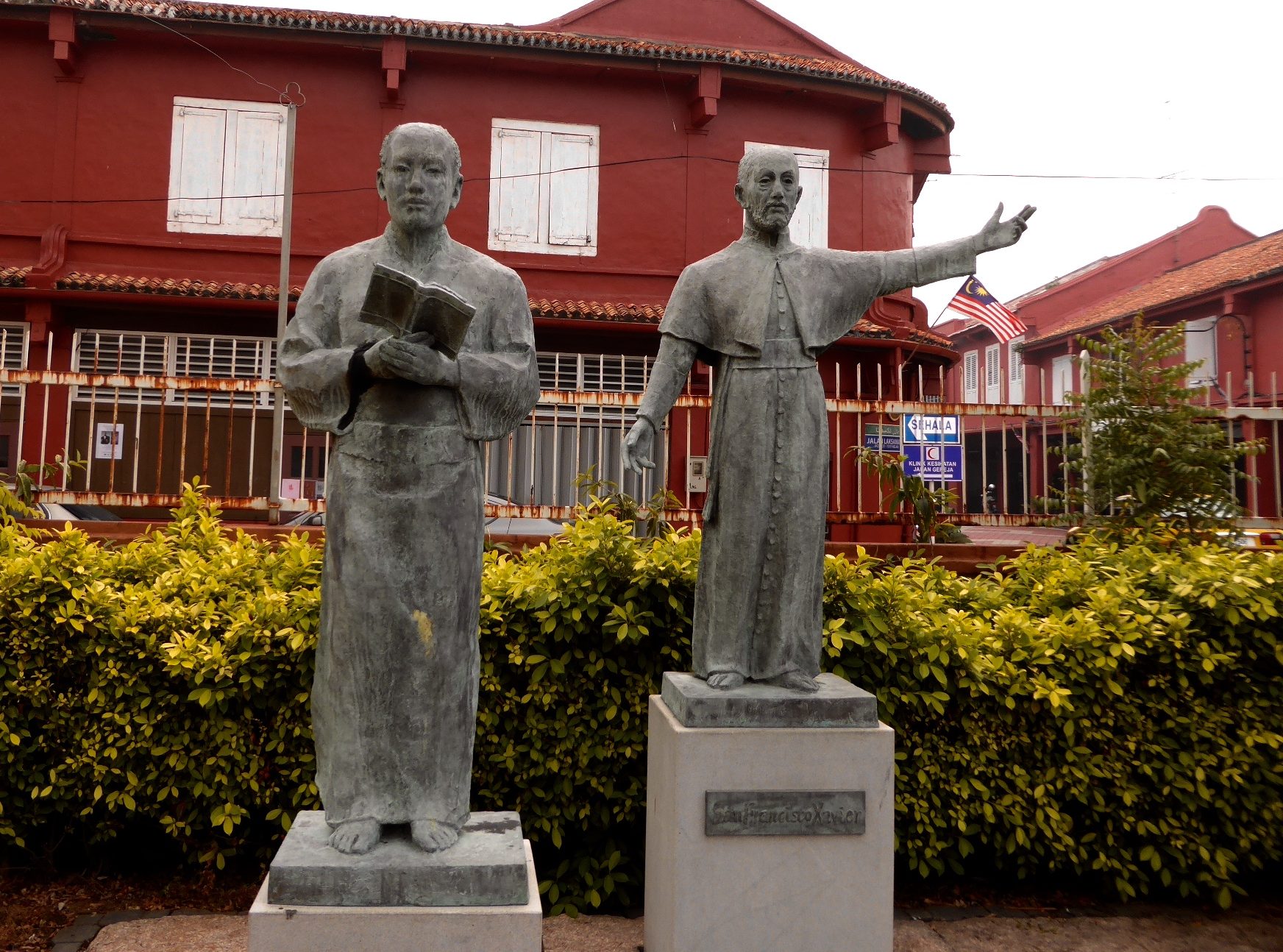
In 1856 the Church of St Francis Xavier was founded on the site of an old Portuguese church. The church has stained glass windows illustrating incidents from Xavier’s life, as well as a statute of Anhiro, the Japanese man he met in Malacca who inspired him to travel to Japan.
The Church’s heritage centre has four relics of Xavier. One of them contains a fragment of finger bone while the other holds a piece of skin taken from the foot of the saint. The church received the finger-bone from the Church of Bom Jesus in Goa in 1953, while the skin was given in 1995 in conjunction with the 150th anniversary of the Church of St Francis Xavier. We were permitted to visit the heritage centre where the relics are stored and had the opportunity to chat a little with some local religious. Surprisingly, the church has no specialist written material about Xavier’s time in Malacca and there is not a depth of understanding of the issue.
“Porta de Santiago”
There are few buildings in Malacca from Xavier’s time and with the land reclamation along the waterfront even the topography of the city is different.
The Portuguese fortified the city with a garrison of 500 soldiers. About 30 years before Xavier’s first visit a wooden fortress called “A Formosa” was completed. It originally consisted of a tower of 4 floors surrounded by a wall. This served as a watchtower and a residence for the captain of the city. After Xavier’s death, a new stone wall was erected around the city and there are no obvious remnants of the wooden fort.
The Dutch attacked Malacca for the first time in 1597, with major attacks in 1606 and 1636. They finally succeeded in taking the city in 1641 after a 5 month seige.
Excavations in the 20th century uncovered some of the old city fortifications, the most important of which is the “Porta de Santiago”, an old gate to the Portuguese city which was severely damaged during the Dutch invasion of 1641 and later demolished and rebuilt. The British East India Company had started to destroy it in 1807 but the remains were saved by the intervention of Raffles. Whether Xavier would recognise it is a matter of conjecture.
Maritime Musuem
Xavier spent years of his life at sea. The weather was often treacherous and the conditions on board were appalling by modern standards. Although offered comfortable accommodation, Xavier preferred to be with crew and the poorest travellers so as to carry out his mission.
Malacca’s Maritime Museum exhibits ships and artefacts from the 14th century to the end of British occupation (mid 20th century). The focus is a replica of the Portuguese galleon “Flora de La Mar”, a huge ship that sunk off the coast of Malacca while carrying plunder to the King of Portugal. The standard of the museum was not so great and it seemed to me that there was an Islamic political overlay to the material presented. Ironically, I did not see Xavier’s name mentioned once in any of the displays or information in the museum.
Portuguese Settlement
More than 450 years after the Portuguese were defeated in Malacca, the region continues to have residents who identify with their Portuguese ancestry and have strived to retain traditions in food, costume, dance and religion. The Portuguese Settlement (Kampung Portugis) is a fishing village of about 1000 people located a few kilometres from the city. The seafood is a magnet for tourists and there is a small museum with a modest collection of items tracing the history of the Portuguese in Malaysia.
You might also like:
→ On my way to Xavier in Malacca
→ Goa and the incorrupt remains of St Francis Xavier
© Paul McCarthy & Iluminar.au

