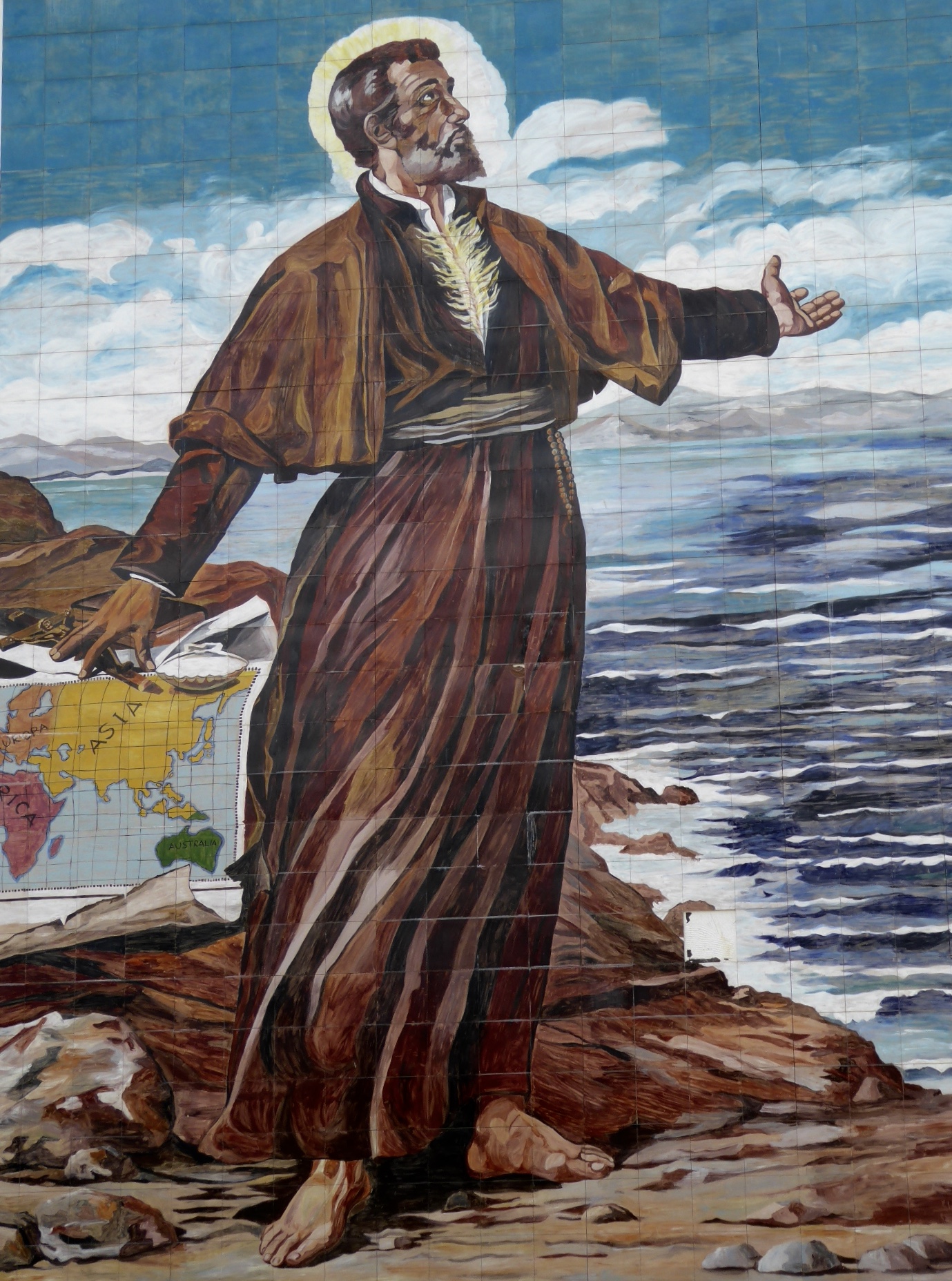
On my way to Xavier in Malacca
En route to St Francis Xavier in Malacca — reflections on the journey and why Xavier keeps drawing me across the world. (4 min read)
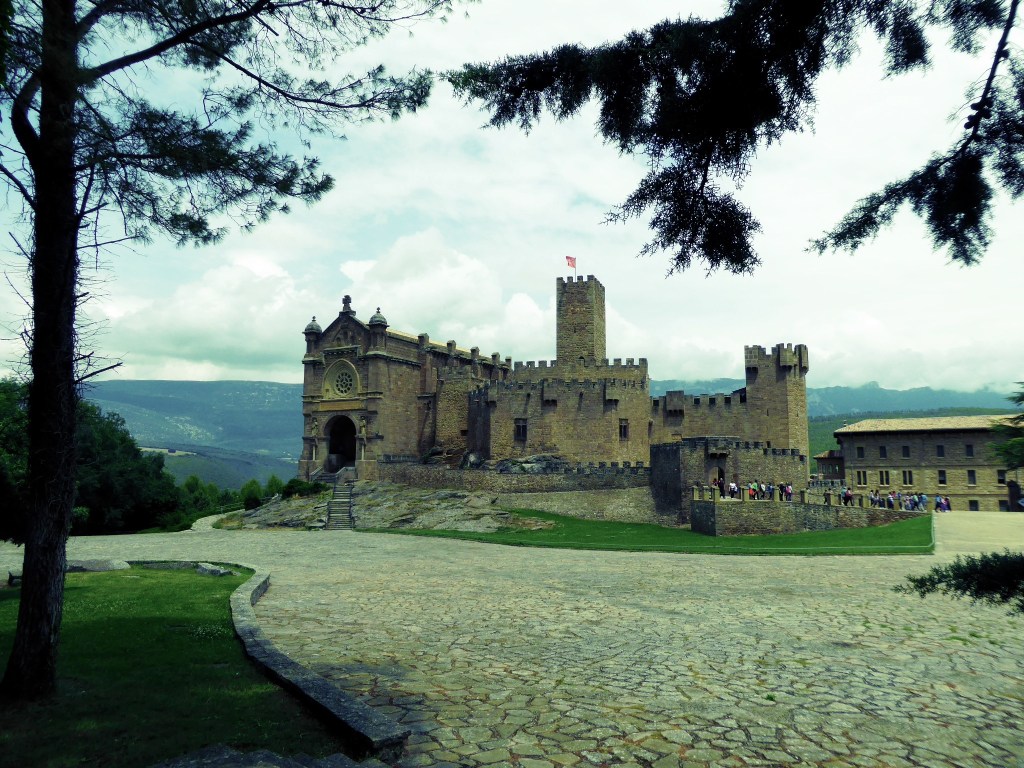
In June 2015 I visited the family castle of St Francis Xavier in Javier, Spain. The castle, which is beautifully restored, is now a fantastic museum dedicated to St Francis.
I loved every minute of my visit to the castle and the nearby basilica but the (totally unexpected) highlight was being introduced to a miraculous statue known as “The Smiling Jesus”. This unusual representation of the crucifixion was beloved by the Xavier family and its chapel has not changed since St Francis’ day. The tradition is that when St Francis died on Sancian Island, off the coast of China, in 1552, this statue wept blood. The chapel is ordinarily closed to the public but when I explained about my pilgrimage and my intentions they kindly let me into it. The energy in this chapel was beautiful and it was the right place to energise my rosaries and make my prayers of thanksgiving for the 2014 Sydney meditation event and to ask for Xavier’s assistance to repeat it (as soon as possible).
I came away from Javier Castle with a stronger connection to St Francis and with a determination to follow-up my book about St Ignatius (called “The Companion”) with one about Xavier. This idea was totally new because I had intended to write about the other Francis (of Assisi) next.
Back in Australia with a few months of writing time available, I started work on the book. I decided to repeat the style of “The Companion” and combine biography and travel narrative. Javier Castle was not my first pilgrimage to a holy site connected with St Francis Xavier. In fact, he’s been traveling with me for years.
I am often in Rome and I always make a point of visiting the baroque Church of Il Gesu where Xavier’s incorrupt right arm is displayed on an altar opposite the tomb of St Ignatius of Loyola. And, if I can, I also visit the Rooms of St Ignatius where Xavier worked as his secretary.
In 2011 I pilgrimaged to Xavier’s shrine in Goa, India. His remains are displayed in a glass coffin above a high altar in the Church of Bom Jesus. Despite the passage of more than 450 years, his body has not fully decomposed. In fact, for centuries the body remained fully intact and pliable, although the extraction of relics and scientific experiments in later years has led to dehydration and some decomposition.
There are many churches and schools and universities dedicated to Xavier all over the world. I keep an eye for them and visit if I can.
In 2013, spirit guided me to the town of Xavier del Bac in Arizona where I was unexpectedly introduced to a Native American saint called Kateri Tekakwitha. This was in a church dedicated to St Francis. Within a fortnight, and with no planning on my part, I was at Kateri’s shrine at the Mission of St Francis Xavier in Kanawake, Canada. I felt certain she was part of Xavier’s phalange and I prayed she would come to the meditation event being held in Toronto the following week. I think she did because my efforts were more than rewarded with a spirit photograph of the materialisation of the face of Jesus above her shrine.
Xavier was, for many years, a patron saint of Australia. In 2012 the precious relic of his blessing arm toured 23 towns in our country on what was called “a pilgrimage of grace”. To the surprise of all, the Marian Valley in the Gold Coast hinterland was added to that tour at the last minute after the dedication of a small chapel to Xavier in their grounds. This chapel, in Australia’s most beautiful sanctuary, was built by the Tongan community in honour of St Peter Chanel but ultimately dedicated to Xavier after his statue was sent to them “in error”.
Interestingly, after the 2014 Sydney meditation event with Joao de Deus, a small relic of Xavier was gifted to St Mary’s Cathedral in Sydney. The reliquary is displayed in the Cathedral between the chapels dedicated to Australia’s saints (Our Lady Help of Christians and St Mary Mackillop).
Xavier is sometimes referred to as the “Apostle of the East”. This is because after being sent to Goa, India as the Papal Nuncio and representative of the King of Portugal, he undertook the most extraordinary missionary activity in the history of Christendom. Xavier’s teaching and example converted tens of thousands of people in the Far East to Christianity – first in India, and later in what is now Malaysia, Indonesia and Japan. His method was revolutionary, especially in terms of engagement with local culture and language and his impact was phenomenal.
Xavier traveled approximately 38,000 miles by sea and land during 11 years of apostolic work. He traveled from Rome to Lisbon and then embarked for Goa on a sea voyage that took over a year. From his base in Goa he traveled to several places in India and to Malacca, the Spice Islands (Indonesia) and Japan.
As I researched Xavier’s life for my book, it became clear that I should honour him by visiting the most important places connected with him in Asia – India, Malaysia, Japan and Sancian Island (close to Macau) and write about it. While I would have preferred to pilgrimage to all these sites in one trip, ideally on a fully restored Portuguese galleon, I reluctantly settled for an incremental approach using a budget airline (a less than satisfactory instance which involved a 10 hour delay in one case).
Malacca is the first stop on this new pilgrimage and will be a chapter in the book. Interestingly, we are visiting Malacca on the way to a spiritist meditation event in Perth, Australia next weekend for the feast of the other Francis. (Curiously, I ended up writing the equivalent of the book on St Francis of Assisi as part of my preparation for that event!).
It is important to understand the significance of Malacca in Xavier’s life. He visited Malacca five times between September 1545 and May 1552. He spent 13 months there over a 7 year period. His longest stay in Malacca was 6 months and the shortest was 3 days.
Located half-way between China and India, and with easy access to the Spice Islands, Malacca was Asia’s “greatest trading city” at the turn of the sixteenth century. It was, inevitably, a hub for travel and communications and an obvious base for Xavier in East Asia, although traveling to and from there would involve many treacherous sea voyages for him.
In Xavier’s day, Malacca was a Portuguese colony although they held if for less than a century. The geopolitics of the region was complex and fluid. Muslims were very active and Malacca itself was taken by the Portuguese, the Dutch and then the British. Xavier’s motive for European expansion was evangelisation but most of his European contemporaries were principally seeking profits.
Some writers say that Malacca was Xavier’s “professed favourite city” but I do not know if this is true.
In Malacca, as elsewhere, Xavier’s routine was largely pastoral, although he was occasionally very political. He lived in or near the hospital. He devoted his time to caring for the sick, praying, teaching and preaching. He was simple, humble, self-less and locals called him “the holy father”. He translated the essentials of the Christian doctrine into Malay (some say he had the gift of tongues) and brought about many conversions to Christianity.
Xavier’s first visit to Malacca, five hundred and thirty years ago, provides us with some interesting examples of his mystical gifts. For example, on arrival in Malacca for the first time, Xavier knew the names of the babies and the names of their fathers. He was the instrument for bringing back to life a girl who had been dead three days and the dis-obsession of a seriously ill teenage boy. His life is full of such miracles.
On his second visit to Malacca, Xavier’s gift of prophecy was most dramatically demonstrated when he accurately proclaimed a naval victory occurring several hundred miles away. A further 30 cases of prophecy were accepted in the cause for his canonisation, including foreseeing storms, dangers and death.
Xavier’s mission was dramatically influenced by meeting a Japanese man called Anhiro (Yajiro) in Malacca. Deeply impressed by Anhiro, Xavier decided to travel to Japan after meeting him. (Xavier later spent over 2 years in Japan. He had limited success in converting the Japanese but was highly impactful in other ways).
And the Governor of Malacca was central to the biggest disappointment in Xavier’s life – his failure to reach mainland China. The story is quite complicated but the key point is that Xavier was unable to meet the diplomatic requirements to lawfully enter China because of the Governor. Xavier tried to get there by stealth and ultimately died in the process.
Xavier died on Sancian Island, near Macau, in 1552 at the age of 46. In order to facilitate the decomposition of his body, it was covered in lime and buried. However, when the body was dug up three months later it was intact and pliable – as if Xavier had fallen asleep. His incorrupt body was next transported by ship to Malacca and the tradition is that its arrival ended a serious epidemic for which people were dying and a famine.
Xavier’s body was re-interred in Malacca in the Church of Our Lady of the Hill where he had spent much time praying and preaching. His body was in Malacca for 9 months (possibly in two locations) and when it was exhumed in August 1553 it was incorrupt. From Malacca it was taken in grand naval procession to Goa, India.
As a priority, we visited the remains of the place where Xavier was buried and venerated four of his relics in the city church that is dedicated to him. Although the city has been greatly transformed since Xavier’s time, there are remains of the Portuguese fort that he knew well. Malacca also has a replica of a Spanish galleon in its Maritime Museum that gives us a sense of the environment in which he spent so much time.
It is ironic that almost 500 years after the death of Xavier, Christianity and Islam are still unable to dance together very well in Malacca. Locals report that the modern Malaysian state is stridently Muslim and that it is not easy for Catholics to practise their religion. This explains why the tourist mecca which is Malacca underplays the story of Xavier and pilgrimage is not promoted. The city’s world heritage status, which drives tourism, is founded on the thriving of all faiths but, unfortunately, the Portuguese Christian influence is acknowledged but not celebrated. Let’s pray that changes.
You might also like:
© Paul McCarthy & Iluminar.au

