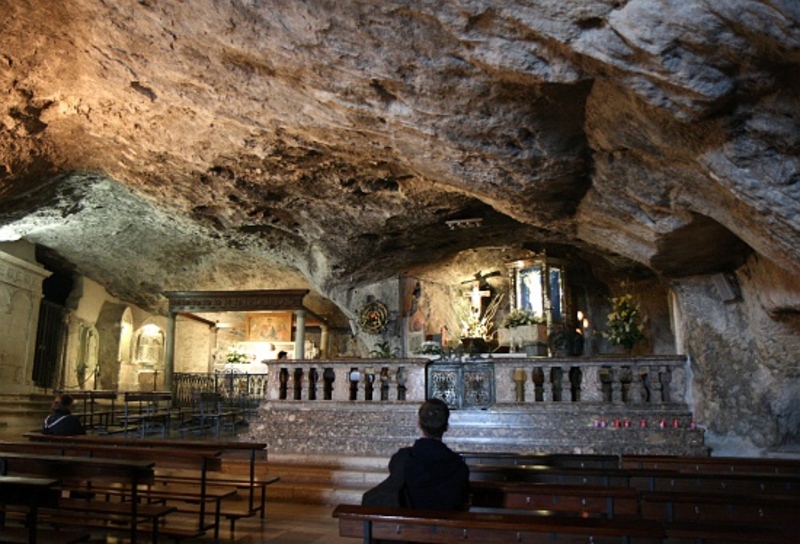
Oldest shrine to Archangel Michael in Western Europe
Monte Sant’Angelo — the cave sanctuary where Archangel Michael appeared in the 5th century, and the ancient pilgrimage road that connects it to Padre Pio. (5 min read)
About half an hour’s drive from San Giovanni Rotondo is Monte Sant Angelo which is home to the oldest shrine to Archangel Michael in Western Europe. Known as the Celestial Basilica, the shrine has been an important pilgrimage destination since the middle ages and if one is visiting Padre Pio, this side-trip may be of interest.
St. Michael the Archangel first appeared at Monte Sant’Angelo in 490. According to tradition, it all started when a local nobleman named Elvio Emmanuele lost the best bull of his herd. After much searching, he found it kneeling in a cave. Unable to approach it, Elvio shot the bull with an arrow, but the arrow turned around and struck the man instead. Bewildered, Elvio went to see his bishop, who ordered three days of prayer to St Michael and fasting. At the end of the three days, St. Michael the Archangel appeared to the bishop and explained the significance of the event and asked for the cave to be dedicated to Christian worship. Michael said:
“I am the Archangel Michael, and am always in the presence of God. The cave is sacred to me. I have chosen it; I myself am its watchful custodian…Where there the rock opens wide the sins of men can be forgiven… What is asked for here in prayer will be granted. Therefore, go to the mountain and dedicate the grotto to the Christian religion”
The bishop, however, began to worry about his own sanity and dismissed the vision.
Two years later, in 492, the Christian city of Siponto, part of the bishop’s diocese, came under attack by the pagan city of Odoacre. Again St. Michael appeared to the bishop, this time promising to save the city of Siponto. Immediately, a violent storm engulfed Odoacre, saving the Christian city. In thanksgiving, the bishop led a procession to the top of the mountain but did not dare to enter the cave.
Soon, Michael appeared to the bishop a third time, ordering him to enter the cave. The bishop then entered the grotto, where he found an altar covered with a red cloth, a crystal cross, and a footprint on the ground. The bishop thereupon commissioned a chapel to built at the entrance to the cave and did not consecrate it because Michael had already done so. For this reason, the church came to be known as the Celestial Basilica.
The bishop appointed priests and psalm-singers to conduct daily services in the grotto-chapel. The account of the “discovery” of the grotto-chapel ends with a description of the clear and sweet water which seeped from the ceiling stone beyond the altar. When drunk from the glass vessel suspended by a silver chain near the source, the dripping water heals all manner of infirmities.
St. Michael made another appearance here in 1656 during a great plague. The local bishop invoked St. Michael for protection, and the archangel appeared to him. The plague then ceased, and the mountain shrine became more popular than ever.
Significantly for filho de Casa Dom Inacio, the hagiographic account of St. Michael’s three apparitions on Monte Gargano ends with St. Paul’s observation on the function of angels (Hebrews 1:14): “For angels are ministering spirits and sent to minister for them who will receive the inheritance of salvation.”
The sanctuary has been a popular place of pilgrimage for many centuries: St. Francis of Assisi, St. Bernard of Clairvaux, St. Bridget of Sweden, St. Gerard Majella, St Vincent Ferrer, St Francis of Paola, St. William of Vercelli and six popes have made the pilgrimage here to ask for St. Michael’s protection.
When St Francis of Assisi went to visit the Sanctuary, he felt himself unworthy to enter the grotto and so he stopped in prayer and meditation at the entrance, kissed and carved on a stone the sign of the cross in the form of “T” (tau). There is now an altar dedicated to him inside the grotto, however, the rock on which he carved the tau was destroyed and a replica is therefore used.
Some might say that the exterior of the sancturary is fairly unassuming, marked by an octagonal 13th-century campanile and a white facade with two portals, but from the small courtyard a flight of stone steps leads down into the atmospheric church incorporating the cave in which St. Michael appeared. The main church and the areas that lead to it are decorated with remains of medieval frescoes and sculptures.
If you decide to visit this shrine buy a copy of the excellent guide book and have a read over coffee before you enter. This will make the visit much more informed and interesting and help you to focus your prayers. I particularly valued the translation of the latin inscriptions throughout the basilica. For example, over the entry portals are the following:
“Impressive is this place. Her is the house of God and the gate of Heaven”
“It is not necessary for you to dedicate this Basilica which I have set up, because I myself, who have laid the foundation, have also consecrated it”.
The guidebook also includes the beautiful “Act of Consecration” which many will find inspiring.
Namaste.
© Paul McCarthy & Iluminar.au

