A Call to Loreto
Mary’s house in Nazareth, transported by angels to a hilltop in Italy — the history, the saints and the enduring pilgrimage call of Loreto. (6 min read)
As the call to go on pilgrimage grew stronger within me and the possibilities for the journey started to form in my mind, I felt an increasing compulsion to visit Loreto, Italy.
My lower mind said that it was “logical” to visit another Marian site. Last year I visited Fatima, Lourdes, Medjugorje and Jasna Gora. And the year before I visited the Marian shrines at Walsingham, Knock, Pompeii. And the year before that the Shrine of Our Lady of the Miraculous Medal and Our Lady of Guadalupe. Of course, I’d do another one or two this year – Loreto and, perhaps, Ephesus in Turkey.
But the lower mind knows so little. And as I sat with the idea of visiting Loreto, I started to wonder if maybe, the quintessential pilgrim, Saint Ignatius of Loyola was calling me there?
In truth, I knew very little about Loreto when the idea of visiting there came into my field. I had a vague memory of a house from Nazareth being transported there by angels in the middle ages, but that was it. And so I started my research.
Geography & History
First, some geography and history. The city of Loreto sits on the summit of a hill, close to the Adriatic, in the Marches area of Italy. It has about 10,000 permanent residents, most of whom are involved in the pilgrimage business. The nearest big town is Ancona, which was a major international port for a brief period in the middle ages. One can reach Loreto by train from Rome, by ferry from Croatia or by flying into Ancona and getting a taxi. One can also drive from Assisi in a couple of hours.
Why did Loreto become the foremost Marian shrine in Christendom in the middle ages?
Loreto was first known as “Villa Santa Maria” because it was believed to be the site of the home of the Virgin Mary in Nazareth – the place where she was born, where she was visited by the Archangel Gabriel to announce the coming of Christ, where she conceived Jesus and where she raised him in his early years.
The Legend of the Holy House
How Mary’s home in Nazareth got to Loreto, Italy requires a leap of faith.
The legend is that in 1291, at the end of the last crusade in the Holy Land, angels miraculously translated the house from its location in Nazareth to several other places in turn. Firstly, a site in what is now Croatia. Many reputable people testified that a small house suddenly appeared in a field in Croatia at the same time the Holy House disappeared from Nazareth. In 1294, when the Muslims invaded Albania, the house miraculously moved again, very briefly, to Recanati, Italy before it ended up in Loreto.
The Holy House Today
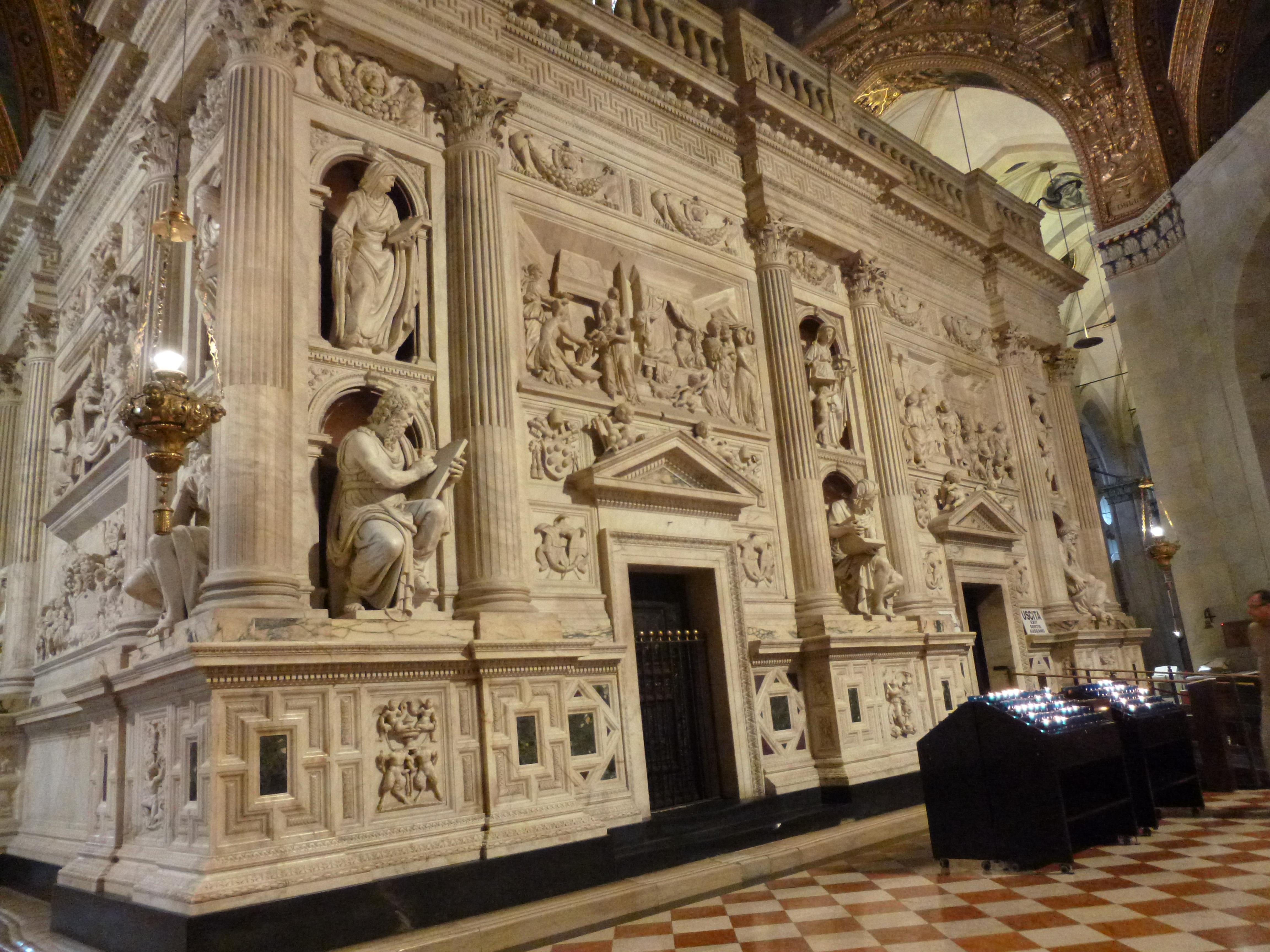
The Holy House at Loreto is comprised of plain, rough walls of a cottage of great age, about thirty feet long by fifteen feet wide and about fifteen feet high. In the centre of the house is a replica of a wooden statue of the Madonna (the original statue, which arrived at Loreto with the house, was plundered and destroyed).
In 1295 a strong wall was built around the Holy House at Loreto and in 1469 a large basilica was built over it. In 1507 a marble enclosure was constructed around the house. Interestingly, many of the artists who participated in the building and decorating of St Peter’s Basilica in Rome also worked for the popes on the new basilica at Loreto.
A Place of Miracles
There have been many inquiries and much research into the Holy House and how it came to be in Loreto. I am keeping an open mind but what I have read is:
- The stones of the Holy House are unlike any to be found in the Loreto region but are similar to those quarried in Palestine.
- The Holy House has no foundations and just sits on top of the ground – unlike other buildings in the area whose structures were compromised due to nearby bombing, the Holy House was not affected.
- There was a holy house venerated in Nazareth. In 1219, St Francis of Assisi visited Nazareth and prayed there. When St Louis, the King of France, visited the Holy House in Nazareth in 1253, the house was intact.
- After the Holy House appeared in Croatia in 1291, the Governor of Dalmatia immediately dispatched emissaries to Nazareth who reported that the Holy House had disappeared from there – the length and breadth of the walls of the house in Croatia corresponded exactly with foundations beneath the former Basilica of the Annunciation in Nazareth. A delegation from the Recanati Government to Nazareth in 1296 also found that the dimensions of the house in Loreto measured up exactly to the spot where the Holy House in Nazareth had stood.
Loreto is a place of many healing miracles and it continues to attract pilgrims seeking divine assistance.
Several Popes received healing at Loreto in the fifteenth and sixteenth centuries and they conferred on the site various material and spiritual privileges. As I mentioned above, a major basilica was constructed and it became a popular destination after Pope Leo X (1513-21) granted all the indulgences available at the station churches in Rome.
Some scholars have argued that Loreto became an important substitute for pilgrimage to Jerusalem – which was very difficult in the fifteenth century due to conflict with some Muslims.
The Saints of Loreto
It has been argued that no other Marian shrine in the world has been visited by as many Saints and holy souls as Loreto. One article claims that over 2000 canonised, beatified and venerable children of the Roman Catholic Church have visited the Holy House.
And the first mentioned saint in every article about pilgrimage to Loreto is St Ignatius of Loyola, followed by St Francis Xavier and other famous Jesuits. Don Bosco and St Therese of Lisieux visited the shrine and there is at least one instance of Padre Pio bi-locating there while remaining present in San Giovanni Rotondo.
There is an argument that the saints loved the truth and were rarely taken by a lie. Given their advanced spiritual understanding and discernment, it logically follows that a visit to Loreto by so many saints is a testament to the shrine’s authenticity and power.
Ignatius of Loyola and Loreto
According to one writer, Ignatius accepted the historicity of the shrine’s relocation and the early Jesuits were quite devoted to the shrine and their interests intensified over subsequent generations. As early as 1537 several of the early Jesuits visited the shrine at Loreto on their way to Rome. In 1552 Ignatius sent a small group to serve as confessors there. For over 200 years, until the suppression of the Society, there was a dominant Jesuit presence in Loreto.
One scholar asserts that sending Jesuits to Loreto had as much to do with ecclesiastical politics as with devotion to the shrine. In fact, it appears that Ignatius was pressured by the Pope and wealthy benefactors to send priests to the shrine. Interestingly, the Pope gave the Jesuits at Loreto the power to absolve “reserved sins”, including heresy, which increased the popularity of the shrine (remember this was the time of the inquisition!).
I have great faith in Ignatius’ motivations. As the holy site was translated from a place that he had visited in Palestine, I believe he would have thought that the Holy House provided an incomparable opportunity for Jesuits to strengthen connection with the life of Jesus.
Also, I believe that Mary was Ignatius’ favourite saint. Written at the door of the Loreto Basilica are words that would have been irresistible to him: “The whole world has no place more sacred… for here the Word made Flesh, and here was born the Virgin Mother”.
Why I Need to Go
And as to why I really need to go to Loreto? During my meandering research these words jumped out at me:
“Our Lady…always manages to bring to what was her home while on earth those who revere and venerate her in a special way.”
Perhaps you would also like to go on pilgrimage to Loreto in thanksgiving to Mary and Ignatius?
Namaste
You might also like:
© Paul McCarthy & Iluminar.au. All rights reserved.

