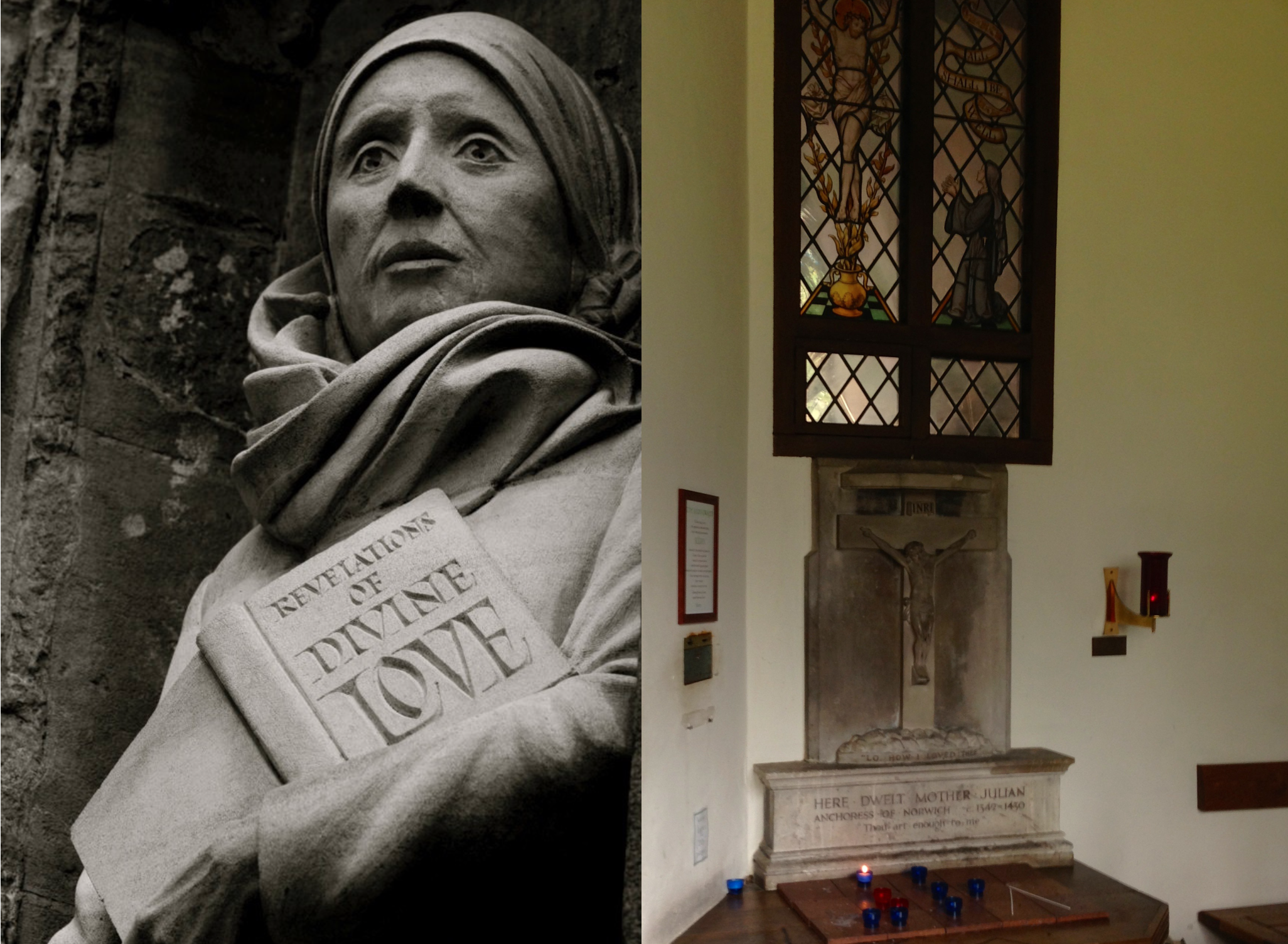
Julian of Norwich
The mystic who wrote the first book in English by a woman — Julian’s near-death visions, her cell in Norwich, and the message that has endured for 600 years: all shall be well. (5 min read)
Julian of Norwich (1342-1429) was the first woman to write a book in English – “The Revelations of Divine Love”. She wrote it while she was an ‘anchoress’ (a hermit anchoring the light) living in a small room attached to St Julian’s Church in Norwich, Norfolk, England.
A pamphlet from the church tells us that it was quite usual for people to live like this in Julian’s day. Some were monks and nuns, but many were just ordinary women and men who took vows to live a solitary life of prayer and contemplation. They lived in a room beside the church and many people came to them for comfort and advice. Maybe I did this?
On 8 May 1373, when she was 30 years old, Julian had a near death experience during which she received a series of visions of the Passion of Jesus and the love of God. When she recovered, she wrote down what she had been taught on the inner planes. Her book took over 20 years to complete and is today regarded as a spiritual classic.
Julian’s clear thinking and deep insight speak directly to today’s world. Her perception that there is no wrath in God, but that this is a projection of our own wrath upon him, is centuries ahead of her time. And her understanding that God’s love is like that of a tender loving mother, as well as that of a father, was very advanced.
In her book, Julian tells us that prior to her near death experience she had desired three graces from God: to have the constant recollection of Jesus’ Passion; to experience bodily sickness when was 30; and to have 3 “wounds” – the wound of true contrition, the wound of loving compassion, and the wound of longing for God. The first two graces were asked for on condition they were according to God’s will; the third was asked for unconditionally. This third request for the wounds remained constantly in her mind, although the conditional ones faded. She got what she asked for!
Julian describes her near death experience very exactly. She distinguishes between apparently visual occurrences, mental understandings and spiritual perceptions. She is remarkably clear and almost mater of fact about what happened. She has a realism and even a sense of humour about the events.
“The Revelations of Divine Love” is a profound and complex book but not easy to comprehend as a whole. Julian was both a mystic and theologian and anxious the book be read as a whole, not piecemeal. I think this is because of the energetic impact of the book – just like the Spirits Book.
Julian’s subject is love, God’s love for mankind. When she says “all shall be well, and all manner of thing shall be well” she is not just being optimistic, she is reflecting the certainty that God is in control however much we may feel from time to time that life is likely to overwhelm us.
The hermitage in which Julian lived was pulled down during the Reformation, but it was rebuilt after wartime bombing – the church sustained a direct hit. Today, pilgrims come from all over the world to kneel in silence and to ponder the words “All shall be well”. Even though the building is a reconstruction, and there is even some debate about the actual location of her cell, I felt that this simple church and Julian’s cell were highly energised and I was in the presence of great loving spirits.
Julian is unlikely to ever be a saint of the Catholic Church as too little is known of her life – which is how she wanted it. I have asked her to speak to Dom Inacio about helping out at the Casa. I also asked her to intercede for two of my dear ones in particular.
If Julian’s story resonates, you might like this little blog: http://www.joannrasch.com/?p=811
Namaste
© Paul McCarthy & Iluminar.au

