The Majorelle Gardens
This reflective visit to Marrakech’s Majorelle Gardens lingers on Majorelle blue, sculptural cacti, and the dialogue between science and art. Weaving in Berber artefacts, Yves Saint Laurent’s legacy, and the joy of watching a friend in their element, the piece reveals the garden as a loved, living work of devotion. (4 min read)
There is a particular kind of travel that reveals itself only at the very end — the final day of a long journey when you are already saturated with beauty and yet somehow the best is still to come. That was the Majorelle Gardens.
My best friend and I had spent several weeks moving through Morocco — the imperial cities, the desert edges, the medinas — and we arrived in Marrakech at the close of it all. He is deeply interested in cacti and succulents, so the Majorelle Gardens had been on his list from the beginning. I came without strong expectations of my own. I left with something I had not anticipated.
The gardens sit in the Ville Nouvelle district of Marrakech, a world apart from the noise of the medina. They were developed from the 1920s by the French painter Jacques Majorelle, who came to Morocco in 1919 and eventually made it his home. He spent decades shaping the estate — planting, designing, collecting — and opened the gardens to the public in 1947. After his death, the property fell into decline until 1980, when the French fashion designer Yves Saint Laurent and his partner Pierre Bergé purchased and restored it, saving the garden from what might otherwise have been redevelopment. Saint Laurent loved the gardens profoundly; his ashes were scattered there after his death in 2008.
Majorelle blue
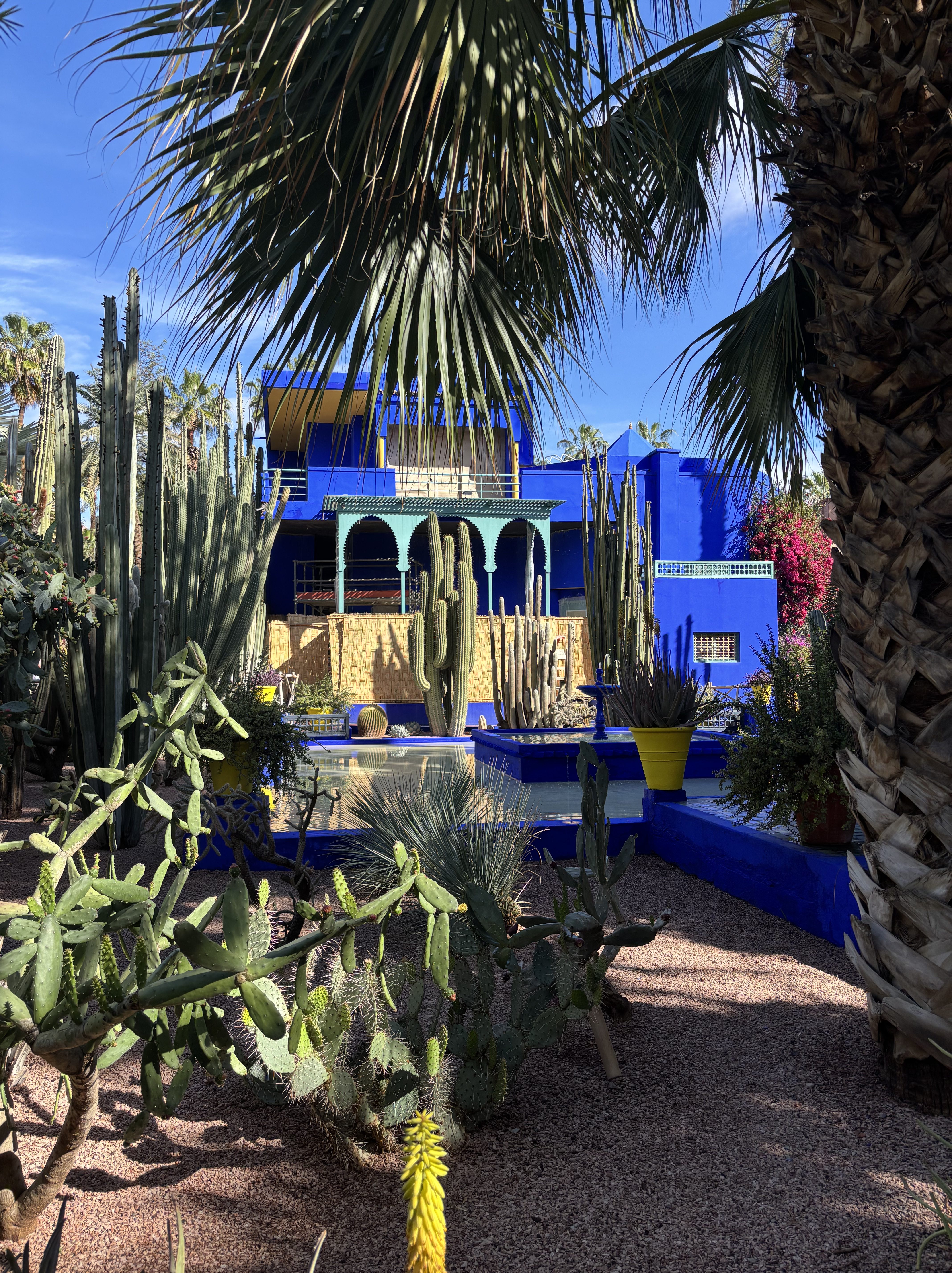
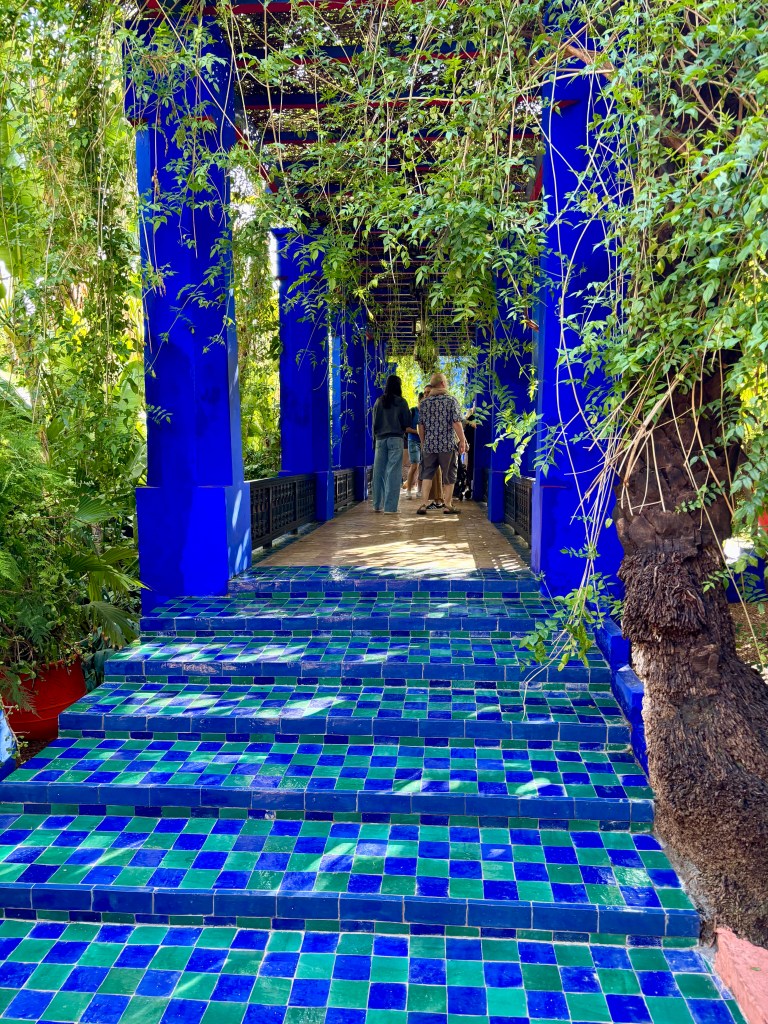
What strikes you first — before the plants, before the water, before anything else — is the colour. Majorelle blue is an intense cobalt-ultramarine that Majorelle applied to the walls, the pots, the trellises and the studio building itself. It is named after Jacques Majorelle, who developed and championed it as a signature of the garden’s architecture. Against the ochre of the Moroccan earth and the dusty greens of the planting, it vibrates. It does not look like a colour that belongs outdoors, and yet it seems to belong nowhere else. The effect is somewhere between painting and hallucination, which is perhaps exactly what a painter would intend.
The garden itself
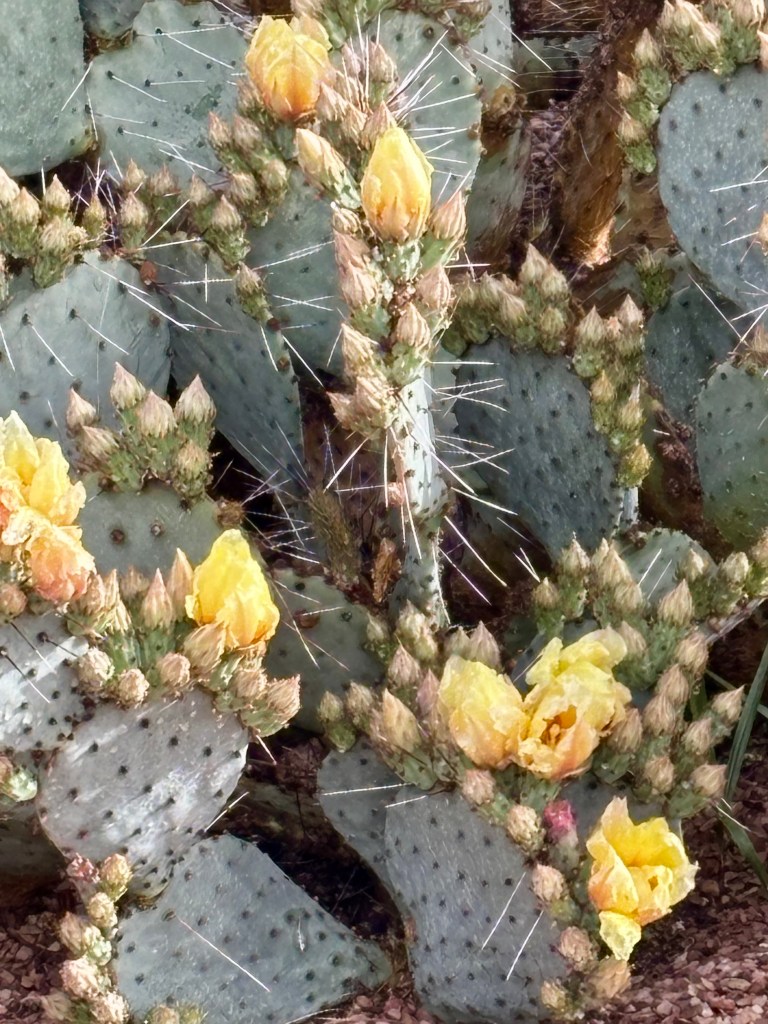
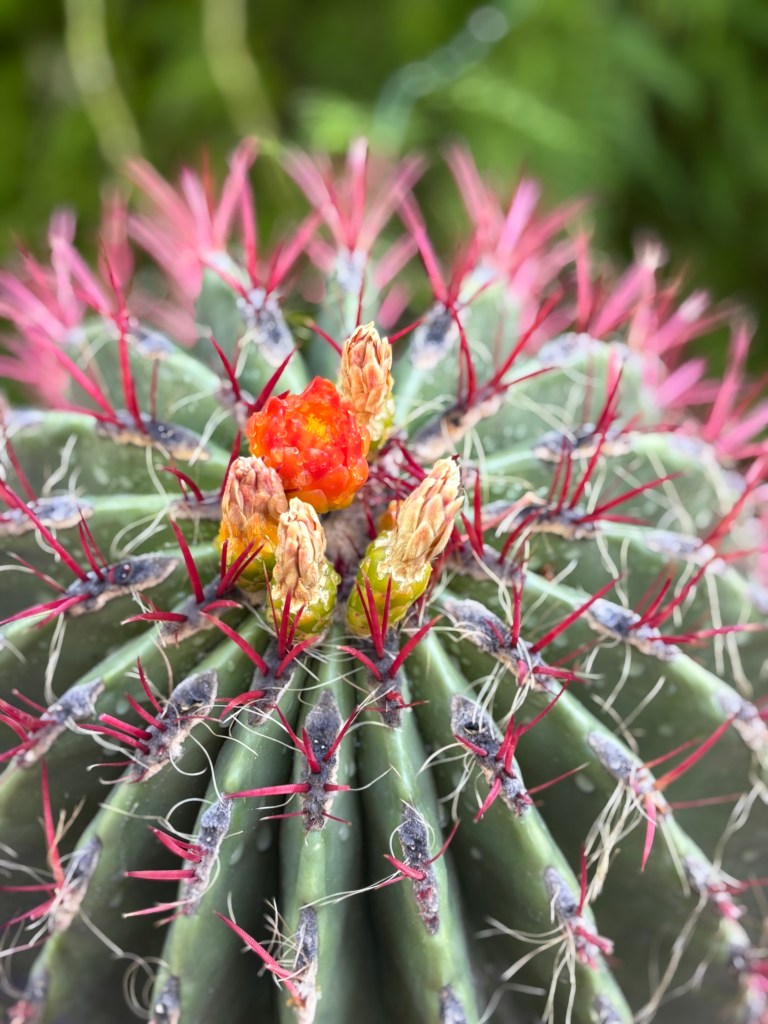
The planting is extraordinary in its range. There are palms of several varieties — tall, architectural, their fronds catching the light. There is bamboo, dense and rustling, creating shade and movement. And there are cacti and succulents in astonishing diversity: great columns, paddles, spheres and cascades, arranged with something between scientific rigour and painterly eye. Water features throughout — still pools reflecting sky and blue walls, the sound of small fountains threading through the quieter corners. Birds are everywhere, drawn by the water and the density of the planting.
What I came for
Within the grounds, the Berber Museum — housed in Majorelle’s original studio — holds a significant collection of Moroccan Berber art and artefacts: jewellery, textiles, ceramics, tools. It is a thoughtful and well-presented museum, and it deepens the visit considerably. Adjacent to the Majorelle Gardens is the Villa Oasis, the private residence that Saint Laurent and Bergé maintained as their Marrakech home; it is not open to the general public, but its presence is felt — the whole complex carries the atmosphere of a place that has been genuinely loved and lived in.
My friend moved through the cactus collection slowly, with the quiet intensity of someone genuinely in their element. He would stop, crouch, look carefully, sometimes just stand and weep at the beauty. I watched him more than I watched the plants. There is a particular pleasure — one that travel reliably offers if you are lucky with your companions — in witnessing someone you love encountered by exactly the thing they love. It does not require you to share the passion. It only requires that you are present for it.
Science and art among the plants
Within the gardens, I also encountered a botanical art exhibition that brought together original plant illustrations and informative notes about the species on display — a combination of scientific observation and aesthetic attention that felt entirely at home in this setting. The works extended the same dual sensibility the garden itself embodies: beauty pursued with rigour, looking closely at living things and finding both knowledge and wonder in the looking. It was a reminder that the Jardin Majorelle has always been more than a garden in the conventional sense — it is a place that takes plants seriously as subjects, whether the medium is planting design, painting, or the quiet discipline of botanical illustration.
For my own part, I was drawn to the lineage of creative purpose the place embodies. A French painter arrives in Morocco, falls under its light, and spends decades making a garden that is also a work of art. Decades later, one of the most significant figures in twentieth-century fashion discovers the same garden, saves it, and is buried there. The thread running through it is not merely aesthetic but devotional — a recurring act of attention to beauty, carried forward across a century by different hands.
That is what the Majorelle Gardens ultimately gave me: not simply a beautiful afternoon — though it was that — but an encounter between botanical passion, painting, fashion, and friendship. A place made luminous by the attention of several lifetimes, and by the quiet delight on the face of someone I love, standing in the middle of it all, looking closely at a cactus.
You might also like:
→ Some of my favourite Islamic sites – A photo essay
© Paul McCarthy & Iluminar.au

