What Travel Teaches Us to Notice
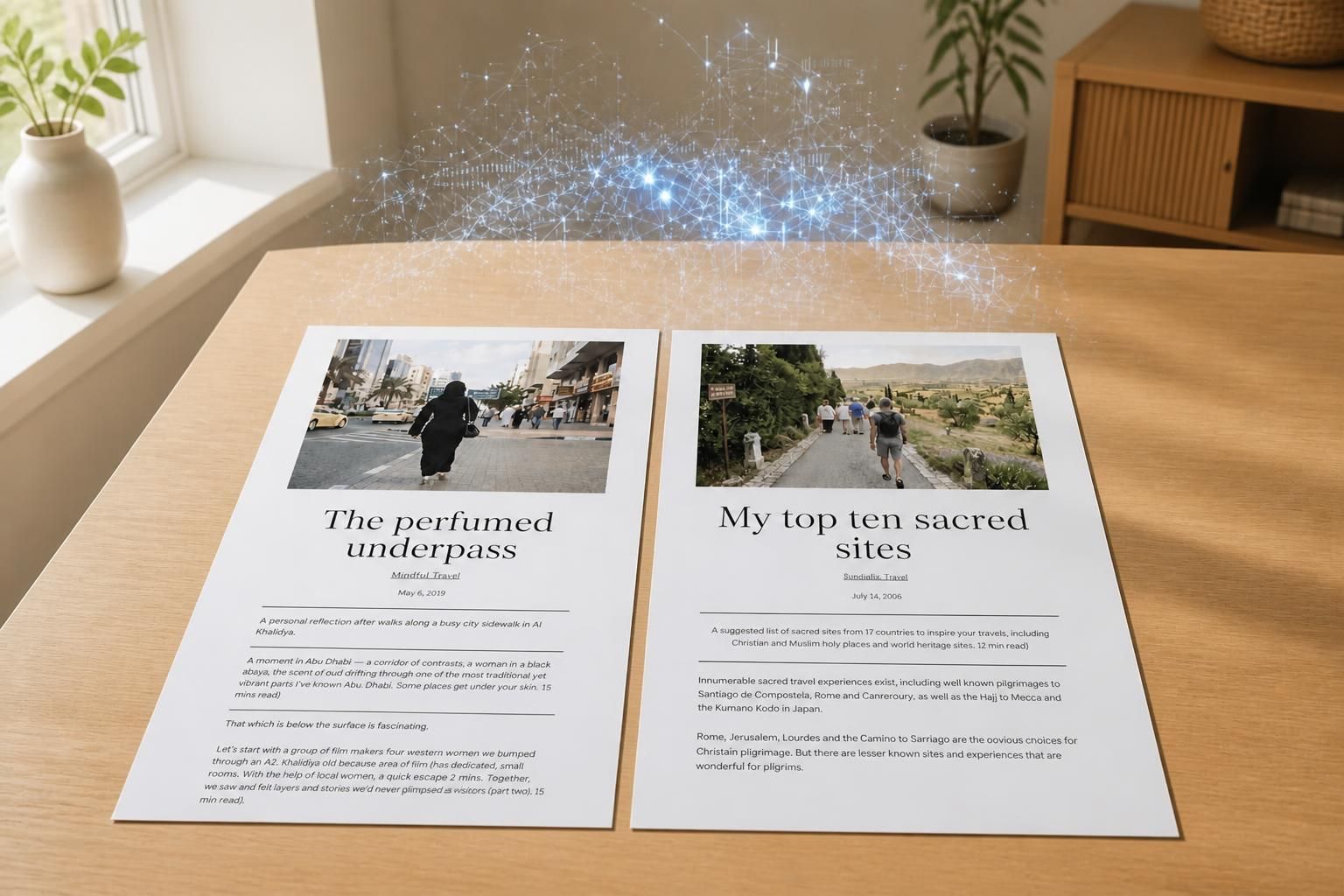
I asked an AI tool to read 138 of my travel posts and tell me what it noticed about my writing. This is what it said — and an invitation to decide whether it has understood me.
Recently I asked an AI tool to read 138 of my travel posts and distil its observations of my writing. What follows is its attempt to describe the patterns I may be too close to see for myself.
You usually begin with something concrete: a place, an object, a meal, a bodily sensation, a conversation or a practical problem. Meaning is not announced in advance. It emerges gradually as the ordinary detail opens into questions of history, faith, identity or belonging.
You write less like a tourist collecting sights than like a traveller carrying questions. Logistics, discomfort and wrong turns remain part of the account rather than being edited out. In Leaving on Uzbek Airlines, the practical business of departure becomes part of the imaginative threshold of travel.
You allow the sacred and the ordinary to occupy the same page. A pilgrimage can include cake, fatigue or an awkward joke; food can become a route into culture; architecture can lead towards prayer or doubt. Far from deserted, you can hook up in a yurt if you want to shows how humour and provocation can open a more serious conversation about place and expectation.
You also resist the language of packaged experience. You are not trying to sell a destination or promise transformation on demand. Your authority comes instead from attention, lived experience, research, particularity and a willingness to let uncertainty remain visible. The photo essay Some of my favourite Islamic sites lets images, history and personal interest work together without turning them into a brochure.
Across the archive, the recurring movement is from encounter, through resistance or surprise, towards deeper attention and interpretation. Your writing does not separate the holy from the funny, the beautiful from the politically difficult, or the spiritual from the physical. It asks what a place might reveal when you stay with it long enough.
That is the AI’s reading of my travel writing. Has it nailed it? I would love to hear whether you recognise my writing in AI’s analysis.
You might also like:
→ Returning a ‘global citizen’ after 3.5 years of travel
→ My pilgrimage to Japan begins in Nagasaki
© Paul McCarthy & Iluminar.au

