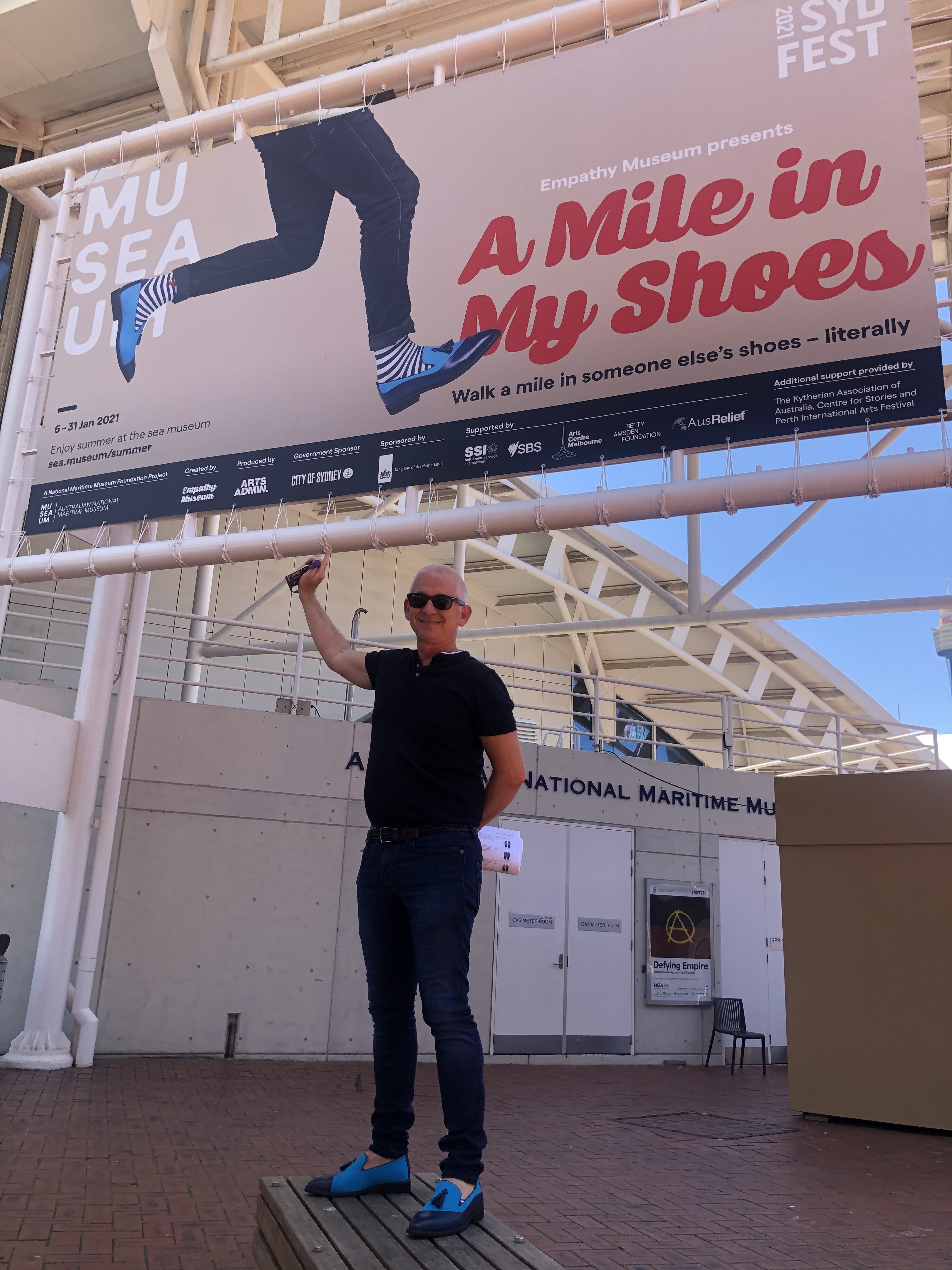
“A Mile in My Shoes”
In a world lacking in empathy, museums can create opportunities to experience it and build social cohesion. (5 min read)
Visitors to the Australian National Maritime Museum are often surprised to discover it is the only museum in the country that deals with Australia’s national migration story.
For 30 years to 2022, the Museum made an important contribution to social cohesion by showcasing diverse migrant stories. This was done through collecting, exhibitions and programs, rooftop projections, very popular educational resources, as well as research and publications and partnerships with government and non-government organisations focused on Australia’s migrants.
In this post I want to describe the most important migration themed initiative by the Museum in the 6 years I worked there – “A Mile in My Shoes”.
But first, a bit of context.
Australia is one of the world’s great migration nations, receiving more than 10 million migrants since 1788. Most of us descend from migrants – 29% of our population was born overseas and more than 50% were either born overseas themselves or have a parent that was born overseas. We are also outward in our focus. Australians are well-travelled and curious about the world.
When we ask where someone is from, it is not to separate ourselves from them, but rather to better understand them and their culture.
Museums can leverage this curiosity to support social cohesion, to create opportunities to listen to each other, to acknowledge different perspectives, to appreciate each other and consciously avoid the divisiveness we see so plainly in parts of the world.
Junot Díaz, Winner of the 2008 Pulitzer Prize, once said
“If you want to make a human being into a monster, deny them, at the cultural level, any reflection of themselves”.
To truly understand Australian identity, we must strive to ensure high quality, innovative exhibitions that centre all voices, but particularly those at the margins. And, with this goal in mind, and as a policy and strategy person, I searched for examples of better practice that could be applied to Australia. And that’s how I found Clare Patey.
Patey is the director of the UK’s Empathy Museum. The Empathy Museum describes itself as “a series of participatory art projects dedicated to helping us look at the world through other people’s eyes. With a focus on storytelling and dialogue, our travelling museum explores how empathy can not only transform our personal relationships, but also help tackle global challenges such as prejudice, conflict and inequality”.
For the 2021 Sydney Festival, directed by Wesley Enoch, the Museum partnered with the Empathy Museum to bring its most famous installation, “A Mile in My Shoes”, to Sydney but with a migrant focus.
The installation involved a large shoebox which functioned as a “shop” in which visitors were invited to – literally – walk in the shoes and listen to the stories of 35 different migrants of various ages and countries.
I tried every pair of shoes and listened to every story that went with them. Although some of the stories were sad, the overwhelming experience was uplifting and connecting. My favourite story was a Sikh taxi-driver from Perth who wanted to learn to swim after migrating to Australia – I had never thought about the challenge of getting a turban into a bathing cap. This man was open, warm and funny. Just the kind of person you want to be friends with.
The installation was commended by visitors and the media but, when we conceived it, we had no idea the world would be in the midst of a public health pandemic that would deter visitors and introduce unexpected complexity to how it was delivered.
In many respects, this installation reflected the zeitgeist. In his inauguration address, a week before the opening of the installation, US President Joe Biden said:
“We can do this if we open our souls instead of hardening our hearts, if we show a little tolerance and humility, and if we’re willing to stand in the other person’s shoes…..Just for a moment, stand in their shoes!’”
Getting this project approved and implemented had highs and lows which, in retrospect, mimic our country’s division over the issues of migration, race and cultural difference.
As the Maritime Museum centres the Captain Cook story, much of its base is white, conservative and living the past. On the other hand, there were many staff, volunteers, individuals and organisations of goodwill – champions of human rights, diversity, inclusion and the power of story-telling – who got behind this heart-felt, visionary project. The Museum’s fundraising arm also courageously underwrote the project and our small team worked tirelessly to build a strong coalition of important sponsors and supporters, plus over 100 individual donors and 70 community organisation supporters.
This coalition of support for sharing the stories of Australia’s migrants paved the way for my proudest achievement at the Museum: upgrading the status of the Museum’s “Welcome Wall” to “Australia’s National Monument to Migration”.
Ironically, despite the election (twice) of a seemingly more progressive Federal Government, social cohesion has gone backwards rapidly in Australia and the voices we worked so hard to amplify are currently drowned out by more powerful interests.
I still strongly believe in the need for empathy and know that we are at our best when everyone is and feels included.
Watch the video on YouTube to find out more about “A Mile in My Shoes”.
© Paul McCarthy & Iluminar.au

