Chasing Caterina around Siena
A full day following St Catherine of Siena through her city — the duomo, the pilgrim hospital, San Domenico, and the remarkable chapel where she exchanged hearts with Jesus. With local guide Anna Piperato and an unexpected materialisation photograph. (6 min read)
My second day in Siena involved visiting the sites connected to St Caterina and the pilgrims.
I started by walking from Porta Camollia – the gate through which the pilgrims on the Via Francigenia entered the city. One can take the pilgrim route past the Templar hospice (which later became a church) to the hospital (which had the function of hospitality, then healing, then orphanage and later commercial activities).
There is a combined ticket that covers entry to Siena’s duomo and crypt, the baptistery and a museum. The facade of the duomo, and indeed the existing and incomplete extension of it, are stunning to modern eyes and must have been unbelievable to the pilgrims. The duomo’s proportions and the artistry and remarkable but it pains me that for many visitors the focus is upon these things rather than the love of God which motivated their construction. It is lazy to presume our ancestors were ignorant and superstitious rather than faithful and connected. Indeed, there is much in our modern world that undermines our connection – noise, pace and commerce in particular.
I don’t think it is possible to capture the duomo in photographs and maybe that is the point. It is so expansive and complex and uncapturable – a bit like all that is. However, there are some elements that are particularly remarkable and have stayed with me – firstly, the beautiful marble flooring which includes graves but also inlaid art works of a beauty and complexity I have not seen before. Secondly, the ceilings are about 50 metres high – enabling not just connection with one’s higher self but the presence of a huge number of benevolent beings under the roof. One of the chapels (or perhaps former sacristy) is fully frescoed and includes illustrated music books for the choir – this jewel box of frescoes is hard to decipher if you do not know Sienese history but the representation of the death of S Caterina is obvious. The crypt and the baptistry are tiny in comparison but impressive nonetheless – again with frescos and marble sculptures.
I spent a couple of hours in the former hospital of the pilgrims. This is a complex and impressive site being used to tell both the story of the building and its functions, as well as exhibit art. The building houses a confraternity of S.Caterina on a lower floor with numerous representations of her. The street level includes the pilgrims hall with frescoes illustrating its mission and a specially designed room displaying a very impressive collection of relics, including passion relics with provenance to S Helena. For sure this collection would have been a magnet for pilgrims. On the lower floor I found an interesting and unusual contemporary art exhibition by Teodora Axente (Romanian) influenced in part by the relics. The tour ends with a large donated art collection which I found a mixed bag – there were some good portraits of Caterina and Francesco but also a lot of works that were not of interest to me.
I retraced yesterday’s path to visit the Church of San Domenico only to realise I had lunch directly in front of it yesterday but shut it out because of the sound of chainsaws taking out trees out front.
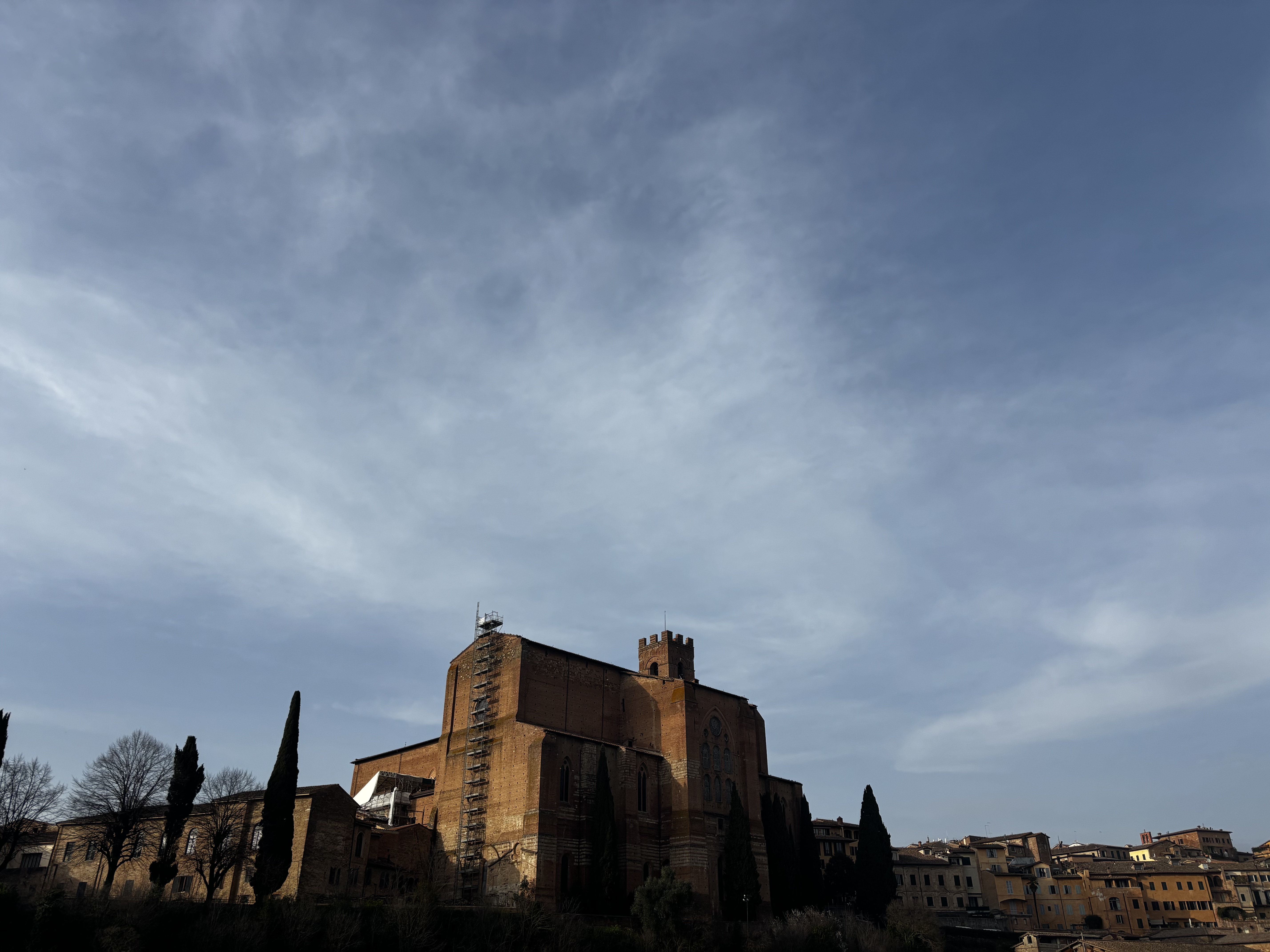
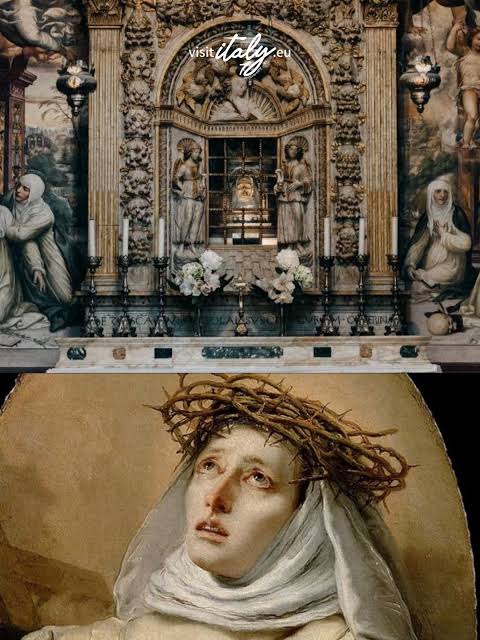
Like so many churches on this trip, there was a lot of empty space in San Domenico and one wonders if it was always thus – with most of the congregation standing in medieval times or if in fact attendances are smaller. This church most famously has the head of St Caterina and so draws crowds for that. Photographs are not permitted inside the church at all but which, on one hand is good in stopping it being a tourist attraction but the downside is we don’t have our own electronic records. I can understand no photographing of the relic but I suspect the church shop has an interest in stopping photos of the paintings and interior of the church. While I could find a photo of S Caterina’s head online, I could not find photographs of the others things in the church that interested me.
To the right of the entrance of San Domenico is a raised chapel which includes the famous painting of S Caterina and a devotee by Andre Vanni which is said to be lifelike and was painted in her lifetime. What surprised me about this painting is that the version I know and use is cropped omitting another person in the original – I would like to know more about that person. The floor of this upper chapel has three markings related to important stories from Caterina’s life – there is a heart (marking the spot where she exchanged hearts with Jesus), a cross (marking the spot where she gave her silver cross to a beggar who turned out to be Jesus) and a third symbol representing the giving up of her cloak to a beggar (who again turned out to be Jesus). I found the spot of the heart highly energised and when I stood there praying I again had the same sensation of the visit to the chapel of the incorrupt hosts in the Church of San Francesco – it was a combination of pressure on my ears but a deep, peaceful silence. This is new.
I was unable to place my rosaries on or near the head of St Caterina but I did place them on the glass of a cabinet that includes her the relic of her finger and the bronze reliquary that used to contain the head. I had the rosaries blessed in Caterina’s name by a priest at the church.
In terms of the head itself, the most remarkable thing is that it did not look decomposed to me. Whether this was lighting or my vision or my interior vision I do not know. Most of the photographs online indicate a clearly deteriorated head… but that is not what I saw.
After taking some photos of the exterior of the church I revisited Caterina’s sanctuary (the former family home) which includes a chapel with an altarpiece being the crucifix from Pisa in front of which she received the stigmata. Next I headed back up to the spot where Caterina said she saw Jesus in a pontifical crown about the Church of San Domenico. I received a materialisation photograph here (most interesting the image was present for several seconds). I thought it was Jesus but Anna is convinced it is Caterina. It certainly has Caterina’s nose but I’m not sure it is her.
© Paul McCarthy & Iluminar.au

