What can we learn about San Francesco from Perugia
Perugia holds an important place in the story of St Francis — he was imprisoned here, and it changed him — yet the city acknowledges him barely at all. A pilgrim’s frustrating and illuminating search for what remains. (5 min read)
Perugia is the capital of Umbria, the same region that Assisi is part of. It is a much larger and seemingly more affluent and powerful city. It has some interesting historical buildings and the National Gallery of Umbria, but it also has a lot of graffiti and scruffy people. While it is a hilltown like Assisi, it has adapted to modernity with a mini-metro and escalators that make getting up the hill very easy.
Perugia is very important to the story of Francis. He spent a year in prison in Perugia when he was captured in a battle between the two cities. Francis was ultimately ransomed but he was unwell and the experience was transformational for him.
Given Perugia was directly implicated in all that followed in Francis’ life, I expected markers, monuments and celebration of Italy’s patron saint but this is not the case.
Aside from a street and neighbourhood named after him, I saw no public acknowledgement of Francis. The huge church of San Francesco del Prato has been deconsecrated and, after almost a century of abandonment, is a performing arts venue (but bizarrely called a museum without any objects).
San Francesco is not prominent in the Duomo. There is an unusual statue of him – standing ramrod straight and looking solemnly upwards – but there are no paintings of him. I started to think the old grudge towards Assisi had not healed.
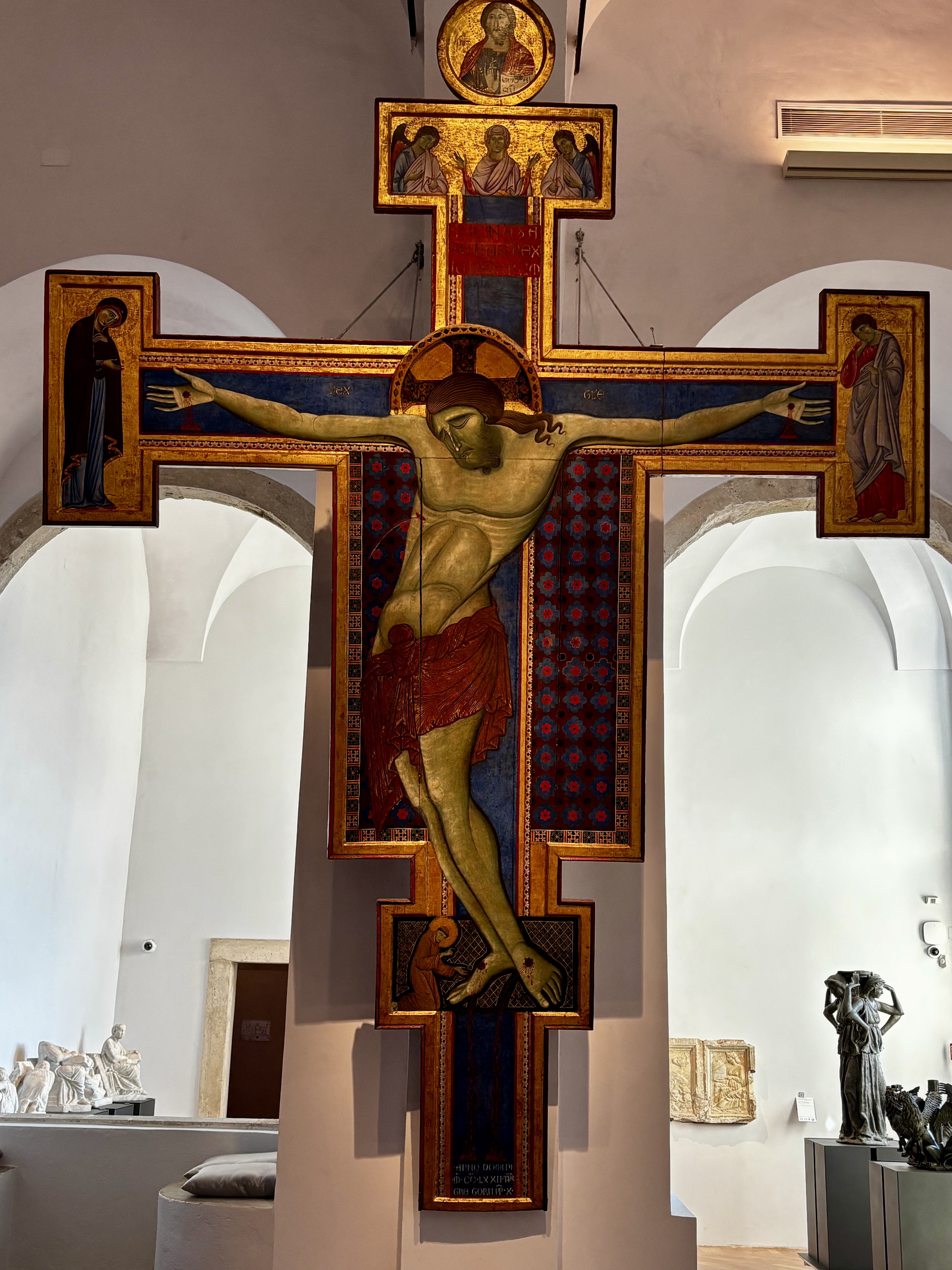
In contrast, behind the paywall of the National Gallery of Umbria, there are many paintings and religious objects with representations of San Francesco. (Note this is the gallery of the region and while located in Perugia it is not just about art from Perugia). The Gallery seems proud to hold the first crucifix with Francis’ image – it is mammoth and we see a tiny little Francis kissing Jesus’ feet.
Nobody in Perugia – not even the staff at the art gallery or the SF del Prato museum – could direct me to the site where Francis was imprisoned.
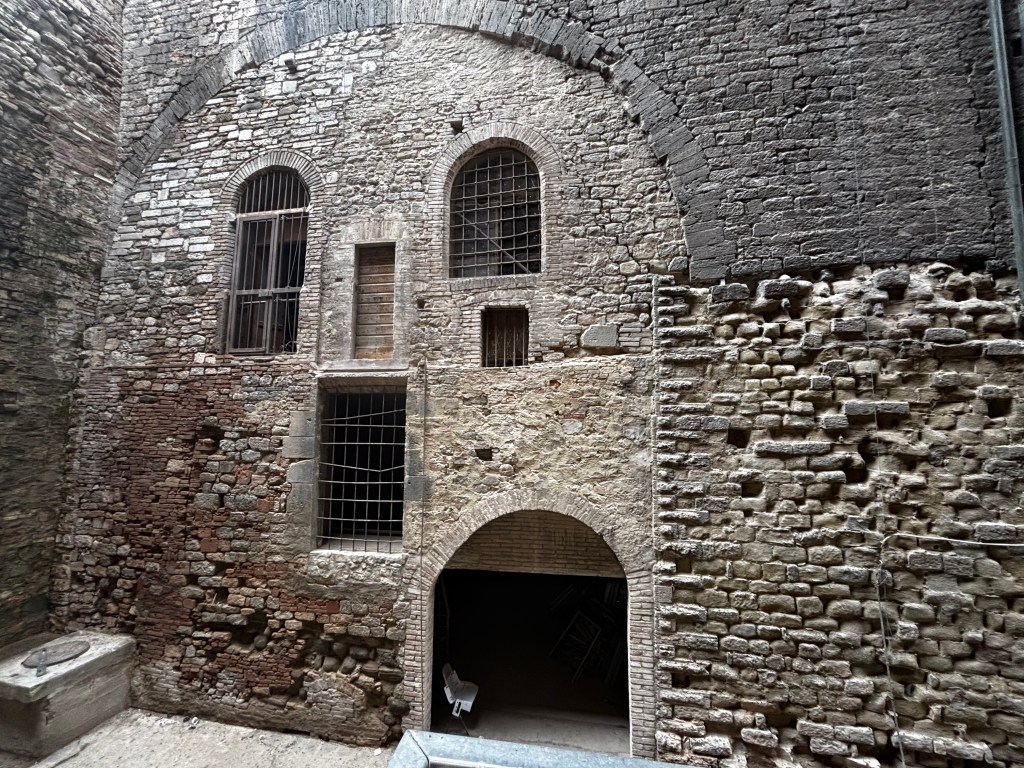
After some hunting online I found an old newspaper article championing the restoration of the site of Francis’ imprisonment. After hours of walking around, I was astounded to discover that “the prison of San Francesco” is to be incorporated into the city’s Chocolate Museum which opened at the end of 2025. I was told the prison, which is in the basement of the Loggia Del Lanari – an impressive building on Piazza Giacomo Matteotti housing the appeal tribunal – is not yet ready for visitors. So I tried to get in anyway through the car park in the museum building. No luck.
The chocolate museum is a transparently tatty commercial tourist attraction that I decided did not deserve my money. To their credit, it has some free public facing panels about the history of the site indicating it has been the location of city market since the early 19th century with lots of changes over time. When I revisited all this with the Tourist Office, they said that it is unlikely there would be any original material from the time of Francis. So what should be one of the city’s major landmarks will probably be a bit like Disneyland.
At this point, there is sadly little for pilgrims to connect to in Perugia but I am curious to see what they do with the prison. I can testify that the chocolate is good here and the pedestrian historic centre makes it a nice place to visit. For me, its best quality is ready access to other towns on the way of St Francis.
© Paul McCarthy & Iluminar.au

