Meet me in the library – I love books
Let me introduce myself through my love of books. From novels that survived a flood to saints’ lives, Spiritism, Islamic art and the art of pilgrimage — a tour of a library that maps a life. (15 min read)
Let me introduce myself through my love of books.
If you ask someone to describe my house, they will begin with two things – the way that it smells and the library.
I like the house to smell like a holy place – oud, frankincense, cedar, sandalwood, clove and cinnamon. But there is also the smell of paper and leather because I live in a house full of books.
From the front door to the back door, and everywhere in between, there are books. Some are half-read, others dog-eared from repeated reading and there is a pile waiting to be read.
I can pretty much plot the course of my life, and my evolving interests and passions, from the books in my library. But I confess there is a heartbreaking gap of several thousand books that became too water-damaged to keep.
Are you curious?
I love great stories
I grieve for the lost ones, mostly paperback novels from the mid-1980’s to the mid-2000’s.
This was a time when I tried to keep up with new writing from Australia and abroad: all kinds of stories and all kinds of writing. Like long gone friends, I occasionally find myself looking for a book that I lost to the water.
I kept about 20 books that were – despite their swollen, distorted bodies and musty smell – too precious to give up. These were mostly novels that I loved as a young man. The stand-outs are hard to replace and I find it curious that in late middle age I still love them all.
Books like “A river runs through it” by Norman Maclean (1976) – a book about being and having a brother which I read so many times the back cover became detached.
Classics, which are dog-eared from use, like “The House of the Spirits” by Isabel Allende (1985), “Perfume” by Patrick Suskind (1985), Julian Barnes’ “A History of the World in ten and a half chapters” (1989) and AS Byatt’s Booker Prize winning “Possession” (1990).
But I also kept some really funny books like Jeanette Winterson’s “Boating for Beginners” (1985), “The Beauty of Truth” by Bruno Bouchet (1999) and “The Visitation” by Sue Reidy (1996).
And literary heroes from my part of the world like “The Bone People” by Keri Hulme (1985), David Malouf’s “Imaginary Life” (1978) and “12 Edmondstone Street” (1985) – the latter linking me to my first home a few doors away.
If I had to name a favourite survivor it would be “The Kadaitcha Sung” by Sam Watson from Meanjin (Brisbane). “The Kadaitcha Sung” (1990) was the first book I read by an Australian Aboriginal writer. I worked with the author’s mum, Eunice, and she was also the first Aboriginal person I befriended. Estelle Castro provides a nice synopsis of Watson’s book:
The Kadaitcha Sung tells the story of Tommy Gubba, son of Koobara, son of the chief of the Kadaitcha clan, and Fleur, a white woman, of Northern European descent. Tommy was born secretly after his uncle Booka Roth killed his father to become the last of the Kadaitcha clan. The Kadaitcha clan is in the novel an “ancient clan of sorcerers” called by Biamee to stand among the tribes of the South Land (i.e. Australia) when he returned among the stars. Tommy is initiated and called by Biamee to recuperate the heart of the Rainbow Serpent stolen by Booka Roth, without which Biamee cannot “complete his earthly manifestation”. Ensuing from the war that Booka waged against his own people, the veil of mists that Biamee had set upon the South Land is lifted, and “other mortals” come from “all corners of the globe and from every branch of the family of man” and join forces with Booka, defeating the tribes of South Land that cannot match the weapons of the invaders. Tommy is to take revenge on the migloo (“fair-skinned” people), who have “raped and pillaged” his people, and conquered the entire land. A fast pace narrative, The Kadaitcha Sung is also an action-packed novel, to which this quick introduction cannot do justice.
Australian political biography, history and social issues
I have quite a few books about Australian political biography, history and current events, including reconciliation with our Aboriginal and Torres Strait Islander peoples.
I love many of these books but there are three first editions I cannot live without – “The Truth of the Matter”, which is Gough Whitlam’s account of the unlawful dismissal of his government by the Governor General John Kerr in 1975, Al Gabay’s “The Mystic Life of Alfred Deakin” about the spiritualist practices of Australia’s second Prime Minister, and “Sir William Deane: The Things That Matter” by Tony Stephens.
William Deane is my hero. There is no other person in Australian public life, past or present, that I respect more. A close friend once described Deane as “a living saint” and with the passing of time, and the polarisation of public discourse in our country, this is now obvious.
Deane was Australia’s Governor-General from 1996 to 2001 and the contrast with the aforementioned John Kerr (whose biography I also own) is dramatic. In case you don’t recall, 1996 was a very challenging year for Australia with the election of a regressive, conservative government, including the evil Pauline Hanson.
Deane, a former High Court Judge, made it clear from the beginning of his appointment as GG that he would focus on the most disadvantaged – Aboriginal Australians, immigrants and the poor. He gave thousands of speeches and was a wonderful, uplifting, unifying force for our country, particularly during times of tragedy and division. Stephens’ book is ‘an attempt to understand what made Deane the governor-general he was and to draw together the strands of the Australian identity that he feels matter most.’ The book contains a lot of biographical material as well as many of Deane’s most important speeches.
While Deane’s speech on the centenary of Federation is widely applauded, my favourite – the one that most impacted me – was given on the eve of Australia Day in 1999 at the Australian National Maritime Museum in Sydney – a place I would come to work at and love many years later. This speech crystallised and crowned a theme that Deane had been addressing for years in response to “race wars” and division that were personified by Hanson. Launching the “Welcome Wall” to honour Australia’s migrants, Deane says:
Apart from the Aborigines and Torres Strait Islanders, we Australians are all migrants or descended from migrants. Directly or indirectly, we come for all the regions, races, cultures and religions of the world. At the same time, the inscription [inaugurating the Welcome Wall] stresses our national unity. In doing that, it reminds us of the fact that perhaps the greatest of all our achievements is the multiculturalism which has enabled our diversity of origins, beliefs and backgrounds to be a source of strength rather than of divisiveness and weakness. The essence of multiculturalism is inclusiveness. It has enabled us to achieve national unity and to escape most of the old hatreds and old conflicts which have afflicted some of the lands from which we or our forebears have come. That multiculturalism both sustains our nation and symbolises what we are.
Deane still speaks for me and all people of good will. And when I feel disheartened by the selfish, right-wing xenophobia that has distorted multicultural policy in Australia, I return to his speeches and feel the soothing balm of deep, deep compassion, fairness and good judgement.
In addition to novels, biographies and books about politics and social issues, my library focuses on three other passions: art, spirituality, and travel. Predictably, I have books that straddle these areas.
Visual arts
There are hundreds of art books in my house – monographs, catalogues, biographies, text books and art history classics – mostly in a special cabinet in the living room.
I started “collecting” books about the world’s greatest painters when I was in high school. The first one was a retrospective about Claude Monet edited by Charles F Stuckey. About an inch thick, with hundreds of colour plates, this book activated in me an interest in French art. I spent hours studying the plates and seeking to understand what made Monet’s work so special.
Art history requires understanding of what came before, what was occurring at the time, and what followed. So I set about educating myself about French painting through an ever-expanding collection of books, visiting art exhibitions and, ultimately, studying art-history at the American University of Paris.
I loathe the idea of parting with any of my art books. But if I could keep only three of them, my highest priority would be Nicholas Watkins’ monograph about Pierre Bonnard which was a 30th birthday present from my grandmother. Bonnard is a post-impressionist and I associate him with my time in Paris. I keep a poster of my favourite of his works – a child making a sand castle – in my living room.
Half of my classes at the American University of Paris were spent in the Musee d’Orsay. This former train station has an unsurpassed collection of French impressionist artworks. The catalogue from my student days now seems obsolete but it is precious.
Twice a week for 3 months I looked intensely at Edouard Manet’s “Olympia”. And 12 days were devoted to reading and talking about this painting. TJ Clark’s “The Painting of Modern Life: Paris in the Art of Manet and His Followers” was a set text. Clark argues that “Olympia” embodies the characteristics of modern life and modern art. He said that Manet’s painting breaks away from traditional representations of the nude, introducing a sense of realism and immediacy that aligns with contemporary urban experiences. The painting was scandalous in the late 19th century and one hundred years later was a lightening rod for discussions about the representation of women (and cats). I appreciate it, but I still hate it.
I own a lot of museum catalogues but there is one that is particularly special. It is a gift from the former Australian-born director of the Museum of Islamic Art in Doha.
I was visited MIA in 2019 to see an exhibition about the cultural heritage of Syria. The museum building, designed by I M Pei, cleverly references Qatari women’s traditional clothing and is marvellous.
MIA’s collection is superb and the catalogue inspired me to learn more about Islamic art and architecture and I now have quite a few books on these topics, my favourite being Yaffa Assouline’s “Uzbekistan – The Road to Samarkand”(2019).
Holistic health, wellness, personal development, spirituality, esoterica and faith
When a dear family member died on Holy Thursday in 1998, my life – and my library – changed dramatically. I became very interested in holistic health, wellness and personal development. This later morphed into esoteric and “new age” topics. And after visiting Brasil, my focus changed to Christian Spiritism, then the lives of the saints, then pilgrimage and ultimately the world’s great religions, especially Christianity and Islam. So these spiritual topics are, collectively, a large part of my library. It is challenging to single out which of these books are most dear to me, so I will mention that ones that I have returned to the most.
In 1998, a dear friend recommended I read “The Legend of Altazar: A fragment of the true history of planet Earth” by The Hermit of the Crystal Mountain. Channelled by Solara in 1987, this book was unlike anything I had ever experienced. One does not so much read this book as become immersed in it. Internationally regarded expert on death and dying, Dr Elisabeth Kubler-Ross gave a very helpful testimonial for this book:
It is a true story written in symbolic language. It is your history and my history – your destiny and my destiny. It is a tale of Lemuria and Atlantis, detailing the fate of both of these great ancient kingdoms.
It is full of wisdom, ancient knowledge and cues for all of us who have served here for aeons. It helps us understand why some of the most decent, most deserving people have to go through lifetimes of pain and lack of self-love in order to serve a Higher Purpose.
Maybe this book will bring back glimpses of memory as the reasons behind such apparent difficulties. The truth is that we agreed to undergo turmoil, to supposedly fall from grace, and ultimately to reawaken thereby raising ourselves in order to lift the entire planet to a higher level of consciousness and thus save Earth from the destiny of Atlantis.
It is MUST reading for all those who want to truly understand the twisting paths of destiny and the Purpose behind it all. Finally, it is a book of victory and survival for you and me and planet Earth.
The writings of James Twyman, a travelling troubadour who would risk his life to sing prayers of peace in places of conflict also impacted me deeply. His 1996 book “Emissary of Light: My Adventures with the Secret Peacemakers” is about a group of mystics praying for peace during the war in the former Yugoslavia. In my experience, it is also a sacred tool to activate deep peace, compassion and awareness of divine connection. I returned to this book many times until I visited nearby Medjugorje – which is also the place of apparitions of the Virgin Mary.
The trajectory of my life changed dramatically in 2008 when I was introduced to Christian Spiritism on a trip to Brasil. I read widely on this topic but was most influenced by two books.
“Nosso Lar: An account of life in a spirit colony in the world of spirits” from the Spirit of Dr Andre Luiz was channelled by the medium Chico Xavier (1910-2002).
Nosso Lar is the name of the spirit colony that the spirit Andre Luiz presents to us in the first book of his acclaimed series. In a compelling narrative, the author tells of his impressions and discoveries about life in the spirit world, acting as a sort of journalist who records his own experiences as they occur. Andre Luiz unveils to us an exciting world, filled with life and activity, and which is organised in an exemplary way. It is a place where discarnate spirits go through a recovery stage and a spiritual educational process supervised by higher order spirits. Nosso Lar enables us to get a glimpse of the spirit world that awaits us after we leave our physical bodies.
From the same tradition, but altogether different, is “The Spirits’ Book” by Allan Kardec (born Hippolyte Léon Denizard Rivail) (1804-1869). Kardec, who is known as the codifier of Spirtism, was a scholar and teacher with qualifications in medicine, education and many languages. In his early 50s he became interested in séances. He began his own investigation of psychic phenomena, mainly mediumship, compiling over 1000 existential questions which were put to ten different mediums. The commonality of the answers convinced him of mediumship, the existence of the spirit world and our ability to actively engage with it.
Kardec compiled the best answer to each research question into “The Spirits’ Book” which became the foundation of Spiritism. The first question in this book is “What is God?” and the last is “Will the kingdom of the good ever be realised on earth?”. These, and all the other questions in this book, deserve deep reflection. “The Spirits Book”, and the other 5 in this series, are a most extraordinary gift to humanity. The information provides us with a moral code for spiritual progress.
As with Altazhar and the Emissaries, one does not just read “The Spirits’ Book”, one instantly integrates the information. Spiritist groups all over the world study this book (and the other 5), reflecting deeply on the answers provided by the Spirits and applying the principles to daily life. This study is complemented by charitable and fraternal acts, including transmission of healing energies. I love everything about “The Spirits Book” but especially the way it is programmed to to support us to integrate deep truths.
Congruent with Spiritism, “Many Lives, Many Masters” by Dr Brian Weiss was published in 1988:
Psychiatrist Dr Brian Weiss had been working with Catherine, a young patient, for eighteen months. Catherine was suffering from recurring nightmares and chronic anxiety attacks. When his traditional methods of therapy failed, Dr Weiss turned to hypnosis and was astonished and sceptical when Catherine began to recalling past-life traumas which seemed to hold the key to her problems.
Dr Weiss’s scepticism was eroded when Catherine began to channel messages from “the space between lives”, which contained remarkable revelations about his own life. Acting as a channel for information from highly evolved spirit entities called the Masters, Catherine revealed many secrets of life and death.
This fascinating case dramatically altered the lives of Catherine and Dr Weiss, and provides important information on the mysteries of the mind, the continuation of life after death and the influence of our past life experiences on our present behaviour.
Studying Spirtism made me to wonder about the backgrounds of the good spirits helping at the centre I attended in Brasil. Beginning with the autobiography of St Ignatius of Loyola, I read a lot of books about the saints. My favourite – “Lives of the Saints for every day of the year” was edited by Hugo Hoover and published in 1955. This precious book belonged to a dear friend’s late mother. It is practical book that gives inspiration from the saint of the day. I started writing this piece on 19 July, the feast of St Vincent de Paul. Hoover gives a brief biography of the saint, an insight into his charism and ends with a prayer for us to be graced with the same virtues and to pray for his intercession.
I sometimes think I could be living a parallel life with Father James Martin. An American Jesuit priest, Martin’s “My life with the saints” (2006) is the book I intended to write. Martin gives a short biography of each of the saints that are important to him and explains their role in his life. The book features chapters on some of my favourite saints, as well as others I had never heard of.
“Holy Bones, Holy Dust: How relics shaped the history of Medieval Europe” by Charles Freeman (2011) is compelling. It reveals how relics were used in religion and also in business, politics and warfare. It also contains photographs of relics and reliquaries and is one of my go-to books for pilgrimages to Europe.
Likewise, “The Incorruptibles” by Joan Carroll Cruz (1977) is fascinating. The book is a classic on the bodies of saints that did not undergo decomposition after death, with many remaining fresh and flexible for years, or even centuries. I use this book to plan pilgrimages.
Travelling the world
The final and most rapidly growing part of my library is the travel section. It is a combination of travel narratives and history books about the places I have visited or want to visit. It ranges from large photo compilations to brief writings. There are many anthologies, as well as deep dives. There are a few travel guides as well but, quite frankly, I really only like the guides from Traveller’s Tales and Bradt publications. The most well represented places are France, Italy, Spain and the Middle East and North Africa.
“The art of pilgrimage – The seeker’s guide to making travel sacred” by Phil Cousineau is a book I cannot part with. Written in 1998, it is beautiful and smells great. But I also have the audio version (narrated by Efrem Zimbalist Jr) and a copy on my Kindle. This book and “Pilgrimage – Journeys of Meaning” by Peter Stanford helped me to make sense of my own need to visit holy places connected to the life of Jesus, Mary and the Christian saints, as well as the importance of pilgrimage in other faiths. Cousineau’s book is linear – framed around topics such as the longing, the call, departure, the pilgrim’s way, the labyrinth, arrival and “bringing back the boon”. Whereas Stanford illustrates pilgrimage concepts by journeys to 12 sacred places, including Santiago de Compostela, Jerusalem, Mecca, Machu Picchu and the Marian shrines.
I am yet to walk the camino to Santiago de Compostela but I have read a lot about it. A favourite book is “The Camino – A journey of the spirit” by Shirley Maclaine (2000). Maclaine is not just a good storyteller, she is also a spiritual teacher, and this book is full of interesting insights. Her observations about the earth energies of the camino are particularly interesting and affirming of my experience in other places.
I have read Elizabeth Gilbert’s 2006 best selling memoir “Eat, Pray, Love” several times. Her voice is authentic, the narrative is compelling and there is a universality of experience and yearning that hooks me in. She is transformed by travelling to Italy (where she eats), India (where she practices meditation) and Bali (where she gets insight into her own relationship patterns and falls in love with a Brasilian). While there is a lot of self-reflection in this book (too much on some days), the writing is also evocative of places I have visited.
“Shopping for Buddhas” is Jeff Greenwald’s 1990 story of an obsessive search for the perfect Buddha statue. As the blurb nicely explains, “in the backstreets of Kathmandu, he discovers more than he bargained for… and his souvenir hunting turns into an ironic metaphor for the clash between spiritual riches and material greed. Politics, religion and serious shopping collide in a witty, thought-provoking account of his experiences in Nepal”. Having searched for my own perfect Buddha statue, I can relate to the obsession and empathise with the turmoil of discerning the right thing to do with someone else’s cultural property.
The last travel book I must share is Alexia Brue’s “Cathedrals of the Flesh”. Written in 2003, this book mirrors my own tendency to obsessively collect experiences. And, after spending so much time visiting churches, I could not resist the title. Brue writes about her experience of public baths from France to Turkey, Russia, Finland, Japan and the USA. She uses these visits to share cultural insights and some practical hints. Being a clean freak myself, this book inspired me to visit bathhouses in Germany, Hungary, the USA and Japan.
The most exciting thing about new books is that you never know which one might become a new favourite that you cannot live without.
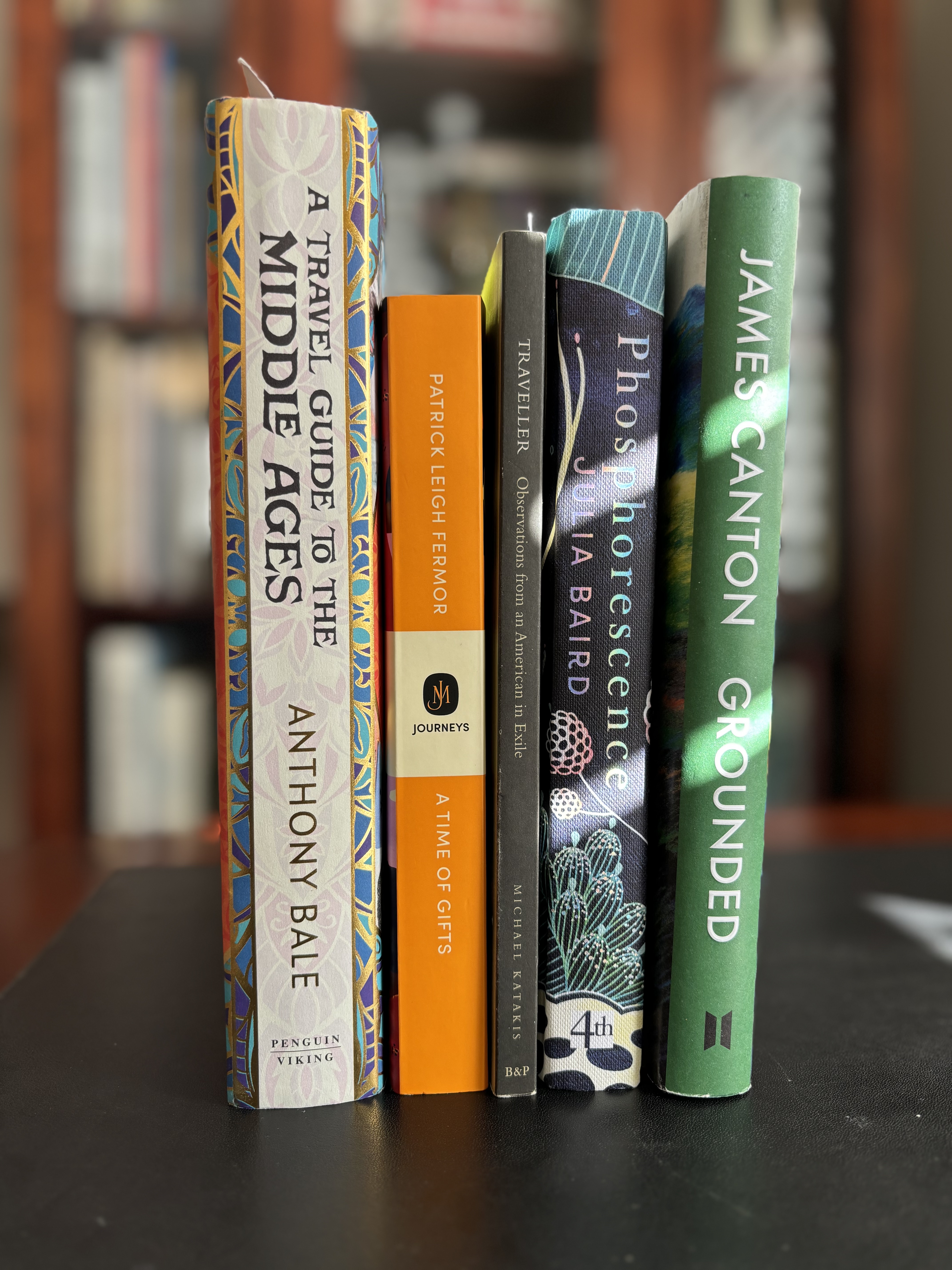
I have 5 books on the go at the moment:
- “A travel guide to the middle ages” by Anthony Bale (2023)
- “Traveller – Observations from an American in Exile” by Michael Katakis (2009)
- Patrick Leigh Fermor’s “A Time of Gifts” (1977)
- James Cameron’s “Grounded – A journey into the landscape of our ancestors” (2023); and
- Julia Baird’s “Phosphorescence- On awe, wonder and the things that sustain you” (2020).
Yung Pueblo’s “Inward” (2018) is at the top of the list to read next.
If you feel inspired to share about your own library, I would love to hear from you.
© Paul McCarthy & Iluminar.au

