To be in Samarkand
To be in Samarkand \/u2014 the Mirror of the World, the Jewel of Islam, the Centre of the Universe \/u2014 on my birthday, and to stand before the Registan at last. A dream fulfilled. (5 min read)
Samarkand has been described as the Mirror of the World, the Garden of the Soul, the Jewel of Islam, the Pearl of the East, the Centre of the Universe, the City of Famous Shadows.
Like generations of travellers before me, to see Samarkand is the main reason for my trip to Uzbekistan.
In the 13th century, Marco Polo called Samarkand a “very large and splendid city” while a few decades later ibn Buttuta called it “one of the largest and most beautifully perfect cities in the world”.
Sweet to ride forth at evening from the wells
James Elroy Flecker, 1913
What shadows pass gigantic on the sand
And softly through the silence of the bells
Along the Golden Road to Samarkand
We travel not for trafficking alone:
By hotter winds our fiery hearts are fanned:
For lust of knowing what should not be known
We make the Golden Journey to Samarkand
Founded in 8th century BC, Samarkand is one of the world’s oldest cities. It was capital of the Timuric empire, the first capital of Soviet Union in Uzbekistan and is now a global city with UNESCO world heritage status as a global crossroads on the silk road.
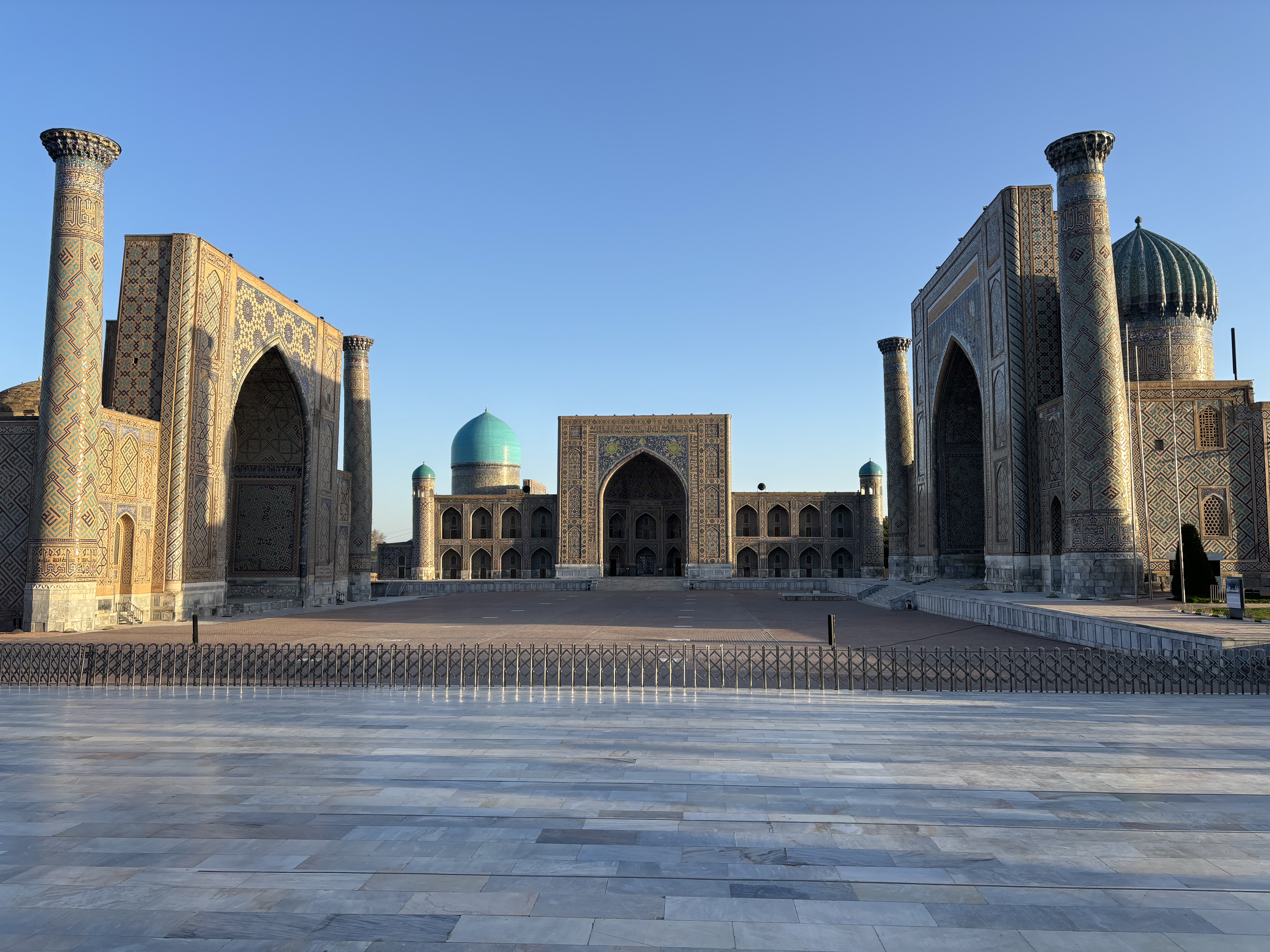
The Registan is the heart of Samarkand. It comprises 3 madrassas (Islamic schools) built over the 14th to 17th centuries and now restored to original splendour. My guidebook ranks it “first in Central Asia and among the greatest of all grandiose and magnificent works of the Islamic world”.
The use and preservation of Registan square and its madrassa may be a useful metaphor to explain religion in Uzbekistan.
The Registan is awesome and profoundly beautiful — by day and night. The dimensions are mammoth and one can readily see the love of the creator in the craftsmanship but outrageous human egos are also evident. It is surrounded by numerous other holy sites and there is an impressive aesthetic created by the beautiful tile works and domes.
Following the Bolshevik Revolution of 1917 and the creation of the Soviet Union, a series of anti-religious drives swept through Uzbekistan culminating in the terrible purges by Stalin in 1937. Islam was the victim. At its worst, the hajj to Mecca, ownership of the Koran and the use of Arabic were all banned.
After the second world war there were “religious concessions” but the tolerance of “official Islam” spurred the growth of “parallel Islam” which was more fundamental — whether one sees the latter as zealotry or orthodoxy depends on who is telling the story.
Getting back to my metaphor, over the centuries the Registan Square was transformed from a place of enlightened scholarship to a site of military parades and public executions. The three madrassa were even used for grain storage at one point. In Soviet times, the red banner of the revolution hung over the square, it was used for political rallies, mass veil-burning and the trials of counter-revolutionaries. To their credit, the Soviets also sought to revive its appearance, straightening minarets, rebuilding domes and restoring tile work. But, unfortunately, this was not always optimal and there is a view that the Godly inspiration of the original craftsmen was replaced with synthetic beauty.
Contemporary Uzbekistan proudly presents itself as a secular country with a market based economy. 75% of the population are Muslim but it is not an Islamic country. There is obviously a strategic objective to discourage the fundamentalism of neighbouring Afghanistan. But in these modern times, even the sacred has been commodified and commercialised. One must now pay to enter the site and most of the hujra (student cells of the madrassa) have become gift shops. My rational mind thinks this a meagre contribution to the upkeep of this huge world heritage site whereas my heart is repelled by charging for holy places.
There are many holy places in Samarkand and my calendar is jam packed for tomorrow. I will write a little more about them if that is of interest.
To be in Samarkand on my birthday, and particularly to see the Registan is a huge blessing and has a profound sense of manifestation about it. After 40 days of fasting, I had 2 birthday cakes today and sampled many Uzbek sweets. I go to sleep very grateful.
Namaste.
© Paul McCarthy & Iluminar.au

