Lithuania – divine mercy, the hill of crosses and great cake
Travel | Sacred Travel | Lithuania
30 May 2018
Lithuania is a green, sunny, beautiful country. The forests and fields remind me of Poland and the historical centre of Vilnius, the capital, is filled with beautiful baroque buildings. Klaipeda, the Baltic’s largest port, is in Lithuania and the coast has the most beautiful white sandy beaches. This year the weather in May has been exceptionally warm – with temperatures around 30C in Vilnius and the regions – indeed, hotter than Malta and Armenia.
After towering over the average Maltese and Armenian, I’m back in the deep end of the gene pool. The Lithuanians are tall, handsome people. The young ones have a lightness about them which is very appealing. And they all speak English beautifully and are mostly very open and friendly. There are Russians about but they are readily distinguished by manner and appearance.
The old town of Vilnius is charming and has a UNESCO world heritage inscription. Everything – even the tourist shops – is in good taste and it is obvious that fine design is part of the Lithuanian DNA. I visited many little galleries and stores selling interesting artworks, beautiful linens and amber. The cafes are outstanding – superb Italian coffee and beautiful cakes and pastries. But there are lots of different animals slaughtered for the Lithuanian table, although I managed to find fresh fish and vegetable meals too.
Of all the places on my itinerary, Vilnius called me the loudest. I thought the main drawcard was the opportunity to see the image of Divine Mercy painted under the instruction of St Faustina Kowolska but the rewards were much greater than I had anticipated.
Faustina (1905 – 1938) was a Catholic nun and a mystic. She experienced frequent apparitions of Jesus, as well as various saints. She was the channel for the image of Divine Mercy and the Divine Mercy prayer. Her diary is an important spiritual tool for many Catholics. Faustina, who was born in Poland, lived in Vilnius between 1933 and 1936 and her diary makes clear she was fond of it.
There are several renditions of the divine mercy image, including the one which appears on the holy card at the Casa Dom Inacio de Loyola. The one in Krakow (at the Shrine of Divine Mercy) is most famous and I saw it for myself in 2014. It was nice but, quite frankly, I got more energy from the relic of St Faustina than I did from this painting. The version of the divine mercy image in Vilnius is another matter altogether. It is the only one painted during Faustina’s lifetime. The painter, Eugeniusz Kazimierowski, was sourced by Faustina’s spiritual director (Fr Michael Sopocko) and she was involved in its execution.
The Divine Mercy painting depicts Jesus with his left hand touching his robe beside his heart from which flow two rays – one white and one red. With his right hand Jesus blesses everybody. I think the image is very modern and beautiful and a progression from the crucifixion images that dominate Western Christianity.
Even though Faustina oversaw the painting, and insisted on many changes, she was not happy with it. Indeed, we know she cried the first time she saw it but Jesus calmed her by saying: “Not in the beauty of the colour, nor of the brush lies the greatness of this image, but in my grace”.
For me, the image is magnetic. My heart centre was immediately activated every time I entered the little chapel where it hangs. But instead of an out-flowing of energy from my heart, I was pulled towards the image. The image itself appears to be three dimensional and Jesus reaches and extends himself in invitation – it is compelling and impossible to capture with the camera. Some say it is the face of Jesus on the cross but I was shown a most interesting photograph which demonstrates perfect alignment with the face on the Shroud of Turin and this feels correct.
Jesus asked Faustina for the image of divine mercy to be venerated first in Vilnius and then throughout the world. He also asked for the divine mercy chaplet to be prayed at 3pm each day.
I visited the chapel with the image of divine mercy many times during my 4 days in Vilnius. While I had not planned it, my first visit coincided with mass in English preceding the divine mercy chaplet at 3pm. Each visit was “random” and each was perfect.
I also visited the little house in which Jesus appeared to Faustina and directed that the image be painted. This visit was a divine appointment as I was able to meet the caretaker of the house and have some time alone in the room where the apparition occurred. In this room there is a copy of the image as well as relics of St Faustina and Fr Sopocko. I left petitions there for my dear ones and was gifted with a beautiful photo of the light coming down on me just like the divine mercy image. I took it as a sign of answered prayers. And this was echoed when I spontaneously asked to be taken to St Casimir’s and found myself in a Jesuit church with chapels dedicated to St Ignatius of Loyola and a relic of a Jesuit saint (St Andrew Bobola) in the crypt.
The caretaker of St Faustina’s house, Petrus, kindly took me on a tour of the sites in Vilnius related to St Faustina and Fr Sopocko. This was perfect as it included a visit to the place where the image was painted (which is now the chapel of a convent of Faustina’s sisters), as well as the Gates of Dawn (where the image was first shown publicly in 1935).
I asked Petrus about St Faustina’s connection to the Jesuits but he could not help. I was obviously not yet ready for the answer. I laughed when I realised that St Ignatius Street runs alongside the chapel where the divine mercy image hangs. And there is a church dedicated to him in that street. What is most interesting is that Fr Sopocko was responsible for this church, including its restoration, from 1924 to 1929. The church itself is not so interesting but the connection to Faustina interests me greatly.
Petrus also mentioned a booklet that brings to life the sites connected to the image, St Faustina and Fr Sopocko. To get a copy required me to visit the pilgrim office and there I met Inesa – who told me that St Ignatius had appeared to Faustina! This was confirmation of a longstanding intuition of the connection between these two important saints.
The information from Inesa prompted me to investigate further Faustina’s connection to the Jesuits. And I found a very helpful article by Harvey Egan of Boston College reflecting on the importance of Jesuit spirituality for St Faustina:
“Jesuit spirituality and mysticism played a significant role in the life of Saint Faustina. For example, the Constitutions of the Society of Jesus influenced the Constitutions of her Congregation, the Sisters of Our Lady of Mercy. Not only was St Ignatius of Loyola one of the patron saints of her congregation but he also appeared to Faustina to inform her that his rule could be adapted to the new Congregation she was founding. During a period of fervent prayer to Jesuit saints, she had a vision and ‘recognised many of them whom [she] knew from their pictures’. However, the Jesuits evidently asked too many questions, because her guardian angel appeared and told her to be silent. While reading about the canonisation of St Andrew Bobola SJ she was ‘filled with a great longing that [her congregation, too, might have a saint. Jesus assured her she was that saint’.” See: https://journals.ateneo.edu/ojs/budhi/article/download/566/563
Egan’s article is full of other interesting anecdotes, observations and analysis. I was particularly interested to note that Faustina had undertaken many retreats using the Spiritual Exercises of St Ignatius and was told on many occasions that Jesus himself was directing the retreat. I was also very interested by her sensitivity to dark energies, the way in which she was bothered by them and the way in which she cleaned the town of Vilnius.
I think that the message of divine mercy will resonate with many of you. My visit to Vilnius has shown me that the focus on worldly pursuits has not diminished my connection with the Good Spirits and I am sure this is true for all of the filho de casa – when one goes on pilgrimage and remains open to signs from spirit, the most interesting and rewarding graces follow.
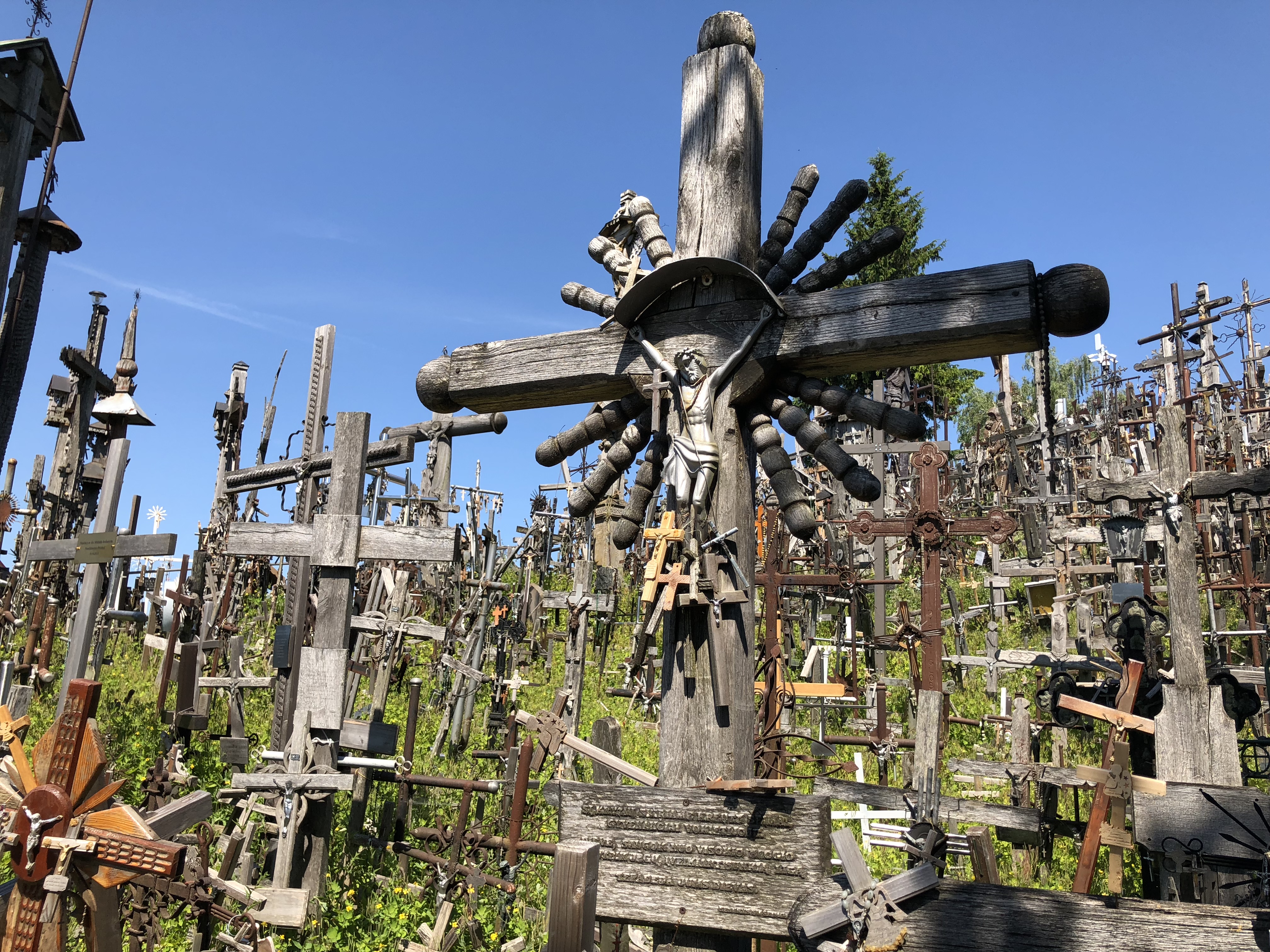
I am amused to have travelled from Armenia – the first country that converted to Christianity (in 301) – to Lithuania – the last country that did so (in 1389). And I am also amused that my last stop in Lithuania is the most overt sign of conversion and national unity – the Hill of Crosses.
The Hill of Crosses is a small hill – 10 to 12 metres high – covered with hundreds of thousands of crosses brought by many ordinary Lithuanians. The precise number of crosses is unknown but it is estimated to be more than 200,000. The first crosses were left in the 1900’s to remember people who resisted Tsarist invasion of Lithuania. There were about 400 crosses at the time of the first world war, which means most have been left in recent times, principally as a sign of resistance to the Soviet regime. The Soviets attempted to destroy the hill and the crosses on it several times – burning, melting down and levelling the area. But the Lithuanians persisted with the hill. What started as an act of faith morphed into an act of political resistance. In the 1980’s the hill became a symbol of independence from the USSR. Since independence in 1991, people bring crosses as votives (e.g. thanksgiving after a birth of child or on wedding day or school graduation) or as petitions (e.g. for someone sick). Our guide told us that the Hill of Crosses is the highest manifestation of religiosity in this part of Lithuania. Pope JP II said it proved the power of faith.
I sensed a lot of divine light around the hill but, for me, the visit was a bit challenging – largely because of the theme park atmosphere created by the foreigners seeking to climb the hill. The Australians and the children were especially badly behaved which I think was probably due to the lighter energy of the area.
I was expecting to find a cross from the Casa Dom Inacio on the Hill of Crosses. My intention had been to wrap one of my crystal rosaries from the Casa around it. I did not find a Casa cross, or even an Ignatian cross but, in perfect time, a humble cross painted in the bright blue of the Casa Dom Inacio presented itself – and so I asked that Dom Inacio and St Faustina intercede for all who have left crosses at this extraordinary pilgrim site. Please find my rosary and echo this prayer when you visit.
The sentiments behind the Hill of Crosses are laudable – faith, courage, tenacity, gratitude and prayer. And while some kind souls had left copies of the divine mercy image on the hill, it seems to me that the real message will struggle to be integrated until we leave the cross behind.
Namaste.
© Paul McCarthy & Iluminar.au

