Դուք սիրում եք Հայաստանը
Eight days in Armenia — the first country to convert to Christianity, and a land of extraordinary beauty, faith, ancient monasteries, and unhealed wounds. Written on the flight home. (10 min read)
I am flying over the beautiful country of Armenia as I write this. My heart is full of gratitude for the experiences I have had and the people I have met during 8 days here.
How I came to be in Armenia is somewhat of a mystery to me. I spent the Christmas before last at the Armenian Guesthouse on the via Dolorosa in Jerusalem and no doubt thought that I would like to visit Armenia one day. And my friend Sam, one of the kindest people I know, is of Armenian descent and no doubt I asked for more people like him in my life. But I did not actively plan to visit Armenia. It came about because I needed a new plan when my pilgrimage to Italy was cancelled and this tour of Armenia aligned perfectly with the dates I was trying to fill.
Ironically, my tour was organised by a company based in Dublin and everyone but me was Irish! And so for a week I was nominally Irish – but from the Republic, of course. There was one person from Northern Ireland on the tour and she certainly distinguished herself from the rest of the group. Everyone else was kind, gently spoken and interesting. I was expecting a lot of “holy joes” given it was a tour of Christian sites but I was wrong. The people in the group were generally very discreet about religion and I was probably the most overt about spiritual matters.
Armenia is a small country in the middle region. It is about 3/4 the size of Switzerland and it borders Turkey (to the west), Iran (to the south), Georgia (to the north) and Azerbaijan (to the east). It was part of the USSR and became independent in 1991. It is the first country to convert to Christianity (in 301), more than a decade before Constantine made Christianity the State religion of Rome.
It is a time of big changes in Armenia. The week before I arrived the so called “Velvet Revolution” was concluded with the election of a new Prime Minister. There were no protests or disruption during my visit and the locals I spoke with were generally optimistic about the future. A taxi driver explained to me that the new Government had promised better relations with China, the EU and Iran – and this was a great relief to me and I think it will be very good for the country.
Armenia is not a wealthy country but it has a lot to commend it and feels like it is about to bloom. It has a long and rich and beautiful culture which has survived the hideousness of the Soviet Union, although some of the dead skin of communism is yet to be removed.
My prejudice against the Russians, and particularly Putin, was very much on my mind this week. There are still many very ugly Soviet buildings, and the remnants of Soviet industry, in this country. Everyone can speak Russian – although Armenian is their first language and the younger ones speak English well. There seems to be affection for “mother Russia” but my sense is that this is anchored in the pragmatism rather than nostalgia. There is an economic and military dependency on Russia which hopefully will diminish over time.
The geopolitics of Armenia comes up in almost every conversation with the locals. While the borders with Georgia and Iran are open, those with Turkey and Azerbaijan are closed. There are many generations of conflict with the latter two countries. While I did not see or experience any evidence of militarisation, DFAT recommended against travelling to the areas bordering Azerbaijan, and in particular, the independent Armenian state of Arkhsar (Norgorno Karabakh) over which there has been military conflict.
In Armenia, the toilet is referred to as “The Turkish Embassy”. The very deep wounds between these countries are yet to heal. The most significant dates to 1915 but there were killings in the 1890s and ongoing squabbles ever since. At the time of the first World War, Turkey annexed “Western Armenia” (including the Mountains Ararat) and carried out a systematic campaign of genocide (“ethnic cleansing’) of all Armenians in Turkey and the occupied lands. 1.5 million Armenians were killed and many many children were orphaned. There is incontrovertible evidence of this holocaust but, for political reasons, only a handful of countries have officially acknowledged it, including Canada, France, Germany, Italy, Sweden and Denmark, as well as several countries from South America and the former USSR. Of course, good Pope Francis has acknowledged the genocide on behalf of the Vatican. It would appear that other countries are concerned about offending Turkey and so do not acknowledge the genocide or the compensation that is warranted. It grieves me deeply that Australia has not recognised this atrocity – especially given the prominence of the Armenian diaspora at the highest levels of Australian politics. There is good information about the genocide on this website: http://www.genocide-museum.am/eng/
There is very strong national pride in Armenia – but not overt nationalism – entwined with language (the Armenians even have their own alphabet) and religion (Armenian Orthodox) and the arts.
On our first day we visited a major museum dedicated to Armenian manuscripts – many of which are holy books with stunning illustrations. I noticed many street names and sculptures and billboards honouring writers, museums and artists.
A unique feature of Armenian culture is the “khachkar”, a stone with beautiful carving which was traditionally used as a votive or as a headstone for a grave. There are khachkar in churches but also in the public squares and on public buildings. The beautiful designs are remarkably similar to those one sees in Ireland!
I stayed in Yerevan, the capital, during my whole time in Armenia and visited a different region by bus each day. This was very easy and convenient. Yerevan, which is as old as Rome, is 1000m above sea level with very little humidity. The dry air, rather than the altitude, was a bit challenging for me, especially because many people smoke (even indoors!). This was really my only complaint.
On first blush, Yerevan is filled with many ugly Soviet style buildings. But the great beauty and sophistication in the Armenian aesthetic emerges on closer examination. The buildings are made of local stone which is actually quite beautiful when clean. The streets are tree-lined and there are beautiful rose gardens on many of the major street corners. There are lots of leafy public squares and parks – I found several which contained restaurants open to the elements and beautifully designed playgrounds. There is a lot of public art but the quality is mixed and there is a lot of “plonking”.
Almost every Armenian I met was friendly, kind and open to conversation. And everyone is dressed very well, even those with modest incomes. Yerevan feels very safe and family orientated. Apart from the smoking, the only bad experience was a waiter who tried to steal from me (providing $ADM 900 in change, rather than $ADM 9000). The issue was resolved when I complained to management but it was shocking because it was such a contrast with my general experience of the country.
The Museum of Armenian History is superb. It was free on the day I visited and filled with people, including many school children. It was fantastic to see the kids so interested in their culture and heritage. Unfortunately, photography is prohibited in this museum but I got a stunning catalogue of the collection for only $ADM 12,000 (ie $AUD 32). I was very taken by the bronze age sculptures in the collection (see photo above of solar system from 12th century BC) but in our group there was much interest in the world’s oldest shoe (c 3500 BC) which was also found in Armenia.
May is the perfect month to visit, although it is too cold for a swim in the lake. There was very little rain and the daily temperature was between about 20C and 26C. This is a country of extremes and we were told that it can be as cold as -15C in the winter. I am curious to know what this country is like in winter but my local friends do not like it.
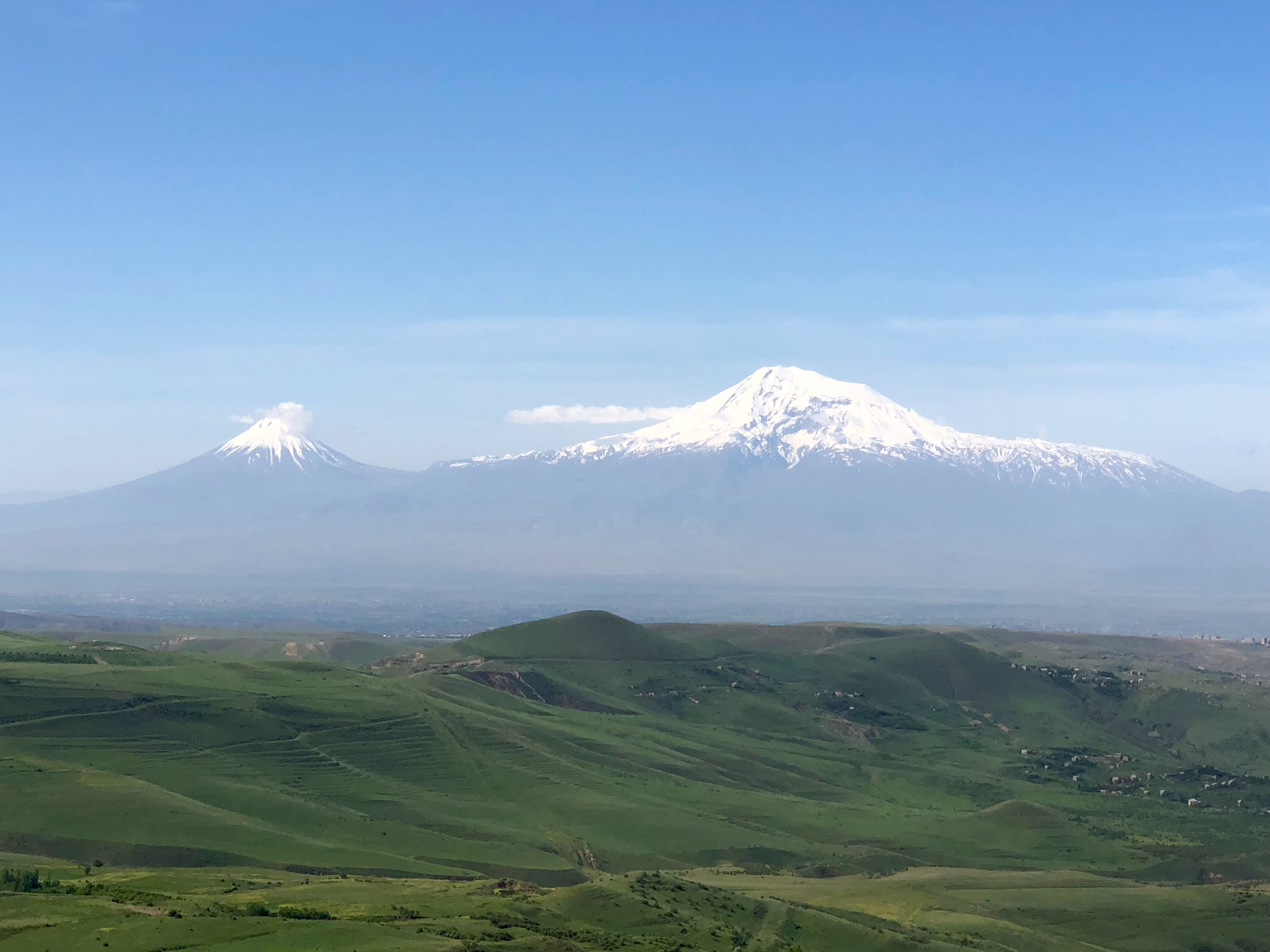
I have already posted a lot of photographs of the various regions of Armenia and will do a final post of shots of Yerevan. I hope this inspires you to visit because there is great natural beauty in this country and a lot of diversity in the landscape. Of course, the mountains Ararat are stunning and most memorable, even though, technically, they are located in Turkey. And Lake Sevan, a freshwater lake that stretches over 1000km, is also stunningly beautiful and known as “the pearl of Armenia”. There are also beautiful forests, rugged red rock gorges and snow-capped mountains a short drive from Yerevan.
I visited many monasteries and have posted a lot of pictures of them. The architecture of the churches was new for me, particularly the “khachkar” headstones and the “gavit” – an enclosed space adjacent to the entry to the church. The gavi provided a place for the unbaptised but also for town hall meetings and other public purposes.
We visited the holy city of Armenia – Echmiadzin – last Sunday. The crowd was relatively small – a few hundred people at most – and Catholicos Karekin II (whose role is the equivalent to the Pope) was present. He blessed many of the people in my group (not me!) and seemed nice and very accessible to the people. Pope Francis concelebrated mass with him in 2016. There seems to be great affection for Francis amongst the Armenians, although they are quick to tell you that they do not recognise his supremacy.
We had a good discussion in the group about the differences between the Armenian Orthodox Church and the Roman Catholic Church and much could be said about this. The matters of most interest to me are that relics are venerated (the holy lance is the most important relic in Echmiadzin but it is acknowledged that there are 3 other claims to this relic); priests may be married or celibate (but only the celibate ones can become bishops); there are no nuns; the sacraments of baptism, communion and confirmation are given at the same time (including to infants); while private confession is available, most do it in congregation; the liturgy, which dates to 5th century, goes for 2.5 hours on a Sunday – without seats in the old churches – but it is informal and people come and go and chat; the consecration occurs behind a curtain; there is less emphasis on holy pictures and statues (I saw almost none in public places and few in churches).
I was expecting the tour to be like a Catholic pilgrimage – with daily prayers at each monastery etc – but alas it was not. In fact, it seems that, with a couple of exceptions, the main interest in the monasteries is architectural, rather than spiritual. I found most of the monasteries to be energetically neutral which was surprising given their age and the devotion of the local population. And then I discovered that Armenian Orthodox churches do not have a tabernacle which caused me to wonder whether this might be implicated in the way that churches feel? Interestingly, the churches with relics felt very familiar and energised.
Yesterday was an extraordinary day. Firstly, we visited the Monastery of Hovhanavank, which is dedicated to St John the Baptist and claims to hold the relic of his head. Of course, this is disputed. Muslims believe his head lies inside the Umayyad Mosque in Damascus, Syria, while some Christians believe it is on display at Rome’s Church of San Silvestro in Capite. Others believe it is buried in Turkey, southern France and even Bulgaria. I honestly don’t know but I certainly felt the presence of the Good Spirits and a lot of divine light in the modest chapel in Hovhanavank. Sadly, I did not have my rosaries with me to charge them on this relic but I nevertheless received a lot of energy in this place as we prayed for peace in Armenia. It was the perfect end for our tour group.
Yesterday afternoon I visited the Yerevan Cathedral on my own. The Cathedral is a modern but very nice design. The vestibule includes an interesting reliquary with a relic of St Gregory the Illuminator (c 257 – 331), the patron saint of Armenia and the person who brought Christianity to the country. I had my rosaries with me this time and energised them on this relic praying for my dear ones but also for Armenia. As is my practice, I photographed the church as I was leaving and was gifted with a photograph of the materialisation of St Gregory in the sky above the church. This was perfect confirmation of answered prayers for this lovely country and for its people.
Armenia holds a special energy for the planet. I have spent a week pondering what it is like to wake up each day to the holy Mountains Ararat and to carry in one’s DNA the story of the flood. The History Museum goes to some trouble to show the diversity of animal fossils in this region but all I saw was cows, goats and sheep. I’ve also been wondering about the soul choice to incarnate in an area that holds a particular type of Christian energy but also one with a legacy of great conflict and pain. Like so many such places on the planet, people are sustained by their faith and I have no doubt there is spiritual growth in this.
I hope this note and my pictures encourages you to consider visiting this country. The tourist industry is emerging but it will not be long before it is overrun with visitors. Now is the time to come. It is very beautiful and so easy to visit and good value too.
Namaste.
© Paul McCarthy & Iluminar.au

