Pilgrimage to the shrine of Padre Pio
Padre Pio — the greatest mystic of the 20th century, who bore the stigmata for fifty years and promised to do more good after his death than during his life. A pilgrimage to his shrine in San Giovanni Rotondo and the story of an extraordinary saint. (8 min read)
We have no greater friends than the angels and saints. They intercede for us, they inspire us and they provide us with examples of how to live a holy life.
They are a bridge between this world and the next. God’s instruments of healing and grace. The facilitators of miracles.
And today you are being offered an opportunity to develop or build your friendship with the greatest mystic of the 20th century.
Saint Pio of Pietrelcina – or perhaps you know him as Padre Pio.
Pio famously said once: “After my death I will do more. My real mission will begin”.
There are thousands of testimonies to the intercession of Pio either during his lifetime or after his death. I know from personal experience that Pio is keeping this promise.
On 23 September we celebrate his feast day – the day of his returning to the spirit world.
I invite you to take a moment – now – to make a prayer to invoke the presence of Padre Pio and to pray for his intercession.
Padre Pio, was born into a devout but poor family in Pietrelcina, Italy in the late 19th century (1887). He was named Francesco (Forgione) after St Francis of Assisi.
At the age of 16, he entered into a Capuchine novitiate, with his seminary education paid for by his parents. In 1910, he was ordained and assumed the name Pio.
After 6 years in his home town, Pio was posted to Our Lady of Grace in San Giovanni Rotondo – one of of the poorest, oldest and most remote of the Capuchine houses. He lived in this small town until his death in 1968.
Pio was canonised in 2002 by Pope John Paul II. As a young man, Pio was visited by the man who would become Pope. Many say Pio prophesised that JP would become Pope.
Pio experienced ecstacies and apparitions from the age of 5. His other psychic gifts included prophecy, reading hearts (especially during confession), bilocation and the emission of an extraordinarily beautiful perfume.
Pio was able to make people who never thought of spiritual matters, religious. He is known as the saint of the common people, always consoling, always accessible to those who visited or wrote to him.
Pio’s masses, and more particularly the energy channelled during communion, were legendary and attracted huge numbers of pilgrims.
Most famously, Pio received the stigmata – the crucifixion wounds of Jesus – on his hands, feet and side, in 1918 (20 September). He also received the pain of the crown of thorns and the shoulder wound of Jesus. The sacred wounds, including the one on on his side, continually oozed blood or bloody fluid. The slightest touch to these wounds caused Pio immense pain which, he said, was “so acute as to be absolutely undescribeable and inconceiveable”. The supernatural character of these wounds cannot be disputed and Pio’s doctor once observed luminous rays of light emanating from the side wound.
But Pio was also subject to demonic attacks throughout his life and he experienced years of severe and unjust treatment by the Church and the world’s media. Although the Pope later exonerated him, Pio always faced a degree of public doubt and suspicion. He also had to cope with appalling behaviour from overly zealous pilgrims, including people cutting his habit and chord for relics.
Pio experienced many years of spiritual aridity and worried that his life was not pleasing to God. Lacking insight into his own pure soul, he never presumed his salvation.
Yet, St Pio understood the transcendent value of suffering: “If humanity could realise the value of suffering, they would ask for nothing else…”.
Padre Pio found great consolation in his devotion to Mary and, in particular, Our Lady of Pompeii. His favourite prayer was the rosary and he insisted his spiritual children carry a rosary with them at all times and pray it every day. And when asked what inheritance Pio wanted to leave his spiritual children, he replied “the rosary… a weapon against evil in the world”.
St Pio’s shrine in SG Rotondo receives over 7 million pilgrims a year.
I have visited the shrine a couple of times in the last 5 years. It is not an easy place to get to as an independent traveller – it is a long train ride from Rome to Foggia and then a bus to SG Rotondo. One of the benefits of an organised pilgrimage is that the practicalities of travel are taken care of.
The light is intensely white in SG Rotondo and, but for the mountain on which the town and St Pio’s shrine is located, the land is flat as far as the eye can see – all the way to the Adriatic. It is farm land mostly and quite remote.
The hills behind SG Rotondo are covered with pines and conifers and the air smells lovely. There is a beautiful “way of the cross” on the hillside behind the churches. Pio laid the first stone for this “way” just before his death and it was very important project to him. The final concept has been beautifully executed.
On alighting the bus, the first thing one sees is the Home for the Relief of Suffering – the hospital established by Padre Pio.
There are now 3 churches in SG Rotondo – the old church, from Pio’s day; the new church (which is late 20th century) and the Basilica of St Pio.
The basilica, designed by Enzo Piano, is superb – physically striking, modern, practical and the most beautiful crypt I have ever been in. There are very fine images of Pio, St Francis of Assisi and Jesus in mosaic, principally in gold, that are quite unique.
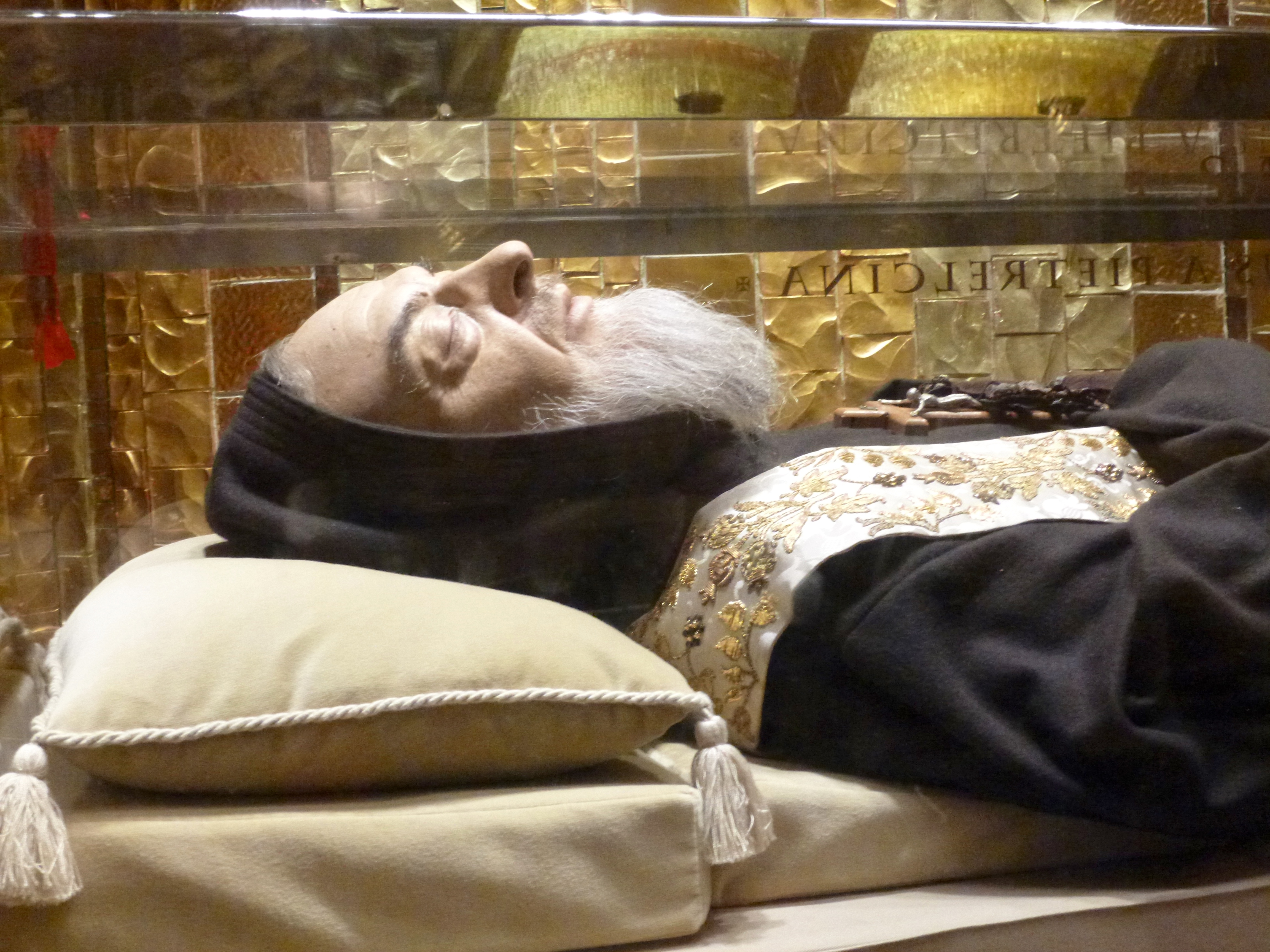
St Pio’s incorrupt body – it has not decomposed – is on display in the crypt.
There were very few pilgrims on that first day I visited the basilica, so it was a mostly serene and easy experience. But as Pio’s body is behind armour plated glass, I initially thought I would be unable to place my rosary on his relic.
There is a small museum in the old church at SG Rotondo. It has Pio’s cell, some of his confessionals and some personal memorabilia and relics. The documentation of his case for beatification (about 2 metres worth of books) is also on display. I also found a reliquary, containing two relics on which I could place my rosaries. This experience was a strong energetic transfer to the beads and, I was to discover some months later, a miraculous image of Jesus and Pio in one of my photographs of the reliquary – which I will now share publicly for the first time.
SG Rotondo is a short drive to Monte Sant’Angelo with the world famous celestial basilica of St Michael the Archangel. Pio was strongly connected to St Michael – whose feast day happens to be next Friday. Mont Sant’Angelo is a beautiful little town and we are so very fortunate to be staying there on our pilgrimage next May.
A pilgrimage to Italy and Poland offers opportunities to meet (or reconnect) with at least 18 saints. From twentieth century saints like Pio and Saint John Paul 2, to saints from the earliest times, like Peter and Paul.
You don’t need to go on pilgrimage to establish and nurture a friendship with these saints. You can seek their intercession at any time.
But pilgrimage offers the opportunity for a different kind of experience.
And it starts now. Learning about the lives of the saints. Asking for their help. Formulating your prayers for yourself and others.
Making the effort to travel to the other side of the world is a big commitment, a big investment but it is also very rewarding and much appreciated by the saints.
So, if you feel touched by the story of St Pio… or any of the other saints.. consider a pilgrimage. The rewards are beyond this world. And, in my experience, one starts to become aware of this as soon as one commits to the pilgrimage.
© Paul McCarthy & Iluminar.au

