Pilgrimage stops: Collevalenza & Orvieto, Italy
Two pilgrimage stops on the road from Assisi to Rome — the Sanctuary of Merciful Love at Collevalenza, founded by the beatified Madre Speranza, and the hilltop town of Orvieto, whose magnificent duomo was built to house a eucharistic miracle. (4 min read)
This year’s pilgrimage to Italy has involved travelling to places I know well (Venice, Assisi and Rome), revisiting places I enjoyed in my youth (Florence) and experiencing some places for the first time (Bologna, Padova, Collevalenza and Orvieto).
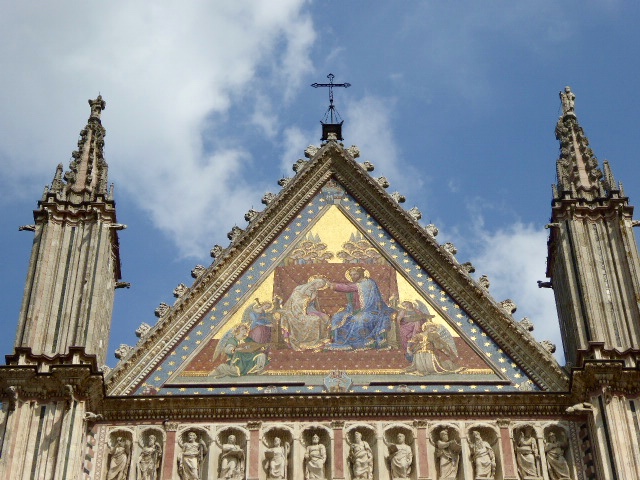
Yesterday we drove the mighty Volvo from Assisi to Collevalenza for the morning mass at the Sanctuary of Merciful Love (perfect for the “Year of Mercy”) and then onto to hilltown of Orvieto (whose duomo houses the altar cloth that inspired the feast of Corpus Christi).
The Sanctuary of Merciful Love, in Collevalenza, is the result of the inspiration received by a beatified Spanish nun known as Madre Sperazna (1893-1983). The sanctuary has a chapel (built in 1955), a minor basilica and crypt (built in 1965) and baths that use water sourced from a well on the grounds. There is also the stations of the cross.
The architecture of the chapel and the basilica is strikingly modern and was directed by Madre Speranza. Although separately conceived, there is an extraordinary similarity with the Sanctuary of Divine Mercy in Poland where St Faustina is buried. What I find interesting is that both of these sanctuaries are focused on the message of mercy, rather than judgement and punishment.
We walked through the Holy Door at Collevalenza and I liked the mass service in the basilica. I understand about 20% of what is being said – which is probably why I like it so much! My sister, on the other hand, is over Latin masses, and craves the English mass. Collevalenza has no shopping, so Jacqui was keen to move on to Orvieto as soon as possible.
Orvieto is really charming. The local tradition is that the duomo was built to house the miracle of Bolsena from 1263, although Pope JPII refuted this a few years back. The story of the miracle is that a Bohemian priest, tormented by the doubt whether the consecrated host was Christ’s body and blood, went on a pilgrimage to Rome in 1263 to strengthen his faith. On his way back he stopped in Bolsena to celebrate mass and at the moment of consecration he saw the broken host spill blood on to the Corporal (a linen cloth). The Pope became involved and declared this a miracle. The Orvietani thought the existing cathedral was too modest to host such a precious relic and decided a new religious building should be constructed to match such a great miracle.
Unfortunately, the Corporal cloth was behind the screen when we visited (it is displayed on the Feast of Corpus Christi), however there are photographs of it in the church, including ultraviolet photographs that show blood separated into plasma and serum. (Note: The blood of a dead person separates into plasma and serum).
My sister got her wish for Mass in English in Orvieto. The priest, a Bostonian Irish Catholic, was most sincere and kind. He was keen for us to view the frescoes in this magnificent church – the judgement day images were the antithesis of the message of Collevalenza and adversely impacted on both us sleeping.
Orvieto is a bit of a tourist trap. There are lovely shops everywhere – most selling ceramics in traditional designs. And the food is superb – the best I’ve had in Italy!
We leave this morning for Rome and the station churches, finishing with St Peter’s Basilica in 5 days time.
Namaste.
© Paul McCarthy & Iluminar.au

