Pilgrimage Stop: Bologna
Bologna’s hidden saint, St Dominic’s basilica, and a 4km portico walk to a miraculous icon of the Virgin — pilgrimage in Italy’s most underrated city. (6 min read)
It has been less than a year since I’ve been on the road but I did not realise how much I miss it! I’ve been happy back in Sydney but nothing makes my heart so glad as being on pilgrimage. I pay more attention, I turn inward and I eat a lot of pastry.
My sister, Jacqui, and I are doing this pilgrimage together. As planned, we flew as far as Abu Dhabi and then separated for a few days – she went to Ireland and I came to Bologna. She chose the green, the wet and the dentally challenged. I chose the red, the hot and the descendants of the gods. I think I won!
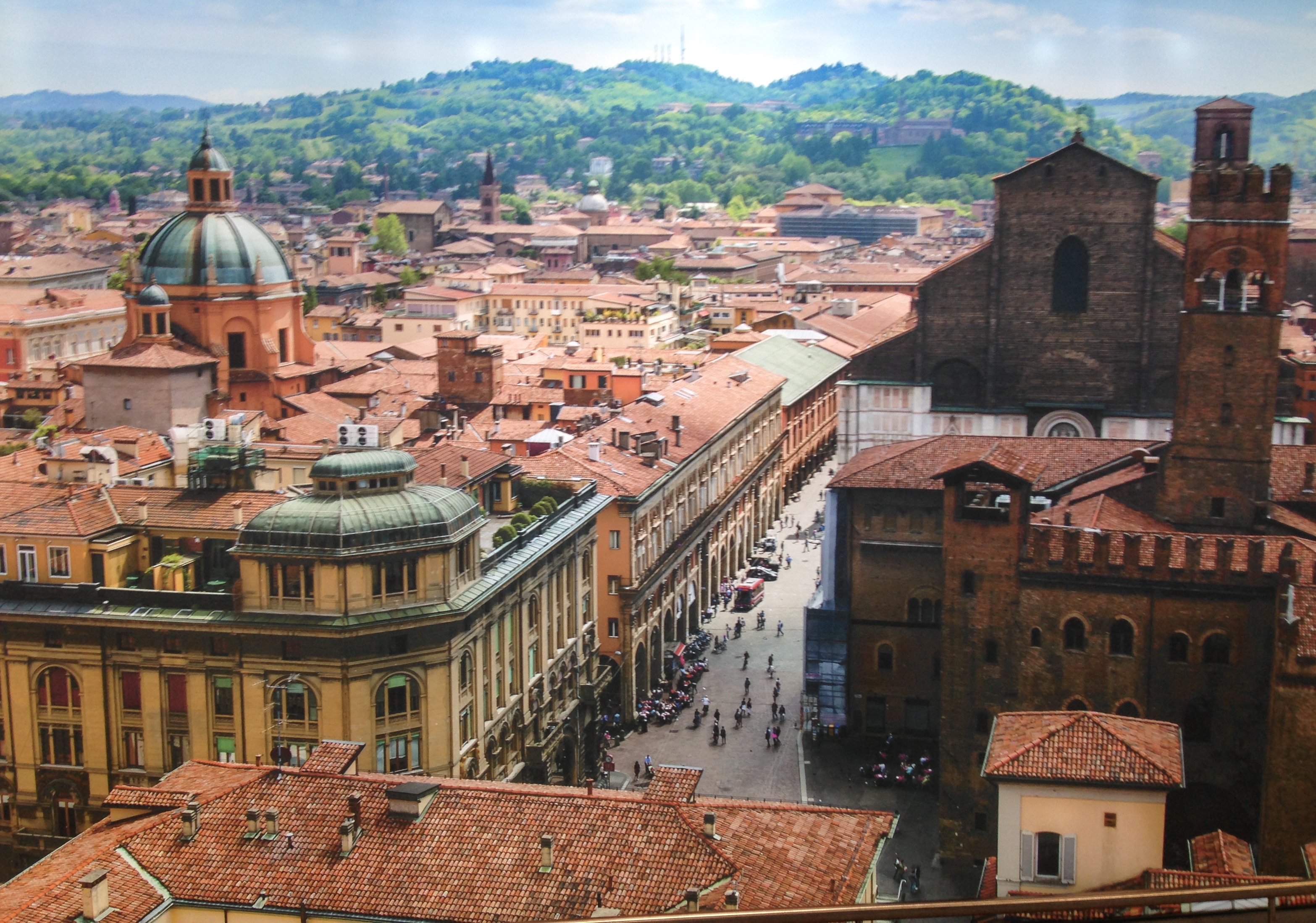
This is my first trip to Bologna, which is located in the Emilia Romagna region in the north east of Italy. It is an hour south of Padova (where I go next) and 90 minutes south of Venice (where I meet Jacqui in a couple of days).
Bologna is a very old city of about half a million people. It is most famous for its 900 year old university, red brick towers and buildings and food (think big fat Italian sausage, tortellini and other pasta dishes). But I’m here for a different reason – the shrine of St Dominic Guzman and two other holy sites.
St Dominic de Guzman
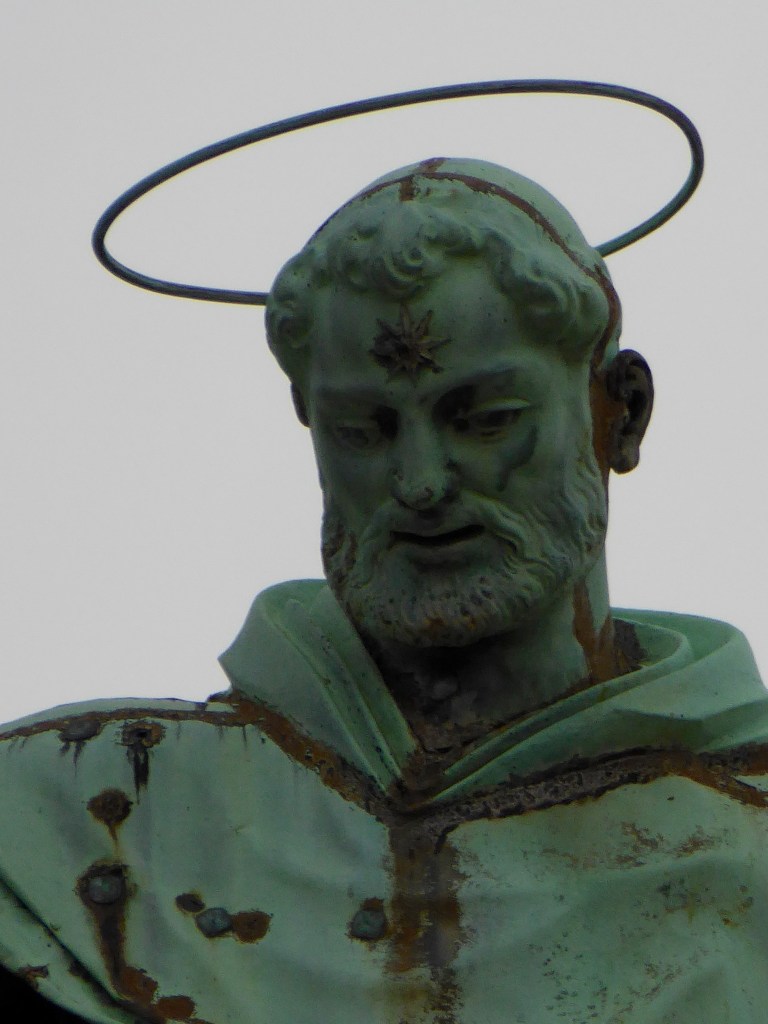
St Dominic was a contemporary and friend of our dear St Francis of Assisi. Both were mystics, devoted to the poor and the founders of religious orders which changed a great deal after their passing. While Francis is greatly loved, Dominic’s audience is somewhat “niche” – most likely because of the hurt many carry from the Inquisition (and perhaps the inherent distaste of a man in a beige smock). Dominic had nothing to do with the Inquisition (the investigation of heresy during the Middle Ages) but it was carried out by members of his order (colloquially called the Dominicans).
One of the few past lives I remember was as a Dominican scholar. I copied a lot of books, was schooled in orthodoxy and didn’t interrogate anyone as far as I am aware. I am still attracted to aspects of this kind of life but I must confess a deep ambivalence about St Dominic which I was hoping to address by pilgrimage to his shrine.
Although Dominic was a Spaniard, his preaching was primarily in Italy and the south of France. Dominic first visited Bologna in 1218 and immediately saw the opportunity to persuade young people from the University to become preachers. He moved to Bologna and died there in 1221 (at about the age of 50). He was initially buried in a humble location but his body was moved several times, ultimately ending up in a huge basilica in a marble tomb that took several hundred years to complete.
I found the Basilica of St Dominic devoid of spirit. It is a cold, cavernous, ugly building staffed by cantankerous old men and with very few visitors. Basilicas generally have a strong loving presence – the combination of years of devotion by pilgrims and the helpers on the other side. When this does not occur, I pay particular attention. I ask if it is me or the place? Spiritual aridity – a lost or diminished sensitivity to spirit – is common and can be purposeful. Perhaps I was feeling that? Or maybe it was simply jet-lag and the fact that this was the first time I had been on pilgrimage without first visiting the Casa Dom Inacio.
I went to the Basilica of St Dominic twice. I prayed the rosary twice . I struggled with it and doubted whether any good would come of it. The experience was further diminished by an unhappy chap who blocked access to Dominic’s tomb. I missed the opportunity to energise my rosaries on the tomb but I ultimately met a nice priest who blessed them.
A few streets away, the experience could not have been more different.
St Caterina of Bologna
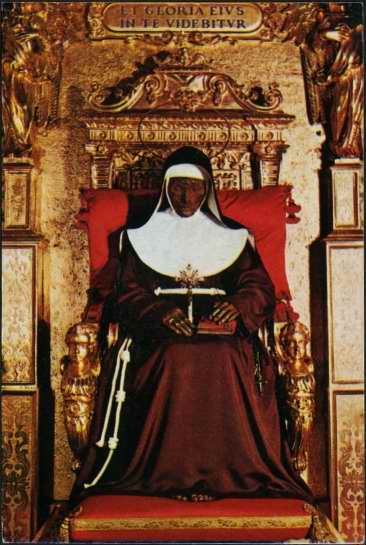
In Bologna, there is a woman known simply as “La Santa” (“The Saint”) – St Caterina de Vigri (or St Catherine of Bologna). Caterina was born in Bologna in 1413. She was a devout child and at the age of 14 entered religious life. In 1431 she took up the habit of St Clare of Assisi. Caterina was a mystic and a healer. She wrote a book about spiritual combat for nuns and was also a painter. She was counsel to many people in Bologna. In 1456 Caterina was asked to be the founder and abbess of the Franciscan convent called “Corpus Domini” – a role she carried out until her death in 1463. Caterina was buried in the Nuns’ churchyard but her body was exhumed after 18 days on account of some striking miracles, including perfume being emitted from the earth. Caterina’s body was found incorrupt – sweet smelling and flexible.
In 1575, twelve years after Caterina’s death, the nuns decided to put her body in a chair so that it could be better venerated. The tradition is that the body immediately became stiff. The then Abbess, inspired by God, commanded Caterina to sit down under obedience (a virtue she had practised so heroically during her lifetime) – which she did and the body is still in the same seated position to this day. 450 years after her death, the body of St Caterina is still incorrupt! It was last examined in 1959 and is in remarkable condition.
The photographs of St Caterina’s body do not capture what one actually sees (and feels) in her shrine. In 1953, her body was surrounded in glass for protection, and at some point her hands were covered in wax. Her darkened skin is blamed on soot from the oil lamps used over the centuries. The darkness of Caterina’s skin hides details in the photographs I have seen online and at the shrine. It is not permitted to take photographs of the saint, so the ones I have posted come from the internet. What I observed was a tiny woman with fine features and skin. The colour is consistent all over but the skin looks perfect. And the loving energy from and around the saint is very strong. I had the chapel to myself for a while and experienced deep peace in the silence. The room in which the saint’s body is venerated is filled with relics and the great love for her is evident in the over-the-top chair on which she sits and the statues of angels that surround her. As Caterina was a Franciscan I prayed for her to help at our meditation event in Perth on the feast day of St Francis of Assisi. God willing, she will be present.
By the way, I met a lovely nun called Sister Margerita who gave me a relic of St Caterina. And a very nice priest who blessed my rosaries in the name of santa.
Portico di San Luca
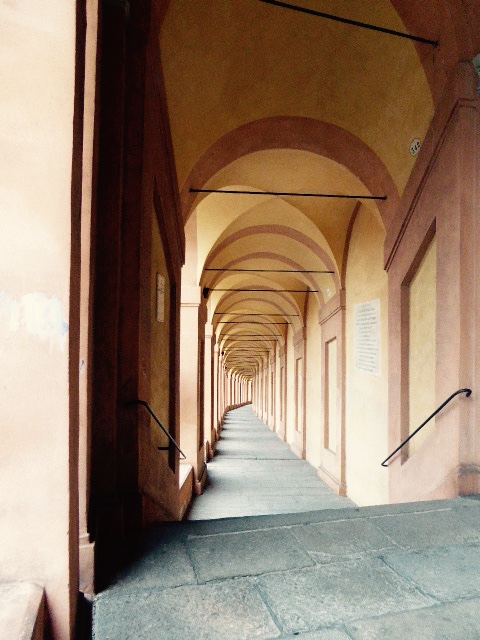
It is said that one can walk through Bologna on a rainy day without getting wet. The city has over 40km of covered walkways or arcades. Some are quite plain, while others have painted ceilings and terrazo flooring. Yesterday, I walked for about an hour from my hotel to the Sanctuario della Madonna di San Luca on a hill overlooking Bologna. One reaches the sanctuary by walking under 4km of uninterrupted walkways called the Portico di San Luca. The walkways were built in the 1700s to enable an icon of the Virgin Mary painted by St Luke to be carried to the city in all weather. The walk is quite heavy going with a small back pack, let alone a 172kg icon with surrounding decoration!
An icon is not an ordinary painting and the process of “drawing” an icon requires prayer and channeling. The icon captures the presence of the holy figure and this is felt by the viewer. The resemblance must be recognised by the church before the icon is blessed. In the eastern church, the icon is independent of artist and spectator and does not arouse emotion but the arrival of the transcendant. The work becomes a manifestation of God. Therefore artist hides behind the tradition and is generally anonymous. However, there are 3 prototypes for icons of Mary and these are attributed to St Luke. The icon in Bologna is not just any old painting but a “presence”.
According to the tradition, the icon was brought to Bologna from Constantinople in 1160 or so by a pious wandering hermit who had undertaken a pilgrimage. The icon was displayed in Hagia Sophia in Constantinople and underneath it was the phrase that said it was to be taken to the “Hill of the Guard”. The church told the hermit that they did not know where the hill was located. The hermit offered to take it to its destination. He first travelled to Rome with the icon and was providentially directed to Bologna where the icon was ultimately installed in a sanctuary on a hill with this name.
The story gets really interesting in 1433 when the Bolognese sought the intercession of Mary to overcome the threat of famine due to constant rain preventing harvesting. As an act of devotion, they carried the icon from the sanctuary to the city in procession. It goes without saying that the rain stopped but what is really interesting is the different take on pilgrimage. In this case, the icon (“the presence”) comes to the people. In gratitude for Mary’s intercession, the people of Bologna walk up to the sanctuary each week (there is an Order dedicated to this) and the icon visits the city on feast days. This continues to the present day.
I got a lot out of walking to the sanctuary and arrived just in time for mass. I can recommend the liturgy in Italian when one is caffineated and breathless… the feeling is near sublime. I skipped communion but kissed the icon and had some face time alone with it and got the rosaries blessed by another nice priest. I felt much lighter as I walked back to Bologna for lunch and the nicest gelato I have had this year.
Namaste.
© Paul McCarthy & Iluminar.au

