Dead since 1879
St Bernadette Soubirous in Nevers — her incorrupt body, the compulsion to pray the rosary, and the quiet miracle of a saint who did not want to be seen. (8 min read)
”Incorruptible” is the term used to describe a person whose body does not decompose on death. Being an incorruptible is not, of itself, a miracle. The circumstances of each case need to be considered, particularly the burial arrangements and, if these are ordinary, the characteristics of the person concerned.
Several of the entities of the Casa Dom Inacio had incorruptible bodies. Last year I visited the tombs of St Rita of Cascia and St Francis Xavier, both of whom are in this category.
This post concerns the incorrupt remains of St Bernadette Soubirous (1844-1879), famous for receiving the communications from the Virgin Mary at Lourdes.
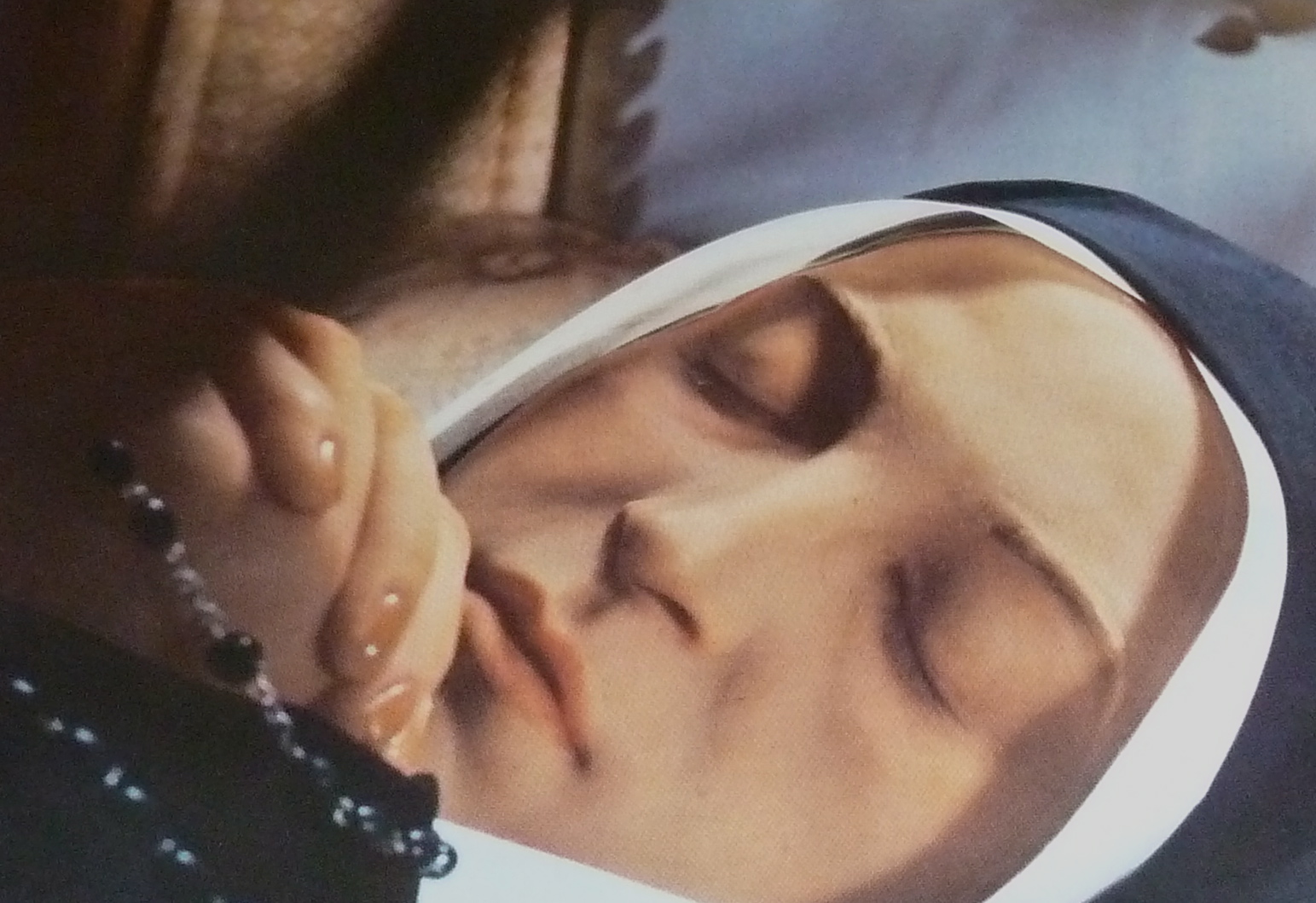
St Bernadette’s body was exhumed 30 years after her death and found to be incorrput by doctors and other eminent witnesses. Ten years later this was also found to be so. And again six years after that, when some relics were taken from her body. Her remains now on display in a glass coffin in Nevers in Burgundy. However, there is a very fine wax mask over her face and hands, as her skin has darkened.
St Bernadette is buried in the mother house of the Sisters of Charity in Nevers. She entered religious life there some time after the investigations into her experiences at the grotto at Lourdes were completed. She was initially an assistant in the infirmary at the convent and, in later years, in charge of it. She was said to be very diligent in this work and I think she must have picked up a little bit of expertise in brain surgery too, because I felt like she was giving me an operation during my visit to her tomb.
Born in 1844, Bernadette had an impoverished childhood with much suffering and ill health (cholera, pneumonia, serious asthma). Five of her 8 siblings died in infancy or early childhood. As an infant, she was sent away because her mother could not feed her (she had burnt her breast). Both her parents worked to earn a meagre living to support the family and because Bernadette was responsible for caring for her siblings she was unable to go to school. At 13 she was sent to the country to work for relatives for a year. Not long after returning from the country she experienced the 18 apparitions of Mary from February to July 1858.
By all accounts, Bernadette handled the great trial of her interrogation about the apparitions very well. She was interviewed by the commissioner of police, the attorney-general, the bishop and minor clergy. This 14 year old girl, with no education and a very poor background, was initially disbelieved and treated very badly. After a commission of inquiry confirmed her story, she became very famous and was subject to further indignities, such as people trying to cut her hair and her clothing for relics. She was required to submit to being photographed to raise funds for construction of the church at Lourdes.
The consequences of extreme poverty and ill health impacted on Bernadette throughout her life. She was often sick and received extreme unction (last rites) on 4 occasions. For over 3 years before her death in April 1879, she was an invalid due to tuberculosis of the lung and a tubercular tumour of the right knee (which she did not disclose and which was extremely painful and handled without any pain relief).
In addition to trials of health, Bernadette had to suffer her superiors and companions in the convent community.
How did she cope with so much adversity? Her note books indicate she saw her role as being sick and offering the suffering to God for others. This is not unlike the approach of St Therese of Lisieux who was her contemporary.
My experience at the convent in Nevers where Bernadette’s body now rests was interesting and full of grace.
Without initially understanding why, I had an overwhelming compulsion to pray the rosary. I have never felt like this before, although the rosary is my favourite thing at the Casa Dom Inacio. So, as I prayed 10 decades, which I dedicated to my sister, the perfection of this experience revealed itself. In retrospect, this is the obvious place to seek the intercession of Mary but the thought of doing so had not entered my head until I was actually doing it.
The chapel at Nevers is simple and beautiful and one can kneel about 5 feet from St Bernadette. Unlike Lisieux and Casia, there is no high metal fence around the casket. And unlike Goa, the casket is at eye height. The nuns maintain an environment of reverence by prohibiting photographs, so the ones I have posted are photos from postcards.
I was initially disappointed that I had no opportunity to touch the reliquary with the rosaries I am carrying, but when I laid them in front of the glass coffin and prayed for them to be energised I swear that intense light was raining down on them and me. This act of grace was very moving. This was felt by others and I traded holy medals with a lovely woman who was helping me with the prayers.
As for Nevers itself, I have nothing much to say. It is about 2 hours by train from Paris and I spent all my time at the chapel (which is an easy walk from the train station).
© Paul McCarthy & Iluminar.au

