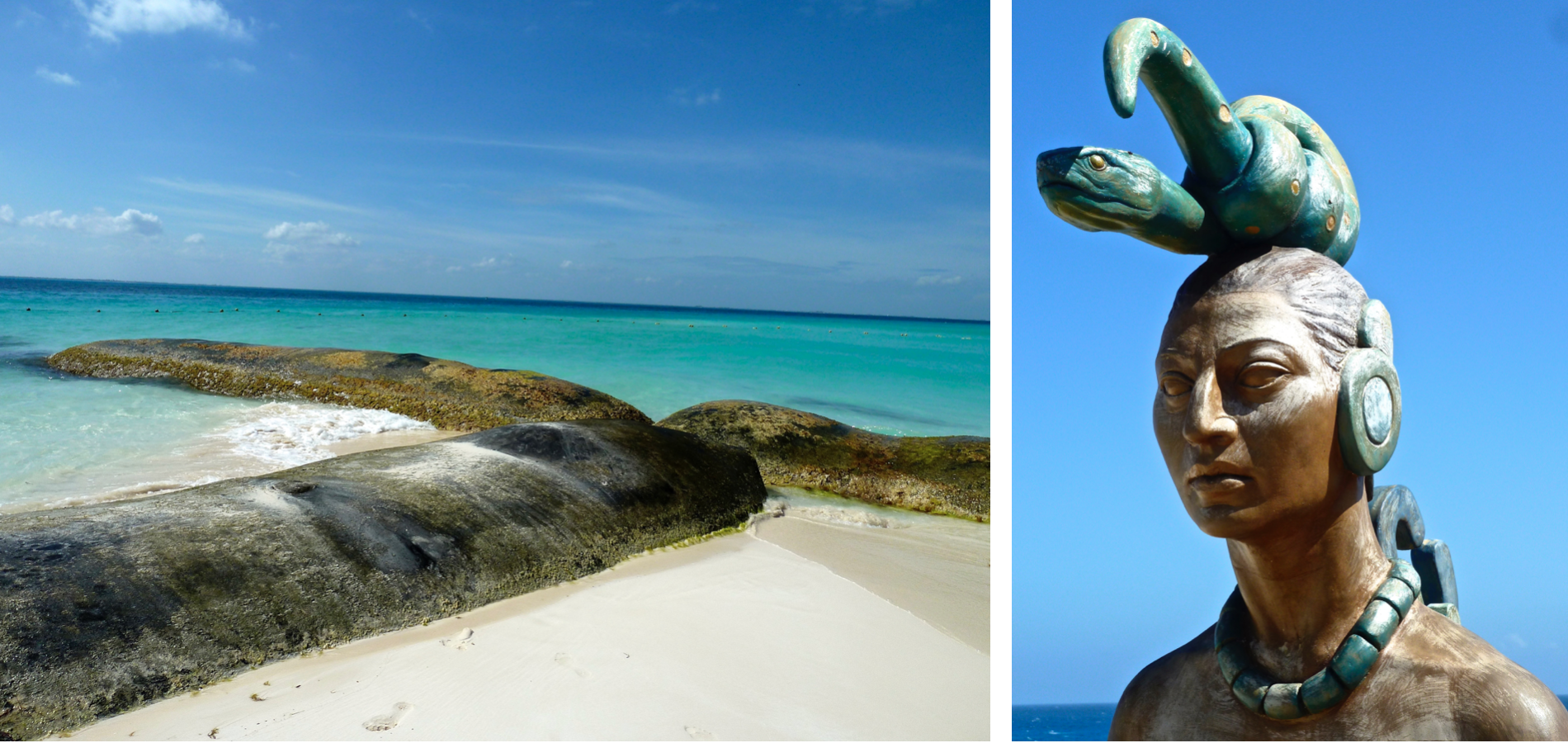
Mexico’s island of women
Isla Mujeres — the temple of Ixchel, the divine feminine, and the particular magic of a small island dedicated to a goddess. (8 min read)
Isla Mujeres is a small island located off the coast of Cancun, Mexico. The island is about 7 kilometres long and 650 metres at its widest point. There are about 15,000 permanent residents and a lot of visitors. Most of the hotels and business activity is located at the northern end of the island around the extraordinarily beautiful Playa Norte (North Beach). The southern end of the island, where I stayed, is much less developed and includes the Mayan sacred site. There are 3 sandy beaches at the southern end of the island facing Cancun, but the whole of the west coast is rocky and too dangerous for swimming. It is possible to walk from one end of the island to the other – I did this only once – but most people travel by taxi, golf-cart or bus.
While I asked spirit to help me to get to the Caribbean, I did not plan to visit Isla Mujeres – it just unfolded naturally. Although I was having a lovely time in Merida, I felt I should move on. As my return flight was booked from Cancun and I was starting to worry about money, I decided to look for somewhere in the Cancun area. Everything pointed to Isla. But it wasn’t until I reached the island that I understood why spirit had brought me here.
The energies are strong on this island, particularly at the southern end of the island near my hotel. I could feel extremes in energy – with great light and dark. With respect to the darker energies, it felt not unlike Bali and I presumed some kind of voodoo had been used to keep many souls tied to the earth. On the light side, the divine feminine is, not surprisingly, very strong here (with intense loving energies directed at your heart centre).
History of Isla
In Mayan times (564-1516 AD), Isla Mujeres was called Ekab – one of the Mayan territories that formed what is today the State of Quintana Roo.
The island principally served as the sanctuary for the goddess Ixchel. It was largely uninhabited, although the Mayans did harvest salt from the salt lagoons. Salt was an indispensable element, not only to conserve the meat and medicine, it was also used for commerce.
In 1517, Francisco Hernandez Cordova “discovered” the island.
The Spanish found many female shaped idols representing the goddess Ixchel, and her daughters and daughter-in-law’s Ixchebeliax, Ixhunie, Ixhunieta – thus Isla Mujeres got its name. The Spanish found the Mayan temple and took certain precious gold objects from it.
For the next three centuries Isla Mujeres continued to be largely uninhabited. The only visitors were fisherman and pirates who used Isla as a refuge and left their women on the island “for safekeeping” while they sailed the high seas. Famous pirates are said to have buried their stolen treasure under the white sands of the island.
After the Independence of Mexico, a small village began in what is now downtown Isla Mujeres. During the wars many Mayans took refuge on Isla Mujeres. Mayan fisherman found the waters around the island to be a fisherman’s paradise and the village slowly grew.
As Isla Mujeres is the easternmost point of Mexico, the frontier of eastern Mexico, the Mexican Navy base was established here in 1949 . Fishing was the main source of income until the 1970’s when tourism started to become a large part of the island.
Temple of Ixchel
The Temple of Ixchel is the first place in Mexico that the sunlight touches each morning.
Ixchel is the Goddess of the moon and also known as the wife of the sun, with fertility and healing powers. Her temple is located at the south point of the island.
The south point originally had more than one Mayan structure, including an observatory which used as the lighthouse (the light from torches was shown through holes in the walls to help the navigators at sea). Unfortunately, these sites have been eroded by time (the site is fully exposed to quite strong wind) and hurricane damage (most recently Hurricane Gilbert).
Now there is a wonderful sculpture park in the area close to the site and I love that it is spirit and the arts that receive first light here.
Energetic cleansing
I mentioned before about the feminine energies on the island. I didn’t know about the story of the island before I got here but I felt these energies immediately. When I meditated to cleanse my hotel room on my first evening on the island, I knew that the whole island needed a good cleanse. I received a lot of energy that evening – much heart activation – and prayed my hardest for the island to be cleansed. I know, without any doubt, that the Good Spirits worked with the Mayan spirits of high degree to move on many souls this last week.
As for the cleansing work, my first stop was the Temple of Ixchel, where I was welcomed by a Mayan man in the traditional manner (I was the only person who got this!). The temple site is cordoned off and visitors are asked not to touch it but I found a crack in the stonework and left a Casa crystal on the remnants of the temple to honour and connect with the ancestors of this place.
Next I visited the church in the main square, the patron of which is Nosso Senhora Ixchel! Atop the building is a quaint statue of the Virgin Mary riding the waves. This is the perfect merging of indigenous and Christian cultures and reminiscent of the story of the Virgin of Guadalupe and the Tonantzin. Of course, the merging is, itself, a characteristic of the divine feminine. It is not necessary to have one or the other any more. The phalange of Mary was very present in my meditations here and I noted the obvious connections with Philae in Egypt and the Island of the Moon in Lake Titicaca. I can see Jo Hutchinson bringing a group of women here soon.
A wonderful local story
In 1890 several fishermen discovered three “sister” statues of the Virgin. They were carved out of wood with their hands and face made out of porcelain. Each of the fishermen carried a Virgin to his own village. It was said that the Spaniards had brought the “sisters” to Ecab many years before in about 1770. One of the statues came to Isla Mujeres. On Isla, the Virgin’s first shrine was a small palm and wood Chapel and at a later date moving “Her” to the place that “She” presently occupies in the church was not easy. More than eight men could scarcely lift her. Upon finally moving “Her”, the small palm chapel burned down completely to the astonishment of all those present. It is said that the Virgin walks on the water around the island from dusk to dawn looking for her “sisters”. Some years ago an Islanders saw the Virgin walking on the sea early in the morning. Later that morning the dress on the statue in the church was found to be contained burrs and sand. Don’t you love this story!!
Leaving Mexico
Today I fly to Mexico City and the next day I head back to the USA. I’ve had many wonderful experiences in this country. I have never felt unsafe and I met many honest, lovely people. This evening I will say farewell to the Virgin of Guadalupe in Mexico City. I now know that she called me here and I’m trusting that we have done some good work together over the last two weeks for the people of this place.
Namaste.
You might also like:
© Paul McCarthy & Iluminar.au

